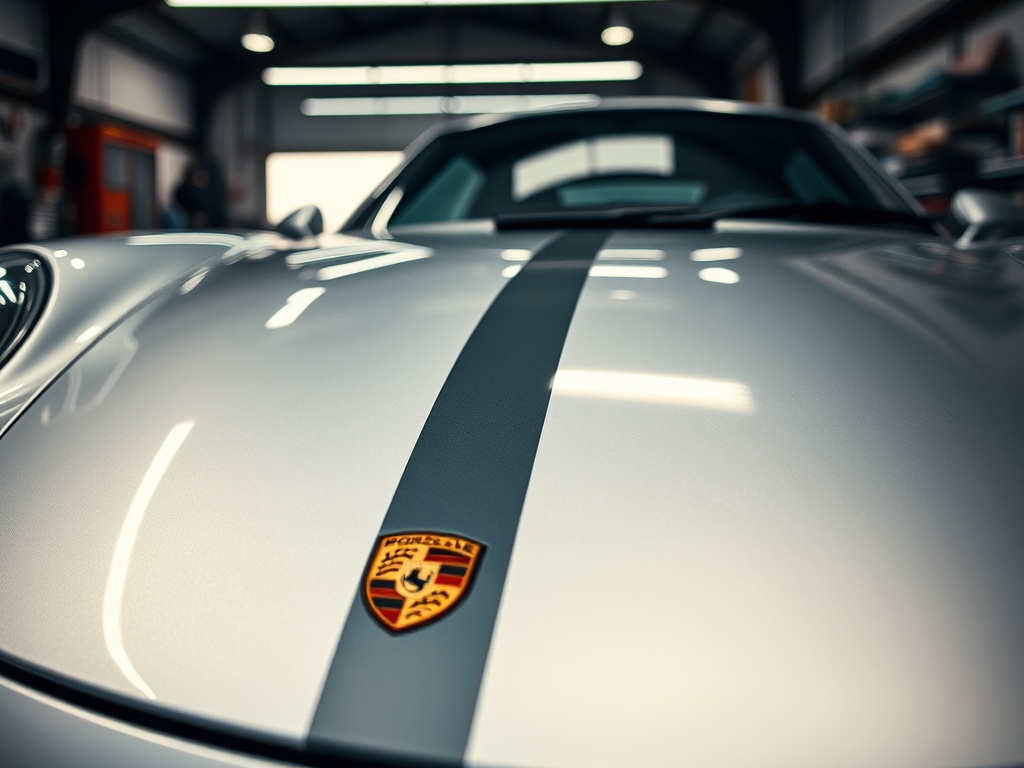

Porsche's Self-Appearance Stripes Reveal What Engineers Overlook
There comes a specific moment in the luxury product lifecycle when exceptional engineering starts to work against the sales team. Porsche has just filed a patent with the World Intellectual Property Organization that illustrates this moment with surgical precision.
The technical proposal is elegant: a film applied to the vehicle's exterior panels, made up of microcapsules with particles of different colors and electric charges, which respond to voltage to visually reorganize themselves. The end result is that racing stripes, invisible in normal driving mode, appear on the hood, roof, and rear lid the instant the driver activates Sport or Race mode. In electric vehicles, that same surface may indicate the battery charge level. In competition, it allows differentiating units of the same line to facilitate the work of teams on track.
The news, enthusiastically covered by automotive media, presents the patent as a leap towards more "interactive and personal" cars. That's exactly what Porsche wants us to say. And therein lies the problem.
What the Patent Promises vs. What the Buyer Needs
Before diagnosing the strategy, it's essential to understand what someone purchasing a Porsche 911 is really buying. They are not buying mobility. They are not buying electrochromatic panel technology. They are buying the narrative that, in that moment of turning a key or pressing a button, they become someone else: the faster, bolder, and freer version of themselves.
In this context, the racing stripes are not merely decoration. They are the external manifestation of that internal transformation. The buyer does not want the car to change; they want to feel that they have changed. This is where Porsche's patent touches on something genuine: the emotional drive of the driver who activates Sport mode is not merely the desire for better grip or faster engine response. It is a symbolic act of declaring an intention to the world.
However, when engineers project that need into a technical solution without considering the brakes that will hinder its adoption, the product enters the market carrying an invisible debt. The first brake is anxiety about the unknown: a buyer who has paid a hundred thousand euros or more for a vehicle adopts a highly conservative stance towards coatings that "change color." Durability, weather resistance, and how the film behaves after hail or high-pressure washes are questions that buyer ponders before any considerations about aesthetics. No available sources can answer those questions because the product currently exists only in a patent document.
The second brake is more subtle and, therefore, more dangerous. Visible personalization generates social exposure, and luxury buyers have a complex relationship with it. Racing stripes that appear upon activating Sport Mode turn the driver into a performer in public. Some will embrace this. Many others will feel that the car is making image decisions for them, out of their control. This loss of agency over the vehicle's appearance is friction that is not represented in any engineering diagram.
The Value That Exists and the Value That Is Overstated
It would be an analytical mistake to dismiss the patent as mere technological vanity. There are at least two applications where the proposal resolves a specific operational issue before creating a new one.
In competitive series like the Carrera Cup, where units of the same model and color circulate simultaneously, rapid visual identification has measurable value: it reduces margin for error in communications between the driver and the team in the pits, and speeds up tactical decisions during the race. Here, the technology does not compete with consumer habits; it competes with adhesive vinyl, which is slow to apply, fragile against abrasion, and not adaptable in real-time. In this specific context, the electrochromatic film wins without debate.
In electric vehicles, the external charge indicator holds real functional merit because it addresses a specific frustration: a driver exiting the vehicle needs to know, without opening an app or turning on the dashboard, whether there is enough charge for the next trip. It is a case where system status visibility reduces cognitive friction for the user and can enhance the everyday experience with the Taycan. It's not spectacle; it is utility.
The problem is that the materials of the patent—and the media coverage it generated—focus almost entirely on the aesthetics of racing stripes for street use. Here, the proposal enters territory where the allure of novelty collides head-on with the luxury buyer's habit, who historically prefers permanence and silent exclusivity over on-demand visual performance.
Porsche is investing patent capital, engineering capital, and brand capital in making the product shine in a new way. That is legitimate. What it is not doing, at least in what the patent and its coverage reveal, is anticipating with equal energy the specific fears that will prevent its most conservative customer—the one who already has a 911 with manually applied vinyl stripes and is perfectly satisfied—from even considering making the switch.
The Pattern Product Leaders Repeatedly Overlook
Porsche's patent is not an anomaly. It is the expression of an organizational pattern that regularly appears in high-engineering product companies: the technical team brilliantly solves the problem they formulated themselves, not necessarily the problem that the market urgently needs to solve.
When a company reaches the point of patenting stripes that activate with a button, it has spent months on internal development, design meetings, prototype iterations, and legal validations. At none of these steps exists, with the same formality, a mechanism to measure the adoption anxiety of the target customer. There is no equivalent of the patent process for customer fears.
This creates a structural imbalance: the company can demonstrate, in a hundred-page document to the WIPO, exactly how the technology works. But it cannot demonstrate, with the same precision, why the specific buyer it has in mind will be willing to pay a premium for it, nor what specific objection they will have to resolve before closing that sale.
The projected commercialization for models post-2027 leaves ample time to do this work. The question is whether Porsche will dedicate to that behavioral effort the same energy it has already invested in the engineering of the coating. Leaders who assume that an impressive enough product will sell itself are making the costliest mistake in product strategy: they confuse customer admiration with their willingness to buy.
Admiration and purchasing are two acts separated by a gap that can only be closed by alleviating fears, not igniting stripes.