
The Lock That Lives Inside the Cell
Certain assets are worth billions and can be stolen by any lab in the world with a sequencer and a tissue sample. No need to hack a server or infiltrate a corporate network; just read the DNA. This is a vulnerability that no one in the biotechnology industry had solved at the genetic level until now.
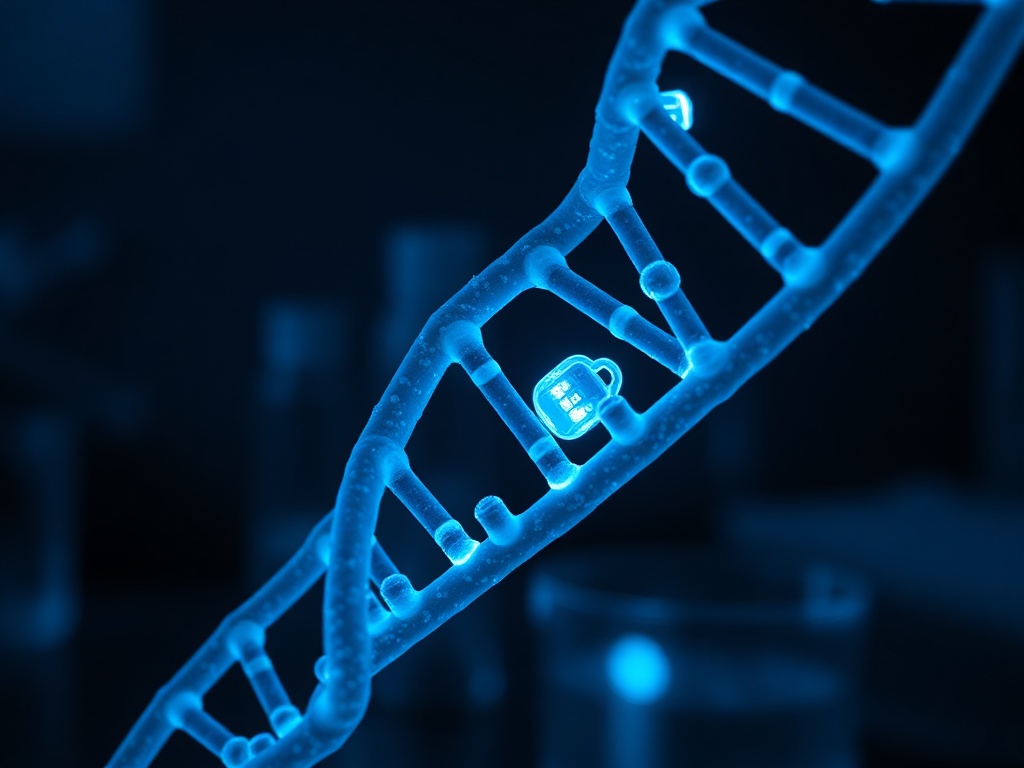
Researchers from the Georgia Institute of Technology published the results of GeneLock in Science Advances, the first password-protected genetic locking technology that inscribes an encryption system directly into the DNA of modified cells. The analogy to an ATM is not metaphorical: the system requires a temporal sequence of small molecules, in the correct order, to activate recombinases that decipher the functional sequence. Without the key, the DNA remains inert, scrambled, and unintelligible in operational terms.
The scope of the problem it seeks to solve merits attention. The global market for modified cells—covering biotechnology, medicine, aging research, and stem cells—is projected to reach $8 trillion by 2035. And the only layer of security protecting these cell lines today consists of physical measures: guards, locks, restricted access to laboratories. Nothing prevents an extracted sample from being sequenced outside the building.
How a Molecular Password Works
The design of GeneLock is directly inspired by computational security architecture. The system employs a “permutation lock” model: functional DNA sequences are assembled in a jumbled manner and only reconfigure into their active form when they receive the correct inputs in the correct order. For a level 2 security configuration, the team built 16 iterations of locks requiring two molecules introduced in the prescribed sequence. In larger scale versions, the search space exceeds 85,000 possible combinations for a system of 45 objects taken three at a time.
What makes GeneLock technically interesting is not just the mechanism but its adversarial validation. The team conducted an ethical hacking exercise where a "blue team" designed the encrypted sequences and a "red team"—with partial knowledge of the system and gray box conditions—attempted to decipher them. The result was 0% leakage in OFF state for the top-level designs: no functional sequence escaped without full authentication. This makes GeneLock the first validated genetic security system under documented adversarial conditions.
The parallel to the software industry is not cosmetic. New England Biolabs markets more than 265 restriction enzymes without disclosing their DNA sequences, relying exclusively on contractual non-disclosure as a strategy for intellectual property protection. GeneLock proposes a technical layer where the sequence can be extracted but remains useless: the asset is encrypted within its own molecular architecture.
The Real Risk Was Not Physical Theft
Next-generation sequencing technology (NGS) has radically democratized access to genetic analysis. What required institutional-level infrastructure a decade ago is now available with portable equipment and cloud-based analysis services. A study published in IEEE Access identified this vector as an active threat: synthetic DNA malware, AI-assisted genomic manipulation, and re-identification attacks are categories of risk that the industry is beginning to document formally.
Dr. Mahreen-Ul-Hassan, a microbiologist at Shaheed Benazir Bhutto Women University and co-author of that study, was direct: "Genomic data is one of the most personal forms of data that exists. If compromised, the consequences go far beyond a typical data breach."
Here is the mechanism that biotech business models have yet to fully internalize: the digitization of genetic analysis has reversed the direction of risk. Previously, stealing a cell line required physical access to the lab. Now, a minimally extracted sample—either legitimately taken or smuggled in transit—can reveal high-value sequences through commercially available sequencing services. The security perimeter has left the building years ago; the sector simply has not updated its protection architecture at the same pace.
GeneLock works in the phase that the 6Ds would call Advanced Digitalization trending towards Dematerialization: the valuable asset stops being the physical sample and becomes the genetic information it contains. When the asset is information, encryption is no longer optional.
Proof of Concept Is Not a Product, But the Vector Is Irreversible
This advancement must be read accurately. GeneLock is a proof of concept published in an academic journal, not a commercial product with a defined deployment roadmap. The authors themselves acknowledge a significant operational limitation: the system assumes non-disclosure as a condition for complementary protection, but it does not fully address the scenario where a malicious actor accesses the encrypted sequence and applies brute force using advanced sequencing tools.
The solution to that problem is under parallel development. Researchers working on DNA data storage have developed unnatural base pairs (the compounds dNaM-dTPT3 are the most documented) that actively corrupt standard sequencing results, rendering the content unreadable without specific decoding tools. Algorithms like IM-Codec combine keys and separate information sequences, requiring a level of brute force that exceeds AES, DES, and MD5 standards for equivalent content. The convergence between GeneLock-style genetic encryption and these sequencing resistance layers sketches the complete security architecture that the sector will require.
What is clear so far is the market direction. A sector that relies on genetic intellectual property to maintain margins in an $8 trillion projected market cannot continue to treat asset security as a human resources and physical access issue. Genetic encryption is the next layer of critical infrastructure in biotechnology, and those who are the first to build this internal capacity—rather than just adopting it as an external service—will have a structural advantage that is difficult to replicate.
For C-level executives in biopharmaceuticals, gene therapy, or stem cell research, the relevant scenario is not whether this will be deployed, but how long it will take to become an auditing standard for institutional investors and regulators. The history of computational encryption took decades to become a contractual requirement. The biological version of that curve has already started.
Power Does Not Shift to Those Who Have the Cells, but to Those Who Control Access to What They Contain
GeneLock accurately illustrates a pattern that defines the maturation of any information-based industry: value migrates from the physical asset to the control architecture over that asset. In biotechnology, this means that sustainable competitive advantage does not reside in having the most sophisticated cell line but in being the only one who can operate it authentically.
This dynamic is in its Early Disruption phase within the 6Ds model. Genetic encryption still disappoints in terms of commercial deployment: there are no products on the market, sequencing attack vectors remain open, and the curve of institutional adoption is slow. But the underlying logic is the same that cemented public key cryptography in telecommunications: once the standard exists and its adversarial validity is proven, adoption becomes inevitable due to regulatory and competitive pressure.
The technology that empowered the individual to read any genetic sequence with a portable device now demands, as a symmetric counterpart, technology that empowers the creator to decide who can activate that sequence. GeneLock is not the final product; it is the demonstration that this level of control is technically achievable within biology itself.