
The Smallest Chip in Space History Could Redefine Healthcare Sales
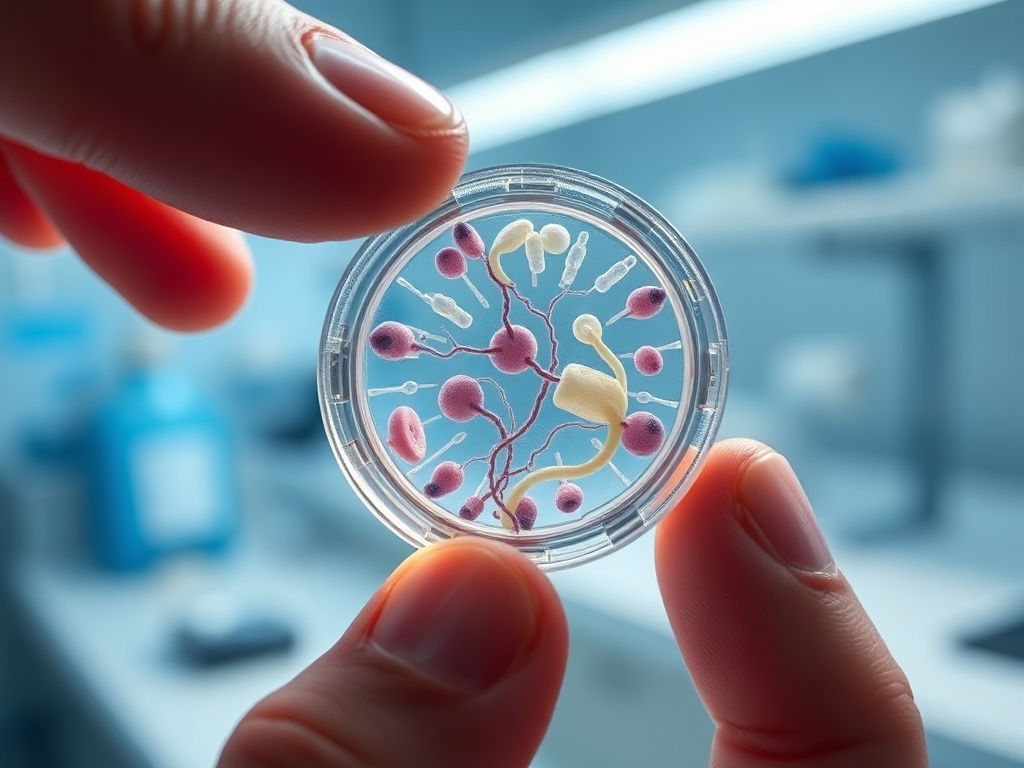
When the Artemis II mission launches towards the Moon, it will carry something not often mentioned in press releases: small devices the size of a USB stick, packed with bone marrow cells extracted from the astronauts themselves. This project, called AVATAR — A Virtual Astronaut Tissue Analog Response — conceptually aims to replicate real human tissue within a chip to observe, in real time, how deep-space radiation destroys the production of red and white blood cells, as well as platelets.
Developed in collaboration with Harvard’s Wyss Institute and Emulate, Inc., this experiment belongs to the realm of space biomedicine. However, if one reads between the lines, AVATAR isn’t just launching a research methodology; it’s the first time an organic simulation system operates with specific patient tissue—not generic donor tissue or animal models, but the exact person whose biology is being studied.
This changes everything. Not in science, but in the psychology of health users.
The Invisible Friction that Destroys Medical Adoption
The medical technology market has been promising personalization for two decades. Precision medicine, genomic profiles, tailored treatments. Yet, the adoption of these innovations among patients and oncologists has consistently lagged behind their creators' projections. The reason rarely lies in clinical efficacy. Instead, it stems from something medical product teams often overlook until it's too late: the psychological distance between the product's promise and the patient's actual experience.
When an oncologist explains to a patient that their chemotherapy treatment was designed based on generic cell models, the patient processes this information in a very specific way. There’s a passive acceptance, almost resigned. "It is what it is." But when that same patient understands there’s a system capable of testing their own tissue before administering treatment—where the doctor could observe, on a chip, how their cells reacted before injecting them with anything—the mental map shifts dramatically.
What AVATAR is generating, unintentionally as a business strategy, is a demonstration that the anxiety for cancer patients largely stems not from the fear of the disease, but from the fear of being treated as a statistical average. That is the friction no hospital has managed to eliminate with brochures or follow-up mobile apps. Instead, it’s eliminated by the certainty that the treatment was tested on them, not on someone like them.
The organ-on-chip market is projected to grow from $1.2 billion in 2023 to $4.7 billion by 2030, with an annual growth rate of 21.5%. Those figures are appealing to any investor. But the most relevant number is not the market size: 50% of cancer patients receiving chemotherapy experience some degree of failure in the first-line protocol. AVATAR—and its terrestrial derivatives—targets precisely that pain point.
When Technology Arrives Before the Narrative
Emulate, Inc. is not a startup without a track record. Its Liver-Chip received FDA backing for pharmacological testing in 2021. The Wyss Institute has accumulated more than $120 million in funding since 2014 and collaborates with pharmaceutical companies like Merck and AstraZeneca in toxicology testing. Technically, the platform already has credentials.
The problem I foresee—and that AVATAR will make painfully visible—is that these companies have built their narratives towards institutional buyers: regulators, pharmaceutical firms, researchers. They’ve made the product shine in front of the contract signers. However, mass adoption in oncology isn’t decided by hospital CFOs. It is decided by the oncologist who has ten minutes with a terrified patient, and that oncologist needs an argument that alleviates the patient's anxiety, not one that justifies the cost of the system.
This is where the industry's most costly strategic blind spot lies. The organ-on-chip technology has a perfect narrative to reduce patient fear—"We test your tissue before treating you"—but that narrative has not been the centerpiece of any positioning campaign. Instead, the sector communicates regulatory efficiency, cost reductions in clinical trials, and superiority over animal models. Correct arguments, targeted at the wrong interlocutor at the wrong time.
NASA's Twin Study conducted in 2015-2016 revealed something disturbing: even after a year in space, astronaut Scott Kelly’s immune system sustained a robust response to the flu vaccine. This suggests that the human body is more adaptable than we assume. However, it also indicates that generic models of immune response prediction fail with a frequency that the sector prefers not to quantify publicly. AVATAR aims to fill that gap with real data. What no one has yet designed is the bridge between that data and the patient’s trust.
The Hardest Habit to Break is Not in the Laboratory
The inertia of the healthcare system isn’t technological. It’s behavioral. Hospitals have operated under standardized protocols for decades because standardization reduces human error variance. This institutional habit holds real value: it saves lives. But it also creates systemic resistance to any technology that requires large-scale personalization since scaling personalization necessitates redesigning workflows, training teams, and accepting that the previous protocol was suboptimal.
No medical director wants to admit that in front of their board.
What AVATAR is set to demonstrate—if the Artemis II mission delivers the promised data and NASA’s Human Research Program publications arrive by late 2026 as projected—is that personalized tissue simulation is operationally viable under extreme conditions. If it works in deep space, with cosmic radiation and microgravity, the technical barrier to implementing it in an oncology hospital in Chicago or Bogotá disappears as an argument.
This shifts the debate. It will no longer be about whether the technology works. It will be about whether healthcare systems have the institutional will to abandon the average habit. And that’s where the real strategic work lies: not in the lab, but in the hospital boardroom, where someone will have to explain to the CFO that the investment is not measured in cost per chip, but rather in cost per avoided protocol failure.
The Mistake the Sector Cannot Afford to Repeat
The companies that lead the terrestrial commercialization of this technology—Emulate and its competitors like CN Bio Innovations or Mimetas—face a positioning decision that will determine whether they capture the $50 billion drug discovery market or remain niche technical suppliers. This decision isn’t about enhancing the chip. It is about understanding what keeps cancer patients awake at 2 a.m.
The answer isn’t "I want a more efficient treatment." The response is "I want to know that someone tested this on me before giving it to me."
Companies that build their adoption architecture around that phrase—not around the technical superiority of the device, not around regulatory approval, but rather around the emotional certainty of the patient—will be the ones to convert a NASA experiment into a sustainable market category.
The capital invested in making a chip shine in front of the FDA is necessary. The capital invested in alleviating the patient’s fear—who has to convince their oncologist to use it—is what will determine whether that technology leaves the space lab or remains in it.