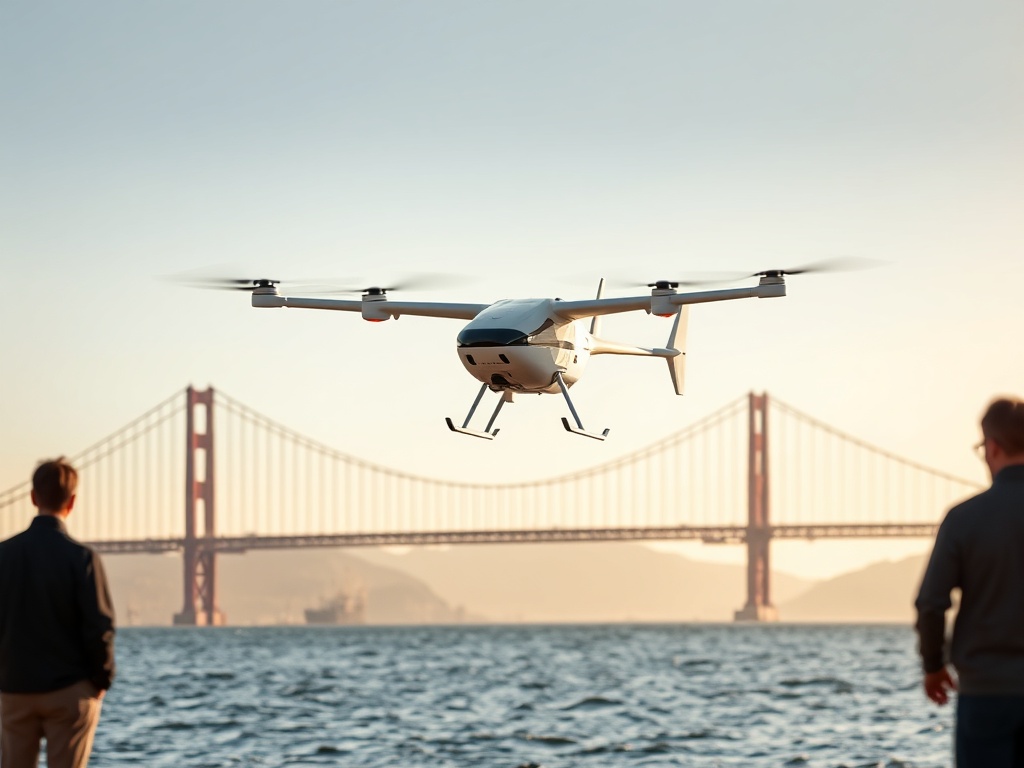

Joby Aviation has recently accomplished something that feels futuristic when viewed from the street: an electric piloted air taxi flew across San Francisco Bay and circled the Golden Gate, in a maneuver designed to push for its commercial approval from the FAA. This gesture is more than just visual. It is supported by two significant facts that outweigh any video: the initiation of tests with its FAA-compliant aircraft aimed at Type Inspection Authorization (TIA), and the presentation of its first area-specific certification plan, a milestone the company describes as a first in the eVTOL sector.
As a consumer behavior analyst, I am less interested in the romanticism of the “first flight” and more in the cold mechanics: this category is not earned with an aircraft that simply flies; it is won with a service that the public chooses repeatedly when there are simple and familiar alternatives. The eVTOL does not only compete against cars and helicopters. It competes against habit, against the statistical fear of what is not understood, and against the cognitive laziness of having to learn a new flow.
The news, when read rigorously, shows a company that is doing things right on the regulatory and production front. Joby reports that more than two-thirds of its “compliance means” are already agreed upon with the FAA, having completed Stage 3 of the certification process, and is entering a “credit” testing phase with FAA pilots’ involvement later in 2026. The company also projects scaling its manufacturing to four aircraft per month by 2027, backed by facilities in Marina, California, and Dayton, Ohio. The business question is not in the air: it is at the counter, in the app, and in the minute before getting on.
Certification as a Trust Narrative, Not Just a Process
From the outside, the FAA process is often perceived as bureaucracy. For the market, it is something else: it is the only legitimate shortcut to trust. Joby is trying to convert a technical advancement into a simple message: “this is not a prototype; this is a product on its way to being authorized.” The flight in the Bay Area acts as a mental anchor because it takes a strange object and places it in a familiar setting. People do not understand a TIA; they understand the Golden Gate.
The company communicated the first flight of its FAA-compliant aircraft for TIA in Marina, California, as the start of the final phase towards type certification. In that same context, a Joby executive emphasized the internal weight of this milestone, describing it as validation of years of work and as an entry into aircraft-level assessments. This type of phrasing does not sell tickets; it reduces uncertainty in two audiences that determine the future of the category: regulators and investors.
For the consumer, regulation acts as a substitute for knowledge. No one wants to become an expert in aerodynamics, redundancies, or composite materials just to make a mobility decision. Certification, well communicated, reduces cognitive friction: it changes “I have to evaluate if it is safe” to “someone competent has already evaluated it.” That is why the detail that the FAA will carry out “credit” tests in 2026 is significant, even if the public never learns the term. The problem is that the public does not process safety as a document; they process it as a feeling. The regulatory narrative must translate into visible, repeatable, and easy-to-remember signals.
Here lies the risk: if the category is communicated in engineering language, the user feels mental work. And mental work kills adoption when the perceived benefit is not yet obvious in day-to-day life.
The Product is Not the Plane, It's the Full Journey Sequence
The typical mistake in mobility technologies is believing that the “product” is the machine. In transport services, the product is a chain of micro-decisions: how I book, how long it takes, where I get picked up, what happens if it rains, what happens if it gets delayed, what do I do if I feel nauseous, what do I tell my family, how does my emergency exit look. Each link can introduce anxiety.
Joby shows operational maturity by highlighting full-transition flights: vertical takeoff, winged cruising, and vertical landing. This transition is a technical argument. In the user's brain, it can become something else: a reminder that it is a hybrid system, distinct, with new states. In new categories, each new state feels like a failure opportunity, even if statistically it is not.
In parallel, integrating into a U.S.-government-driven program to accelerate eVTOL adoption helps shift the conversation from “private company testing something” to “public infrastructure enabling a new modality.” Joby was selected for applications in the program that would allow flights in ten states, some of which include its Superpilot™ technology for automated operations. This opens a strategic lane but also creates a perception dilemma: automation sounds efficient to the regulator and operator; for the average passenger, “autonomous” might sound like a loss of control.
If the business model is designed as if the user is rational and a time maximizer, it underestimates the weight of anticipatory emotion. The customer pays for saved minutes, yes, but first they pay with something more scarce: their peace of mind.
The Invisible Battle is Between Magnetism and Anxiety
In mobility, magnetism is easy to envision: avoiding traffic, arriving quickly, flying in relative silence, enjoying a premium experience. Joby is building that magnetism through public demonstrations and signals that certification is nearing. The push also exists: congested cities and unpredictable times.
Adoption stalls when anxiety outweighs magnetism at the moment of purchase. That anxiety is not abstract. It usually focuses on four simple thoughts that arise uninvited:
First, perceived safety. It is not enough to just say “it complies.” The user looks for visible redundancy, comprehensible protocols, and a sense that the operator has rehearsed disaster.
Second, control. In a car, the user believes they control something, even if they do not control traffic. In an eVTOL, control is completely delegated. That delegation requires institutional trust.
Third, social normality. Getting into something new feels less risky when others have already done it. Social evidence becomes psychological infrastructure.
Fourth, reversibility. If something goes wrong, the user wants to envision a “plan B” without shame or friction. Clear cancellation policies, immediate alternatives, and contingency management reduce fear before it appears.
Habit, on the other hand, has an advantage: people already know how to order a car, they know the airport, and they understand a helicopter as an expensive, rare service. Novelty does not compete against “nothing”; it competes against decades of automatism.
From this lens, entry into integration programs in multiple states can serve a purpose beyond flying: accumulating repeatable operational rituals, communication scripts, and evidence that the service remains sustainable when it stops being news.
The eVTOL Economy is Decided by Reliability and Cadence
Joby's projection of reaching four aircraft per month by 2027 is an industrial datum, but it is also a business model datum. Without cadence, there is insufficient supply; without sufficient supply, there are no competitive wait times; without competitive wait times, magnetism becomes just a pretty promise. Mass adoption rarely fails due to lack of desire; it fails because of friction in availability, timeliness, and predictability.
There is also an implicit financial reading: these types of programs are capital-intensive and have limited revenue until commercial operations are mainstreamed. Therefore, each advance in certification reduces execution risks and protects the narrative towards the public market. Joby is publicly traded and reported fourth-quarter results for 2025, although the available information does not specify figures. In the absence of numbers, the market looks at milestones: completed FAA stages, compliance, TIA, operational agreements, production ramp-ups.
Selection in the integration program and the move to OTA-type agreements with planned flights within 90 days of those contracts being signed, according to the briefing, introduces a closer operational horizon. Operating “before” full certification, in enabled schemes, can accelerate learning. However, it also increases the reputational cost of any minor failure. In nascent categories, an operational incident does not remain an “incident”; it becomes foundational history for detractors.
Here is where many management teams go wrong: they focus their capital on perfecting the hardware and leave the perceived reliability system underfunded. In urban air mobility, reliability is both technical and narrative: timeliness, weather management, ability to explain delays, visible protocols, and a passenger service designed for people who do not want to think.
Leadership Wins When It Invests in Reducing Friction, Not Just Polishing Gloss
The flight over San Francisco Bay was a timely demonstration of progress, and its regulatory milestones show that Joby is advancing down the tough path. The hardest part comes when the product stops being news and becomes routine. At that point, adoption does not depend on an iconic bridge or a press release on certification stages; it depends on the complete experience, daily predictability, and the calmness that the service can sell.