
The New Economy of Storage: It's Not Decided in the Lab, It's Decided in the Lifecycle
The energy transition has been trapped in an accounting contradiction for years. Renewable electricity is becoming cheaper to generate, but it remains expensive to deliver when the system really needs it. This differential is not solved by a solar panel or a wind generator; it is solved by storage. Over the past decade, lithium has become the de facto standard: fast to deploy, modular, and with a steep learning curve.
The news from Qnetic, a mechanical storage company using flywheels, becomes interesting because it does not sell an aesthetic revolution. It announced a $5 million funding round to commence manufacturing in the United States and deploy its first Q500 systems, totaling $7.1 million raised over the last 12 months if we include its prior $2.1 million crowdfunding campaign. Furthermore, the company reported that early investors from that campaign saw nearly 25% appreciation of the asset after conversion to equity. While the surface is financial, the underlying message is structural: the market is beginning to reward technologies that compete on total cost of ownership and lifespan, not just initial cost per kilowatt.
The Turning Point Is Not the Capital Raised; It's the Move to Manufacturing
Five million dollars alone do not change the global storage landscape. What changes the game is Qnetic's explicit decision to use that capital to kickstart low-volume manufacturing in a facility in California and accelerate pilots with utilities and grid operators. This move marks the threshold that separates “showcase” innovation from “supply chain” innovation.
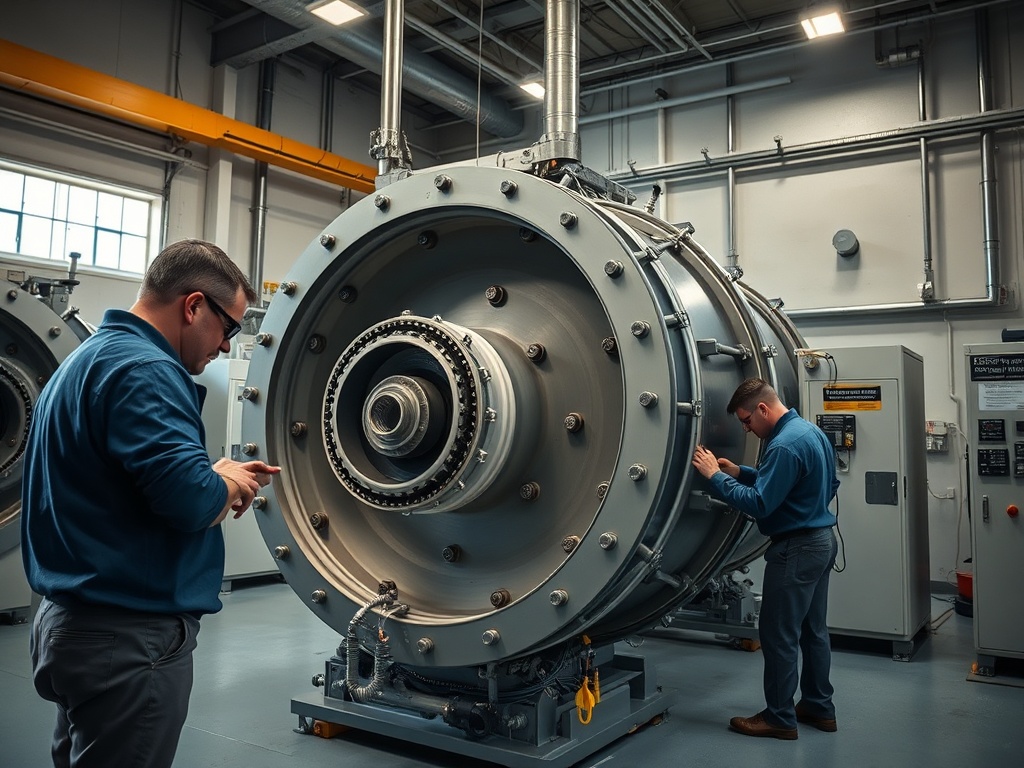
In storage, the distance between prototype and product is not just a formality; it is the abyss where most technologies fail. In electrical grids, customers purchase an inseparable combination of hardware, reliability, warranties, operation, maintenance, permits, insurance, and reputation. Qnetic is betting on crossing that chasm with an economic argument: its flywheel, described as a solid-state mechanical battery, promises a lifespan of up to 30 years and discharge durations of 4 to 12 hours, in the critical range for daily energy arbitrage.
That detail of 4 to 12 hours is key. It’s not “seasonal backup” nor pure “instant response.” This segment determines whether a grid can displace peak fossil generation and store solar energy from midday to evening. If that use is addressed with an asset that does not need to be replaced every few years, the debate shifts from being technological to financial: who amortizes better, who reduces risk, who lowers the levelized cost of service.
When Sustainability Becomes Accounting: Degradation, Replacement, and Operational Risk
Public discussions about storage often revolve around efficiency and capacity. In the CFO's office, the real conversation is different: degradation, replacement, security, insurance premiums, and disruption risk. Qnetic positions its proposal against lithium with three points that, while repeated in the industry, are articulated here as product theses.
First, lithium degrades and, in grid applications, may require complete replacement every 6 to 10 years according to the briefing. This introduces a pattern of recurrent capex that distorts any comparison based on initial cost. Second, there is the safety vector: the briefing highlights the risks of fire due to thermal runaway. Although the market has made advances in controls, the residual risk has a cost that is expressed in permits, regulations, siting, and insurance.
Third, the environmental angle appears without moral posturing: production and end-of-life disposal. The company argues that a long-lifespan mechanical system reduces the pressure for periodic replacement, and thus minimizes material flows associated with replacement. Here, my lens is unequivocal: The Grid and Circularity. Not as a slogan, but as system engineering.
In electric grids, value does not lie in the “battery object” as an isolated asset, but in the continuity of service over decades, with a controllable risk profile and predictable maintenance. A 30-year asset, if materialized, shifts the material metabolism of storage: fewer cycles of extraction-manufacturing-disposal per unit of energy delivered over time. In terms of hard sustainability, this is not narrative; it's material intensity per megawatt-hour served.
Total Cost as a Strategic Weapon: 38% Cheaper and 2× Better Are Not Innocent Claims
Qnetic claims that its systems can be 38% cheaper than lithium-ion batteries in certain applications and that its total cost of ownership can be twice as low. Expert modeling and analysis reportedly place them with the “lowest lifetime cost” in an energy arbitrage scenario, and an independent assessment concludes they could execute energy arbitrage “significantly more cost-efficiently” than lithium.
These numbers alone are not a guarantee of victory. However, they signal how the market is being rewritten. For years, lithium won by industrial scale and rapid deployment. Now, storage is beginning to segment by duration and life-cycle cost structure. In durations of 4 to 12 hours, the customer does not buy “energy,” they purchase “capacity to displace generation” repeatedly over decades.
A macroeconomic consequence emerges here: when the electrical system is seriously electrified, storage moves from being an appendix to becoming critical infrastructure. Critical infrastructure is governed by investment rules: lifespan, discount rate, operating costs, regulatory risks, and disaster risks. That’s why Qnetic's emphasis on pilots with utilities is more important than any claim of being a “global leader.” The grid is conservatively designed. A successful pilot is not marketing; it is the beginning of a bankability curve.
Another aspect not to be ignored is geography. Manufacturing in California is not just about proximity to talent or capital; it’s about being close to an area with high renewable penetration, reliability tensions, and urgency for long-duration storage. The implicit strategy is to position oneself where the system's pain is most acute, and therefore where an improvement in total cost can be monetized faster.
The Real Bottleneck: Industrializing Without Turning the Factory Into a Cost Trap
Starting manufacturing is both the right step and the biggest risk. The company mentions initial low-volume production. This phrase is a healthy confession: it means they are still calibrating processes, quality, yields, and supply chain before promising scales that could undermine balance sheets.
Recent cleantech history shows that failure rarely arises from lack of science; it comes from poor financial engineering of scaling. The factory can morph into a rigid asset demanding constant utilization even when the market has not yet validated the product. That’s why the sequence of “low volume + pilots” makes sense: it validates performance, actual operating and maintenance costs, and builds evidence for larger contracts.
The briefing also mentions a hybrid financing component: institutional capital and equity crowdfunding. The fact that RegCF investors saw nearly 25% appreciation after converting to equity indicates an upward valuation, but more importantly, shows the company is using multiple channels to finance an industrial transition. In a world where the demand for storage accelerates and the system “needs 100x more grid storage than is currently available,” the bottleneck will be who can manufacture with consistent quality and sustainable warranty models.
In my view, the battle is not lithium versus flywheel. The battle is between architectures that require frequent replacement and those that amortize as 20 to 30-year infrastructure. As operators internalize replacement and risk costs, the market will shift toward technologies that minimize episodes of massive asset replacement.
The Imperative Emerging for Utilities, Regulators, and Investors
Qnetic did not announce a megafactory or a massive deployment; it announced the beginning of an industrial process with relatively modest capital and a surgical focus: to manufacture in the United States and demonstrate in the field. This sobriety aligns with the sector's current moment. The electric grid is entering a stage where reliability is purchased with storage portfolios, not fossil backup capacity.
The inevitable macroeconomic result is that storage will become an asset class evaluated as infrastructure, and this will raise the standard of what “competitiveness” means. Solutions that dominate the complete lifecycle—from materials to operational risk, from amortization to permits, from maintenance to safety—will prevail. Leaders allocating capital today must treat long-duration storage as an industrial survival discipline, because the electric system of the future will reward measurable durability and penalize obsolescence disguised as rapid deployment.