
The Hidden Cost of AI in the UK: When the Bottleneck is No Longer the Chip, but the Power Grid and Water Supply
The UK government has finally acknowledged a clash that many digital economies have been postponing. This isn't an abstract debate about sustainability; it's a physical capacity issue. The energy regulator Ofgem received connection requests for 140 new data centers that collectively seek 50 GW of electricity, a figure that exceeds the recent peak demand for electricity in the UK, which is around 45 GW. This data shifts the conversation: AI growth is no longer just a software discussion; it has become a competition for electrons, permits, pipelines, and network priorities.
Simultaneously, the Environmental Audit Committee (EAC), chaired by Toby Perkins MP, launched a formal investigation on February 26, 2026, about the environmental impact of data centers: energy, water, planning, connection queues, and effects on decarbonization. The Energy Secretary, Ed Miliband, has already publicly acknowledged that the aggregated climate impact "remains inherently uncertain," even as the government claims to incorporate this into its modeling for the seventh carbon budget.
From my perspective on social business, this is the kind of news that separates serious operators from those merely chasing growth. The expansion of data centers can serve as a platform for prosperity or become an extractive machine masked as modernization. The difference lies in a single word: disclosure.
Transparency Transforms from Reputation to Permission to Operate
The call for developers to disclose the net effect on emissions is not a bureaucratic whim. It is a logical reaction to the information void in a sector where the impact occurs 24/7 and easily gets externalized: the grid bears the burden, communities feel the water stress, and national decarbonization plans carry the uncertainty.
Today, the regulator foresees connection intentions for 50 GW spread across 140 projects. This doesn’t mean everything will be built, but it reveals the scope of the gamble and the level of pressure that’s coming. The National Energy System Operator projects that electricity consumption from data centers in the UK could quadruple by 2030. In a country with legally binding net-zero targets, the arithmetic leaves little room for improvisation.
There’s a critical point that the C-Level must internalize: when an industry becomes critical national infrastructure — as happened with data centers in September 2024 — the threshold for political and social tolerance changes. That label brings protections but also elevates the accountability standard. If the sector fails to provide comparable data on energy, water, and emissions, others will impose it through regulations, delays, or litigation.
Disclosure should not be designed as mere “compliance.” It must be crafted as a trustworthy product: auditable reports, clear assumptions, demand scenarios, and traceability of local impacts. In an environment of connection queues, transparency morphs into a competitive advantage: it allows prioritization of “ready” projects while penalizing those that merely block capacity without credible plans.
The Real Economics of Data Centers: Constant Electricity, Dominant Cooling, Invisible Water
Data centers are not traditional factories, but their consumption pattern is more demanding than many industries: continuous operation coupled with extreme sensitivity to interruptions. The EAC’s research puts the spotlight where it hurts: energy and water, and how that consumption interacts with planning and decarbonization.
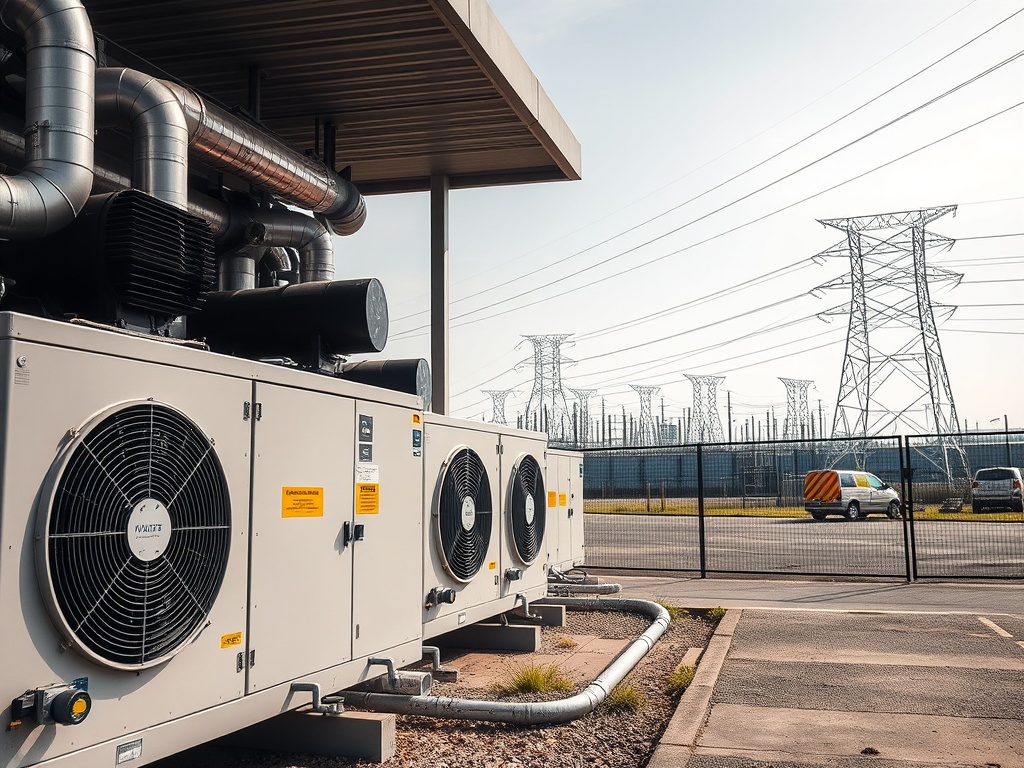
A key technical fact explains it all: cooling accounts for 30% to 50% of a data center’s total energy usage. In other words, a massive portion of electricity is not used for “computing” but for maintaining an environment that prevents that computing from collapsing. If the country is rewiring its grid to be cleaner, every additional megawatt consumed through constant demand pushes investment decisions that affect everyone: networks, generation, storage, and costs.
Water is the second axis and is often left out of the public narrative. A typical 100 MW hyperscale data center can consume 2.5 billion liters of water annually, equivalent to the needs of about 80,000 people, with daily usage around 2 million liters. Globally, the sector already consumes more than 560 billion liters per year, with the potential to increase to 1.2 trillion liters by 2030. On paper, this discussion appears as “sustainability.” In practice, it’s social license and operational continuity during hotter summers and episodes of water stress.
The financial consequence is direct: water and energy cease to be minor operating lines and become risk variables. The cost isn’t just the bill; it’s volatility, conflict of usage with communities, and the risk of restrictions. An operator that does not quantify and reduce its water footprint is building liabilities, even if they do not appear on the balance sheet.
The Country Risk of the Cloud: Connection Queues, Invoices, and Competing Decarbonization
When Ofgem receives requests for 50 GW for data centers, the issue is no longer just technological. It's about allocation of scarce resources. The report mentions years of delays due to connection queues, and Ofgem is contemplating reforms to prioritize prepared projects. That reform is inevitable because, in the absence of rules, the system rewards the first to arrive, not the one that is better for the country.
Here emerges a power tension: data centers are essential for AI and the digital economy, but they can also displace other electrification priorities if the system does not expand at the right pace. The warnings from environmental groups and political actors point to a concrete possibility: that without network upgrades and low-carbon generation, the growth of data centers could end up pressuring net-zero targets and raising costs.
The discussion about “net impact” is precisely that: net. It’s not enough for the operator to buy “green” energy through contracts if the physical system continues to depend on carbon-intensive generation to cover peaks and base load. And it’s not sufficient to promise efficiency if the total load multiplies.
For cloud and AI user companies, this scenario also reorganizes climate accounting. Digitalization shifts energy consumption from offices to data centers. This affects corporate reporting and purchases, but more importantly, it impacts continuity and pricing: if infrastructure becomes congested, the “infinite elasticity” of the cloud becomes more expensive and less immediate.
The Winning Strategy: Verifiable Efficiency, Moderate Cooling, and Comparable Public Data
A typical blind spot in the sector is treating sustainability as a set of isolated initiatives. The EAC research and the pressure for disclosure push against this: integrate the impact into the core of the model.
There are three levers that, when viewed as a business, offer competitive defense.
First, measurable efficiency. If cooling takes up to half the consumption, cooling engineering defines margin and regulatory viability. Water reduction technologies and closed circuits become more than just innovation; they become operational risk reduction.
Second, local planning with numbers, not promises. A 100 MW hyperscale facility with annual water usage equivalent to 80,000 people cannot land in a territory without an explicit mitigation and monitoring proposal. Conflicts over resources begin with a lack of shared data.
Third, standardized disclosure. Evidence gathered in the briefing mentions calls for mandatory reporting on energy, water, and emissions because there is currently insufficient "reliable data" for planning. When the regulator and parliament state that the impact is uncertain, the market indicates that information is asymmetric. In mature markets, that asymmetry is corrected in two ways: regulation or voluntary verifiable transparency. The sector should prefer the latter, as it allows designing useful standards instead of receiving late and clumsy rules.
The business that wins is the one that transforms its consumption into a value proposition: operating with less energy per useful load, with lower water dependence, and with real integration into the clean expansion of the system. Not out of virtue, but for commercial survival.
A Mandate for the C-Level: Transforming Digital Expansion into Verifiable Shared Value
The UK is entering a decade where AI will grow on two finite infrastructures: power grid and water supply. Politics has already reacted with parliamentary investigation, and the regulator is now seeing connection requests that surpass national demand peaks. In that context, data centers are not just competing for customers; they are competing for legitimacy.
The pragmatic route is clear: disclose impacts with comparable metrics, design projects that reduce intensive cooling and water footprints, and align with the physical realities of the grid rather than exerting pressure on it from paper. The company that achieves this first will not only reduce regulatory risk but will also buy time, priority, and operational reputation.
The mandate I leave to the C-Level is to execute a brutal audit of their moral and financial equation, operating under a simple rule: to stop using people and the environment as silent inputs to generate money, and use money strategically to uplift people while building digital capacity that the country can sustain.