
Blandford and Forest Acquisition as Infrastructure: When Land Conservation Reduces Risk and Friction
The news may seem minor when looking only at the figure: 218 acres of forest in Blandford, located west of Chester-Blandford State Forest, acquired and "permanently protected" by the Massachusetts Department of Conservation and Recreation (DCR), announced on February 25, 2026. However, the real significance of this move lies not in its size but in its function.
This is not a symbolic gesture. It is an operational decision aimed at converting land into resilience infrastructure: a wildlife corridor that reduces fragmentation, a watershed that protects water quality downstream, and a project with direct implications for road safety through planned improvements at under-highway crossings.
The acquisition is part of the Blandford Cross-Pike Nature Connector, a multi-agency initiative to close conservation “gaps” along the Massachusetts Turnpike corridor. The complete package comes from a larger property initially purchased by The Nature Conservancy (TNC) specifically to address a chronic issue faced by the public sector: the State does not always move at the same pace as private sellers.
What is happening in Blandford is a clear example of how sustainability, when executed well, shifts from being rhetoric to an execution equation: increasing certainty in environmental outcomes and public safety while cutting bureaucratic friction and reducing the “wait time” to secure critical assets.
Protected Land as a Risk Asset: Biodiversity, Water, and Road Safety
The DCR announced that the acquired land is dominated by species such as sugar maple, hemlock, birch, and ash, and that part had previously been a Christmas tree farm before being reforested. This description matters because it dispels a common fantasy: not all conservation is “pristine nature.” Many times, it’s about taking an altered asset and guiding it onto a trajectory of recovery through public management.
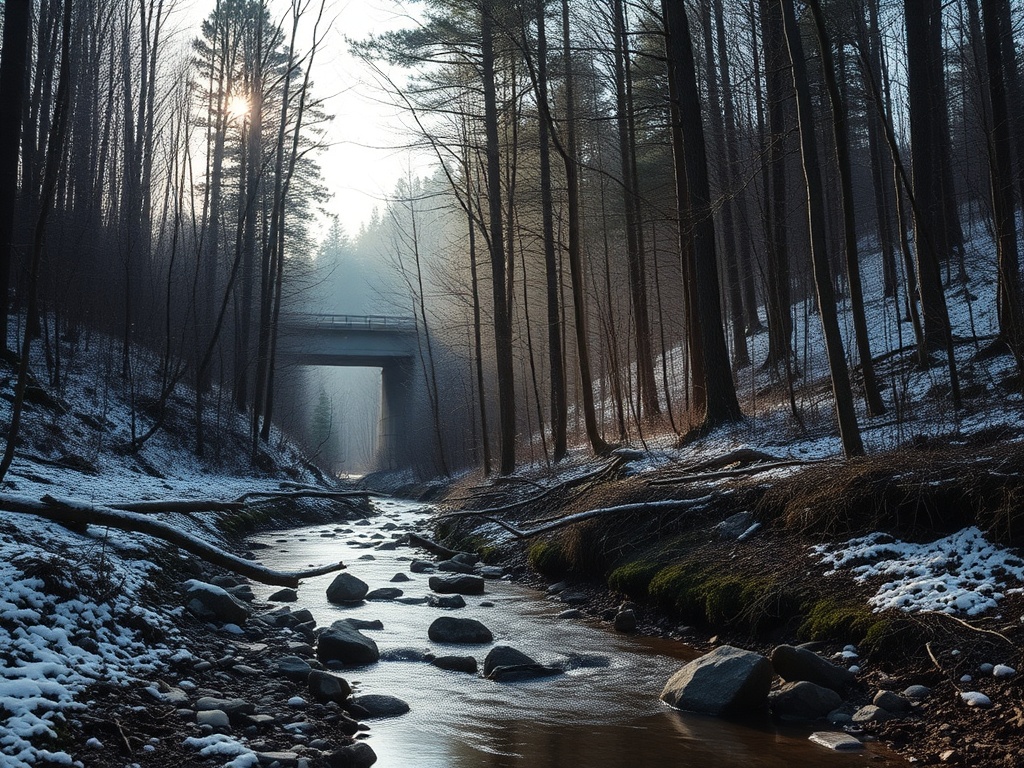
Within the property are rocky streams that contribute to water quality in Saunderson Brook and in the Westfield River downstream. Translated into business and state logic: this is the protection of an invisible supply chain. When forest and riparian areas are conserved, soil is stabilized, water is filtered, runoff is moderated, and pressure on subsequent infrastructure is reduced. There is no need to invent figures to understand the mechanism: in any system, it’s cheaper to control variability at the source than to pay for corrections at the end.
The DCR also documented the presence of deer, moose, turkeys, and bears. That inventory is not a detail “for wildlife enthusiasts”; it is evidence that the site is already functioning as habitat and that its value multiplies when it ceases to be an island. The idea of a “connector” is precisely that: it is not about protecting points; it is about protecting continuity, which allows for species movement and resilience in scenarios of climate change.
The most underestimated component of the announcement is the road infrastructure part: improvements are planned for culverts under the Massachusetts Turnpike to enable wildlife crossings, with the collateral effect of reducing collisions. From a public management perspective, this is disaster management: fewer crashes mean lower healthcare costs, fewer disruptions, less property damage, and less friction for the local economy. Sustainability wins when it translates into reduced incidents and operational volatility.
The Real Product is Connectivity: From Isolated Park to Functional Network
This move aligns with a clear trend: the shift from conservation for “pretty parcels” to conservation for functional connectivity. The Blandford Cross-Pike Nature Connector was designed to close gaps in conserved areas along a corridor bisected by hard infrastructure. The highway acts as a physical and ecological barrier. The project responds with two levers: land acquisition to connect forest masses and safe passageways to cross existing infrastructure.
Institutional logic is also important. The DCR manages nearly half a million acres, and its land protection program exists to conserve natural and cultural resources while enabling public recreation. Yet even with mandates and capacities, the state often faces a “purchase cycle” problem: procedures, timelines, approvals. In land markets, that delay translates into missed opportunities.
Here appears the tactical role of TNC, which initially bought a larger property (referred to as 580 acres in the briefing) intending to transfer portions to state agencies. Project documentation explicitly explains why: this approach was taken to accommodate the owner’s timeline since the agencies could not move as quickly. That straightforward phrase is at the heart of the model.
From my perspective, this is a strategy to increase execution certainty. Instead of promising connectivity and getting caught up in internal timelines, a capable intermediary is used to close the deal first and transfer later. It is a way to transform a high-friction process into a more predictable one without sacrificing the end goal of public ownership and permanent protection.
Moreover, the initiative is not solely the DCR’s effort. The larger property is divided between the DCR and the Department of Fish and Game, revealing another critical point: connectivity requires coordination. If each agency buys its own piece without alignment, patchy results emerge. If there is joint design, a cohesive network is created.
The Financial Architecture Behind the “Yes”: Speed, Partnerships, and 2030/2050 Goals
Massachusetts has declared ambitious conservation targets: 30% of lands and waters protected by 2030 and 40% by 2050, intending to double the pace of conservation. In the same framework, the administration proposed historic investments: $304.5 million for land protection programs and $20 million to advance biodiversity conservation goals.
For a CFO or public leader, what matters is not just the amount; it’s what these funds are attempting to buy: execution capacity. The 2030 targets are not lost due to a lack of ideals; they are lost to bottlenecks: property pipeline, negotiation times, available funds at the right moment, and coordination with transportation when the project depends on infrastructure such as culverts and wildlife crossings.
The Blandford operation demonstrates a pragmatic way to manage that bottleneck: an NGO capable of acting quickly can serve as a “bridge” so the state does not arrive late. This is not philanthropic romanticism; it is transaction engineering.
On the incentive level, the scheme also protects reputation and reduces political risks. When the announcement is made, the acquisition is already complete, and the land is protected. This reduces the space for half-promises and unfinished projects. In citizen engagement language, it delivers a verifiable fact.
Public statements reinforce positioning. DCR Commissioner Nicole LaChapelle described the acquisition as a means to safeguard habitat, support species movement, and strengthen natural systems that sustain clean water and healthy forests. The state director of TNC, Kris Sarri, emphasized that the transfer enhances habitat protection and strengthens safe passage for animals and people. Lastly, the commissioner of the Department of Fish and Game, Tom O’Shea, linked the value of large, connected landscapes with wildlife resilience against climate change and outdoor recreation.
This consistency matters because it elevates the “perceived certainty” of the project: it is not sold as loose land; it is sold as a piece of ecological infrastructure with interconnected benefits.
Implications for Leaders: Making Conservation a Self-Defending Offering
This case poses an uncomfortable lesson for any corporate or public sustainability agenda: the difference between real impact and mere smoke is not in the slogan; it is in the architecture.
First, the project is designed to be verifiable. There is a concrete acquired asset, a clear location, a specific size, and an explicit condition of permanent protection. Second, the project is coupled with an operational improvement outside the “green world”: wildlife crossings beneath the highway with impacts on collisions. Third, the transaction was structured to solve a speed problem, using a partner capable of advancing capital and closing in the seller’s timeframe.
For a CEO or an investor, this serves as a reminder that “ESG” initiatives become defensible when they translate into risk reduction and operational continuity. For a government, it is a signal that achieving 2030/2050 goals requires less ceremony and more repeatable mechanisms: property acquisition pipeline, partners to reduce friction, and projects that provide collateral benefits perceived by the citizenry.
The danger many organizations fall into is attempting to purchase cheap legitimacy with small, disconnected, and slow actions. Here, instead, we see a more serious pattern: connectivity at a landscape scale, multi-agency coordination, and rapid execution.
The technical close is simple yet demanding: sustainable and commercial success occurs when a strategy is designed to reduce friction, maximize perceived certainty of outcome, and raise stakeholders’ willingness to pay, because it turns a promise into a proposal so solid that it defends itself by its results, not just its narrative.
---