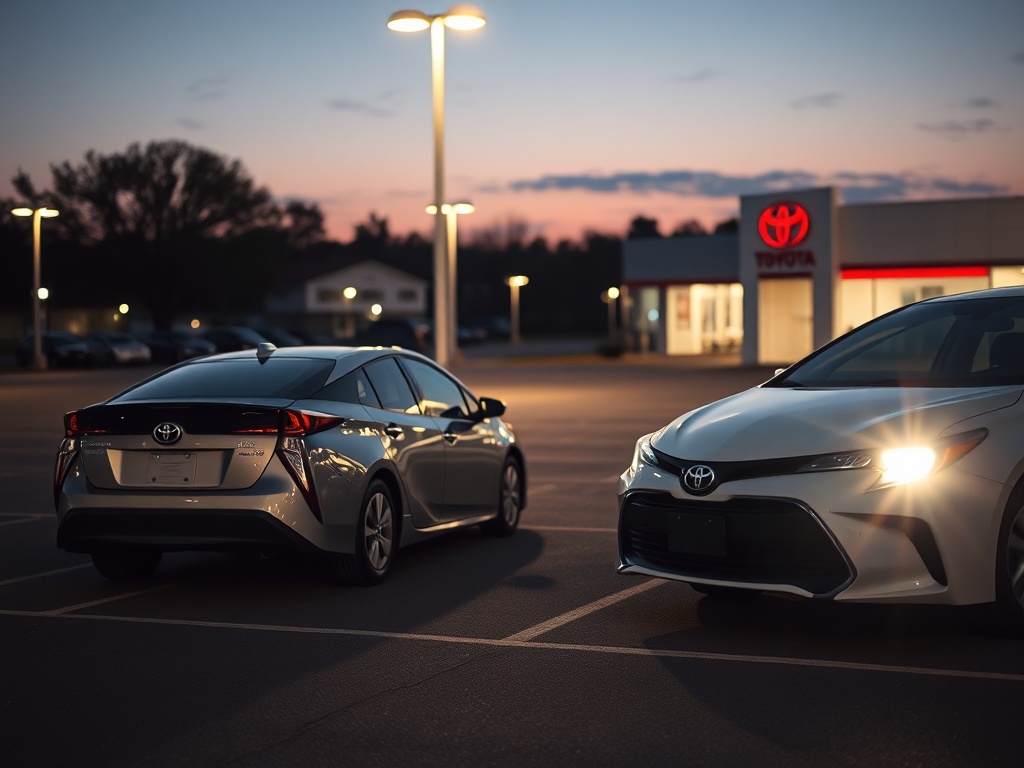

The Camry Outperformed the Prius and Toyota Celebrated
The Toyota Prius has been the mental image of efficiency in automobiles for over two decades. As the first mass-market hybrid, it became a technological symbol defining Toyota for an entire generation. Therefore, it is striking that when its sales in the United States fell 41.5% in the first quarter of 2026 —from 16,653 units to 9,737— the official response from the company was somewhat akin to a shrug.
There was no alarm. No rescue plan or relaunch campaign. Derrick Brown, spokesperson for Toyota Motor North America, explained the situation with a calmness that deserves attention: demand shifted toward the Camry, as both models share components, and the company simply redirected production. The Camry sold 78,255 units in the same period, compared to 70,308 the previous year. The “crisis” of the Prius, seen from Toyota's internal plans, looks more like a planned reassignment than a structural failure.
But this reassuring reading hides a more complex mechanism. And that mechanism is worth dissecting.
The Cannibalization That Toyota Turned into a Tactical Advantage
In business model theory, when one of its own products displaces another within the same portfolio, it is referred to as internal cannibalization. Typically, this is seen as a symptom of failure in defining segments: the company failed to accurately delineate to whom it sells each proposal. The usual result is a net loss in margin and confusion for the buyer.
What Toyota executed in Q1 2026 was different, and the key differences lie in the manufacturing plans. By sharing components between the Prius and the Camry, Toyota built a production line with inherent structural flexibility. When demand shifted, the company did not need to redesign the plant or negotiate new supply contracts. It took the parts it already had and redirected them to where the market was pulling more forcefully. This isn't improvisation; it’s a deliberately modular manufacturing architecture.
The operational result is notable. Toyota sacrificed volume in the Prius —a vehicle manufactured in Japan and consequently subject to import tariffs imposed by the Trump administration, with a reported cost of $9.1 billion annually for the company— and increased production of the Camry, assembled in Kentucky and free from that tariff burden. In this case, cannibalization also improved the cost structure of the sales mix. This is not an accident; it's a piece of the model that fit when the environment demanded it.
What is structurally interesting is not that the Camry is outperforming the Prius in volume; it’s that Toyota had built the capacity to make such a move without significant friction. Most manufacturing companies cannot do this; their lines are optimized for a specific product, and any adjustment requires weeks of downtime, retooling costs, and renegotiation with suppliers. Toyota moved a lever. That speaks of a design decision made years before this quarter existed.
The Prius No Longer Has a Unique Segment to Defend
Here lies the architectural failure that is worth highlighting. The Prius, now in its fifth generation, improved in design, efficiency, and reliability —Consumer Reports rates it above average for the 2023 and 2025 models—. However, improving a product is not enough if the segment the product is aimed at has eroded from both internal and external pressures at the same time.
From the inside, the hybrid Camry offers more space, more power, and a perceived value proposition that is more complete for the average family sedan buyer. From the outside, the demand for purely electric vehicles, which began to press the hybrid market from above, shows signs of cooling, which could have benefitted the Prius if not for the fact that the Camry itself captures that rebound. The buyer who is torn between an electric vehicle and an efficient hybrid is choosing the Camry, not the Prius.
This exposes a positioning problem that no product improvement solves on its own. The Prius was born with a clear segment: the environmentally conscious driver who wanted the most efficient vehicle available, willing to pay a premium and accept a compact format. That segment still exists but is no longer finding the product easily: inventory reports in markets like Arizona show fewer than 25 units available within a 200-mile radius. When a motivated buyer cannot access the product, purchase intent dies without converting into sale. And when this occurs systematically, the segment ceases to belong to you, regardless of how you technically defined it.
The inventory shortage is not just a consequence of the production reorientation. It is also a signal that Toyota has implicitly made a decision about the hierarchy of its models in the U.S. market. There is no formal announcement of discontinuation, but with 9,737 quarterly units trending downward and structural tariff pressure on each imported unit, the viability of the Prius in the U.S. depends on Q2 2026 showing a reversal that, for now, nothing in the competitive environment suggests will occur.
What Toyota's Plans Reveal About Real Adaptability
The story of the Prius in 2026 is not one of a product that failed. It is one of a business model that has shown a piece of genuine adaptability —modularity in manufacturing— while simultaneously revealing a piece that was not updated in time: the definition of the target segment and the product availability for that segment.
When a company can move production between lines without significant friction, it has a real structural advantage. But that advantage only protects aggregate revenue, not the relevance of each individual product. Toyota as a system is functioning: the combined volume of Camry and Prius in Q1 2026 exceeds what the Prius alone could have sustained. Toyota as the manager of the Prius is allowing a specific proposition to lose traction without an equivalent positioning intervention akin to what it applied in manufacturing.
Companies that survive demand shocks are not those that have the best product in every category. They are those that have a sufficiently modular internal architecture to reallocate resources where the market pays, and sufficient segment clarity to avoid losing their specific buyer in the process. Toyota achieved the first. The second point remains open, and data from the next quarter will resolve it without ambiguity.
A business model does not collapse due to a lack of product engineering. It collapses when the pieces that define who it sells to, through what channel, and at what cost cease to fit together to produce sustainable cash flow. Toyota has the tools to reassemble that puzzle. It has yet to show that it will do so.