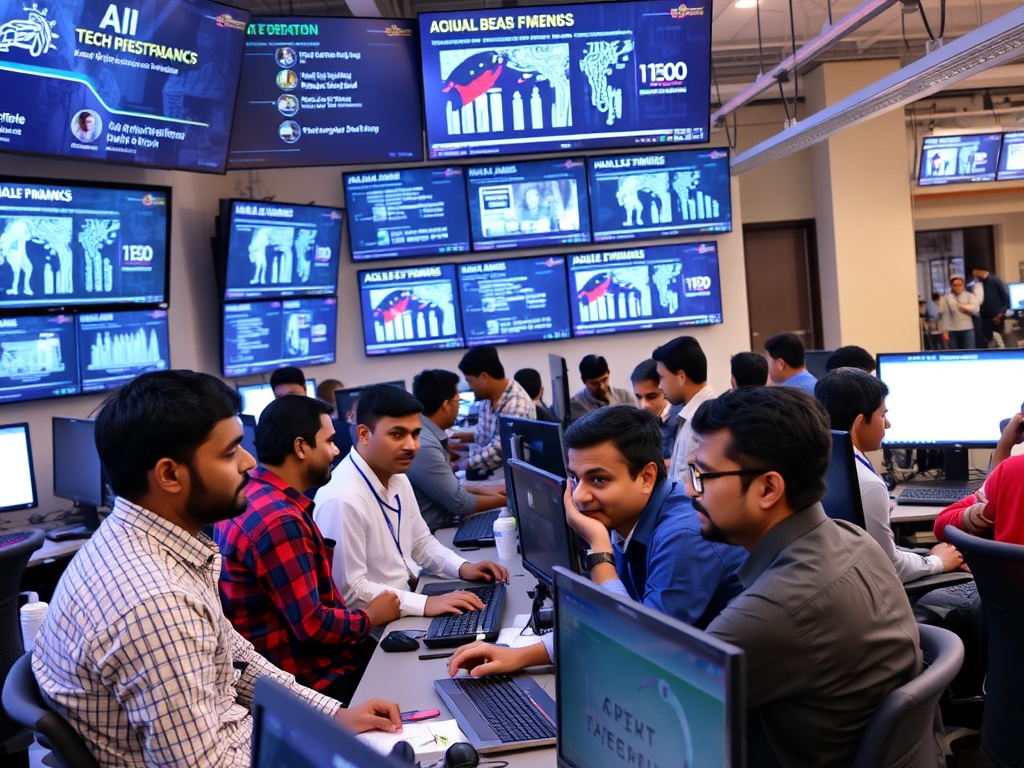

The Sovereignty of AI in India: Beyond Models, Towards Control
India stands at a technological crossroads, particularly in the domain of artificial intelligence (AI). As the country moves forward in developing AI models, a critical question arises: who controls the evaluation parameters of these models? Currently, evaluation standards are predominantly set in San Francisco, compelling India to urgently develop its own assessment system to ensure its technological sovereignty.
The Necessity of an Independent Evaluation System
In the realm of artificial intelligence, having models is insufficient. The real competition lies in who defines the criteria for success. AI models in India have, until now, been assessed using benchmarks designed outside their cultural and social context. This not only limits the accuracy of the evaluations but also perpetuates an unnecessary dependence on foreign standards.
The case of GPT-5, which scores less than 40% in reasoning based on Indian cultural context, starkly illustrates this disconnect. For India to fully harness the potential of AI, it must take control of its evaluation metrics. This is not merely a question of technological independence; it is also about cultural and economic relevance.
Economic and Cultural Implications
Adopting an independent evaluation system has profound economic and cultural implications. Economically, it allows India to develop models that are more aligned with its specific needs, optimizing resources and reducing costs associated with reliance on foreign standards. Culturally, it ensures that AI models more accurately reflect the complexities and nuances of Indian society.
This approach not only democratizes access to technology but also empowers local communities, enabling them to actively participate in the design and evaluation of technologies that impact their lives directly. The decolonization of technological dependence is key to transforming scarcity into abundance.
Challenges and Opportunities
Creating an independent evaluation system is not without its challenges. It requires investment in infrastructure, talent, and policy development. Nevertheless, the opportunities far outweigh the obstacles. By establishing its own standard, India has the chance to lead the way in responsible and sustainable AI innovation.
Moreover, this paves the way for more equitable international collaborations, allowing India to negotiate from a position of strength, contributing its unique perspective to the global AI landscape. The democratization of technology becomes a tangible reality when nations control their own resources and standards.
The Role of Augmented Intelligence
In this context, augmented intelligence plays a crucial role. It is not just about creating more efficient models but integrating AI into an ecosystem that enhances human decision-making capabilities. Efficiency without awareness is a misstep. Therefore, AI should be a thoughtful partner that complements and enriches human judgment.
This approach ensures that technology is not merely used to cut costs or automate errors but is leveraged to empower individuals, improving quality of life and nurturing a more equitable society.
Towards Technological Sovereignty
Technological convergence presents India with a unique opportunity to redefine its position in the global landscape. By developing an independent evaluation system and adopting a framework of augmented intelligence, India can secure its technological sovereignty, challenging the dominance of large corporations and shifting power towards more agile and decentralized actors.
Technology should serve as a means to empower humanity and democratize access to knowledge and opportunities. India has the potential to lead this transformation, establishing a model that not only benefits its population but also serves as an example for other developing countries.
In conclusion, the phase of disruption India is currently experiencing serves as an opportunity to reimagine its technological future. Creating an independent evaluation system is a crucial step towards the democratization of technology, ensuring that AI becomes an ally in the journey towards a more equitable and sustainable development.