
The Experiment That Isn't What It Seems
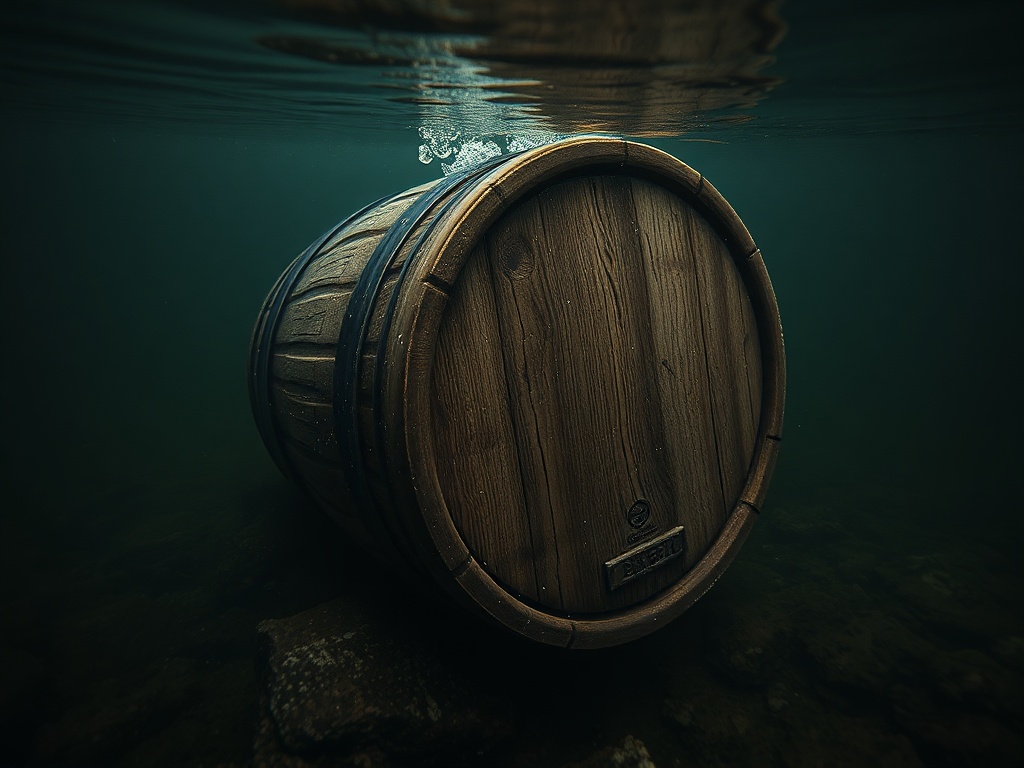
On February 14, 2025, a barrel of 2010 barley distillate descended 214 meters beneath the surface of Loch Ness. Thirty minutes later, it emerged transformed into something neither Scottish legislation nor the market knew how to categorize. The company behind this barrel is called Domhayn — pronounced "doyn", from Gaelic meaning "deep" — and its founder, James Patterson, is a civil engineer by training, not a distiller by trade.
The result of that half-hour of hydrostatic pressure: six bottles, legally unclassifiable as whisky due to their altered molecular composition, bottled at 55.5% ABV. The first was auctioned for £850 (approximately $1,133). The Department of Chemistry at the University of Oxford confirmed, through molecular analysis, that the distillate profile differed from control samples. Different compounds. Different smoothness. Different aroma.
That's all there is for now. Yet this calculated scarcity has already signaled the next phase: the ocean abyss.
What interests me isn't the Loch Ness monster as a marketing asset — although it works perfectly — but the business mechanics behind a product that can’t compete on volume, can’t be called whisky, and still managed to get someone to pay £850 without batting an eye.
Why £850 Is a Cheap Price for What They Sell
The global spirits market is valued at around $500 billion. In that arena, Domhayn lacks scale, doesn’t have mass distribution, and has no historical records like Diageo or Pernod Ricard. What they have is something none of those giants can replicate immediately: verified certainty of uniqueness.
This distinction matters operationally. Most luxury products in the premium beverage sector operate on subjective promises: oak nuances, vanilla notes, "complexity" that the consumer must imagine. Domhayn did something different: they delivered an Oxford report that documents, at a molecular level, how their process alters the composition of the liquid in ways that traditional aging cannot replicate in the same timeframe. This isn’t marketing. It’s evidence.
That evidence serves a specific pricing function: it removes the main friction of purchase in the collector segment, which is the doubt about whether the price is arbitrary. When someone pays £850 for an aged Macallan bottle, they do so based on a reputation built over decades. When they pay £850 for Domhayn, they do so based on verifiable GPS coordinates from the bed of Loch Ness and independent university analysis. The certainty of the dream outcome — owning something unique, with a traceable history — doesn’t rest on brand faith but on documentation.
For an SME without historical records or a branding budget, that’s a far more efficient offer architecture than any advertising campaign. The expense in external validation (the collaboration with Oxford) replaces years of investment in reputation. And the result in unit price speaks for itself: six bottles, one auctioned at £850, with a production cost that doesn’t scale linearly with that price.
Regulatory Restriction as a Competitive Advantage
There’s a detail most analyses of Domhayn treat as a problem: the distillate cannot legally be called "Scottish whisky". Hydrostatic pressure alters its molecular profile sufficiently that it doesn’t meet the regulatory definition of the Scotch Whisky Act. For a firm wanting mass volume, this would be a serious obstacle.
Domhayn doesn’t want mass volume. And that’s the difference.
The impossibility of legal classification becomes, in this model, a differentiator that no competitor can legally copy. There’s no other category to belong to. The product is alone on its shelf. This isn’t a compliance problem; it’s a market position that established firms, bound to protect their designations of origin and certifications, cannot occupy without abandoning what makes them great.
For SMEs operating in highly regulated sectors — food, cosmetics, specialized manufacturing — this pattern is relevant beyond spirits. When a small firm lacks the resources to compete within established rules, sometimes the most profitable move is to operate at the edges of those rules, where larger firms cannot follow without incurring reputational or legal costs they aren’t willing to pay. Patterson, with a civil engineering background, understands well the relationship between structural loads and breaking points. He applied that knowledge to the regulation of his sector.
The next experiment targets the ocean abyss, depths exceeding 4,000 meters. The pressures in that zone will generate molecular effects that no barrel in any conventional cellar can approximate. Each new experiment expands the gap between Domhayn and any potential imitator, because the barrier to entry isn’t the formula — it’s logistical access, scientific validation, and the time invested in building the process.
What Domhayn Tells Any SME About Funding and Scale
Domhayn has no public figures on revenue, employees, or external investment. This absence of data is, in itself, data. The firm operates on a logic of limited-edition high margins, apparently without needing external capital for expansion. The next experiment — the ocean abyss — is presumably funded by the revenue generated from the six bottles from Loch Ness and those yet to come.
This model inverts the usual sequence with which many physical product startups approach growth: they raise capital first, then build products, then seek a market. Domhayn did the opposite. They built the most expensive and smallest product they could. They validated the demand through an auction. And they used that price to finance the next level of experimentation.
The lesson for any SME isn’t to replicate the process of submerging barrels. It’s in the sequence of decisions: define the smallest segment willing to pay the highest price, deliver a promise with verifiable evidence, and use that margin to finance expansion without relinquishing control or equity. Six bottles at £850 generate £5,100 in gross revenue. With that volume, you can’t build a conglomerate, but you can validate a process, build a case study, and fund the next leap in depth.
The ocean abyss isn’t just a branding adventure. It’s proof that the model can be iterated without dilution.
The Price Is Set by Those Who Eliminate Doubt, Not by Those Who Lower Costs
Domhayn doesn’t compete in the spirits market because it can’t. It competes in the market of objects with verifiable histories, where collectors don’t evaluate price per liter but price per certainty of uniqueness. This reconfiguration of purchasing criteria allows a firm without history to charge £850 for its first bottle and project prices exceeding $1,000 for future releases.
Companies that charge little generally do so because they haven’t built the evidence to justify charging more. Patterson invested in Oxford analysis before setting a price, not after it. This turns scientific validation into a commercial asset, not an operating expense.
The pattern is reproducible in any sector where there’s a segment willing to pay a premium for certainty: professional services with independent audits, manufacturing with documented traceability, products with verifiable provenance. Willingness to pay doesn't increase because the product is better in the abstract; it increases because the buyer can demonstrate, with concrete evidence, why they chose that product over any alternative. Designing that evidence before setting the price, and structuring the offer so that the buying friction is minimized, is the only thing that turns a small SME into a firm capable of operating on margins that larger ones cannot touch.