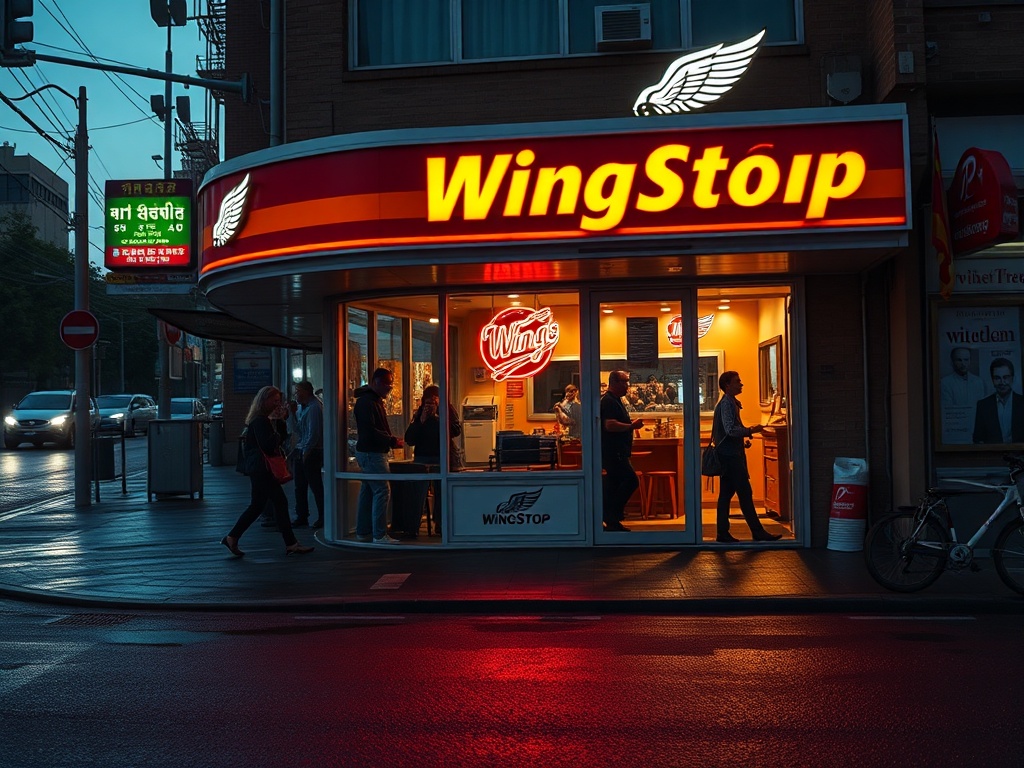

The Wingstop Model Reveals the Blind Spot Analysts Overlook
When a fast-food chain closes a quarter with an operating margin of 37.9% and earnings per share surpassing market consensus by nearly 20%, the financial conversation becomes predictable: analysts raise their price targets, headlines celebrate, and algorithms log the volume. That’s precisely what happened with Wingstop on March 13, 2026. Its stock rose 5.35% to $203.44, firms like Truist Capital raised their price target to $374, and the market processed this news as a story of flawless execution.
And, to a large extent, it is. A 9.3% year-over-year system-wide sales growth, a 15% year-over-year adjusted EBITDA increase, and the opening of 493 restaurants in just one year, including entry into six international markets, doesn’t happen without operational discipline. The rollout of Smart Kitchens across all U.S. locations in just ten months is a feat of logistical execution that deserves respect.
However, there is a dimension that Wall Street valuation models do not capture in their spreadsheets, and it is precisely the one that will determine, at a global scale, whether this model holds together or fractures.
Growing 493 Restaurants in a Year is an Engineering Achievement; Doing So with Cultural Coherence is Another Discipline
The physical expansion of a franchise chain is not merely a real estate and supply logistics operation. Fundamentally, it is a matter of transmitting tacit knowledge. Each new location that opens in a different market, with different operators, and within diverse cultural and labor contexts represents a point where the company’s operational culture can quietly degrade.
Wingstop operates under a highly decentralized franchise model. This has obvious advantages: it turns fixed costs into variable costs, transfers operational risk to the franchisee, and allows for an expansion speed that a company-owned model could never maintain. The result is that gross margin that technically exceeds 100% when isolating the brand structure against direct costs. The mechanics appear elegant on paper.
The issue is that extreme decentralization, without a robust network architecture among franchisees, produces fragmentation that will inevitably affect product consistency, customer experience, and thus brand value. Intelligence about what works and what doesn’t in a market like Singapore or Mexico City rarely finds its way back to the center in a systematic manner. That peripheral intelligence, which is held by the franchisee who has been understanding their local clientele for 18 months, is lost unless there is a horizontal network where operators can exchange that knowledge in a structured format.
This is not a critique of Wingstop’s strategy. It is a diagnosis of where the unseen risk lies in any company growing at this speed and with this structure.
Operational Technology is Powerful; The Biases of Who Designs It Determine Its Real Scope
The rollout of Smart Kitchens in all U.S. locations in just ten months is one of the most significant developments in the report due to its speed and coverage. Technology promises improvements in throughput efficiency, lower labor costs, and a better customer experience. Analysts at DA Davidson explicitly cited it as a catalyst for long-term growth.
My technical reading goes in a different direction. When a company deploys operational technology on a massive scale across a geographically dispersed franchise network, there’s a variable that rarely appears in implementation analyses: the homogeneity of the team that designed that solution.
Automation tools in kitchens and order management are efficient within the contexts for which they were designed. If the team that built them shared a narrow demographic, linguistic, and cultural profile, the tool will have blind spots that will only emerge when operating in different contexts. A system calibrated for the consumption pattern of the average customer in Texas will face measurable friction when deployed in international markets where demand peaks, customization preferences, or kitchen workflows differ structurally.
This is not ideological speculation. It is the mechanics of how biases in training and design limit the actual scalability of any technological solution. A diverse team in origin, market experience, and operational perspective is not a corporate responsibility aspiration: it is a technical condition necessary to build a tool that functions outside the context in which it was conceived. Wingstop’s international expansion margin depends, at least in part, on whether its technological tools were designed by people who understood more than just the domestic market.
Social Capital Doesn't Show Up on the Balance Sheet, But it Determines Whether Expansion Creates Lasting Value
There is a data point in Wingstop’s financial report that, viewed through a structural lens, reveals more than merely accounting risk: book value per share is negative at -$26.81. The company operates with debt that far exceeds its tangible assets. This is relatively common in mature franchise models where the real value lies in the brand and future cash flows, not in physical assets. Authorizing a $300 million stock buyback program on this equity basis is a confidence bet, not an operation from a position of balance sheet strength.
What interests me about this data point is not the risk of leveraging per se but what it reveals about the underlying value creation model. Wingstop is betting that the brand, technology, and digital loyalty programs will sustain its ability to expand and generate cash in the face of debt commitments. That bet is reasonable if the social capital of the organization—that is, the density and quality of relationships between the brand, its franchisees, its customers, and local markets—continues to grow alongside the number of locations.
A network of 493 new market contact points is an extraordinary opportunity to capture distributed intelligence. But that intelligence only flows to the center if there are real channels of trust between operators and the corporation. Networks built solely on contracts and compliance metrics are fragile: franchisees will comply with what is measured and withhold what they observe. Networks built on reciprocity and genuine value contribution to the operator produce something qualitatively different: honest feedback, early alert for emerging problems, and co-defense of the brand in moments of pressure.
Wingstop has the financial instruments to grow. The strategic question its leadership should be answering with the same discipline it uses to manage EBITDA is whether the relationship architecture with its international franchisees possesses the same sophistication as its kitchen architecture.
The Pattern that Quarterly Numbers Fail to Show
Valuation models placing Wingstop’s price target between $320 and $374 discount future cash flows, unit expansion speed, and margin levers. They are technically correct exercises within their own assumptions. What they do not discount is the cost of the organizational blind spots that accumulate when a board evaluates global expansion with the same conceptual categories it managed the domestic market.
This is not a moral failing. It is a cognitive architecture failing. Management teams that share origin, trajectory, and frame of reference process the same information in overly similar ways. They are efficient in the scenarios they know and systematically slow to detect friction in contexts where they have not operated. For a company that entered six international markets simultaneously in 2025, that slowness incurs a concrete operational cost that does not show up in next quarter's margin but does appear in the one after that.
The next executive who chairs a strategic review meeting about Wingstop’s international expansion should conduct a simple exercise before opening the financial deck: look around the table and count how many of the attendees have lived, operated, or managed in any of those six new markets. If the answer is none or almost none, the expansion carries a structural risk that is not reflected in any of the models of analysts recommending a buy today.