
Rivian's Founder Bets Industrial AI is Worth More than Dancing Robots
There’s a crucial distinction between what captures headlines and what generates real value. For the past two years, the prevailing narrative in robotics has been centered around humanoids folding laundry, climbing stairs, and performing pirouettes during carefully choreographed demonstrations. The industry celebrated every viral video as though it were a monumental achievement. RJ Scaringe, CEO of Rivian Automotive, observed this trend and reached a different conclusion: doing flips does not create value in manufacturing.
On March 11, 2026, Scaringe announced a Series A round of $500 million for Mind Robotics, the industrial robotics company he founded in November 2025 as a spin-off from Rivian. The round was co-led by Accel and Andreessen Horowitz, adding to a previous seed funding of $115 million led by Eclipse Ventures, bringing the total to $615 million in less than four months since its inception. The resulting valuation hovers around $2 billion, making it one of the largest Series A funding rounds in the history of the robotics sector.
This isn’t just a statistical anomaly. It signals where institutional investors are looking for the next cycle of value in physical AI.
Why $615 million in Four Months is More Than Just Hype
Most robotics startups raise less than $50 million in their Series A. Mind Robotics achieved ten times that amount with a company that, technically, hasn’t completed its first year. To understand why big funds from Silicon Valley signed that check without hesitation, one must look at what Scaringe delivered that other founders cannot offer.
Rivian is not just a shareholder in Mind Robotics. It serves as its production laboratory. The factory in Normal, Illinois, where Rivian assembles its vehicles generates manufacturing data under real-world conditions that no competitor can replicate in a controlled environment. Boston Dynamics tests in labs. Agility Robotics practices in environments tailored to their robots. Since day one, Mind Robotics has access to a live assembly line, with all the variability, noise, and unpredictability that implies.
Sarah Wang, a general partner at Andreessen Horowitz, described it not just as a technological advantage but as a systems advantage: Scaringe is one of the few founders who has built and scaled a vertically integrated hardware company, from vehicle architecture to supply chain. In industrial robotics, that matters more than having the most sophisticated AI model on the market because the issue has never been just the algorithm. It’s been the friction between that algorithm and the chaotic physical reality of a real factory.
What investors are buying isn’t just an abstract tech bet. They’re acquiring the data advantage coupled with the execution history of the individual at the helm. That combination is rare; in a capital-intensive field, scarcity comes at a price.
The Design Mistake that Nobody Wants to Admit in Robotics
The humanoid segment faces a structural issue that its funding rounds have managed to temporarily mask: it’s building solutions for the wrong problem.
Humanoid robots are implicitly designed to replace humans in their entirety. That logic makes narrative sense, but it’s poor product engineering. Industrial manufacturing does not require a human body with two arms and legs. It needs adaptable dexterity in specific tasks that are currently beyond the reach of conventional automation: operations with dimensional variability, non-standard materials, or assembly steps requiring situational physical reasoning.
Current production lines handle repeatable and dimensionally stable tasks well with traditional articulated arm robots. The bottleneck isn’t there. It lies in intermediate processes where variability breaks programmed logic of classic systems, and where a human operator makes real-time decisions that no existing system can replicate in an economically viable way.
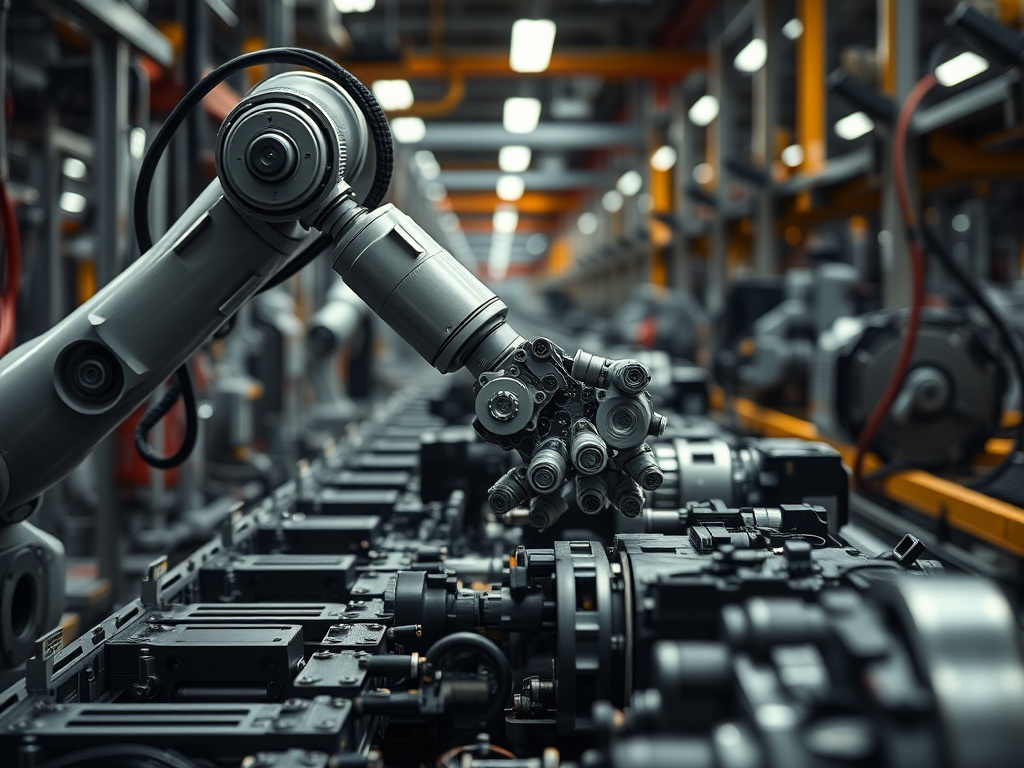
Mind Robotics is tackling exactly that bottleneck, designing industrial hardware that doesn’t aim to resemble people but to resolve that specific range of tasks stuck in limbo between rigid automation and human labor. Scaringe calls it prioritizing manufacturing utility over attention-grabbing demonstrations. In terms of business model, this translates to a value proposition that the industrial customer can justify on their P&L without needing to believe in a sci-fi vision.
That distinction is what makes Mind Robotics’ model more defensible than those of its more media-visible competitors. A robot that impresses on stage needs to convince a marketing director. A robot that lowers unit costs in a plant needs to convince a CFO. The second contract is harder to secure but infinitely more difficult to lose.
The Double Bet That Rivian Couldn’t Afford Not to Make
There’s a reading that extends beyond Mind Robotics as an independent business: it serves as infrastructure for Rivian’s own production plan.
Scaringe’s confidence to found Mind Robotics stemmed, according to his own statements, from the certainty that Rivian would scale production with its R2 platform. Scaling electric vehicle production across multiple plants requires solving exactly the kind of dexterous automation that current systems cannot handle. In other words: Rivian had a manufacturing problem that the market could not solve, so it created the company to solve it.
This differs from a spin-out motivated by market opportunity. It’s a spin-out driven by internal operational necessity, with external market potential as an additional benefit. This difference matters because it aligns incentives in a way rarely seen: Mind Robotics doesn’t need to seek its first customer while building the product. Rivian already is that customer, with real urgency and real data.
Discussions about potential sales of customized silicon chips from Rivian to Mind Robotics add another layer: if it materializes, Rivian converts part of its automotive manufacturing investment into a technology revenue stream. While this isn’t a confirmed business line, the pattern it describes is that of a company arbitraging its own technical infrastructure to generate value in multiple directions.
Scaringe plans large-scale deployments by late 2026. If Mind Robotics’ AI models are validated in real production by that timeframe, the case for expanding to other industrial customers won’t need additional arguments. The numbers will speak for themselves to any operations director facing a problem similar to what Rivian is currently solving.
The Factory Was Always the Problem the Industry Didn’t Want to Hire
Mind Robotics’ early success as an investment thesis demonstrates something the major funds have already processed, even if the broader market hasn’t yet: the work that the manufacturing industry has been trying to hire for years isn’t for a more capable robot, but rather for a system that understands the chaotic physics of a real production line and acts accordingly. Humanoids were a response to a question no one in manufacturing had asked. Mind Robotics reversed the process: it started with the documented problem on the factory floor, built hardware around that specific issue, and came to market with validation data that no competitor can produce in a laboratory. That sequence—problem before solution, factory before stage—is the only reason why $615 million makes sense in less than four months.