
AI Canvases Become the New Gateway to Business Workflows
On March 4, 2026, Google activated its Canvas in AI mode for all users in the United States. Nine days later, Forbes published an analysis declaring that AI canvases were becoming the new central interface for business work. Two significant moves in less than two weeks that, when viewed together, describe more than just a product update: they indicate a shift in the architecture of how organizations will process information, make decisions, and execute operations.
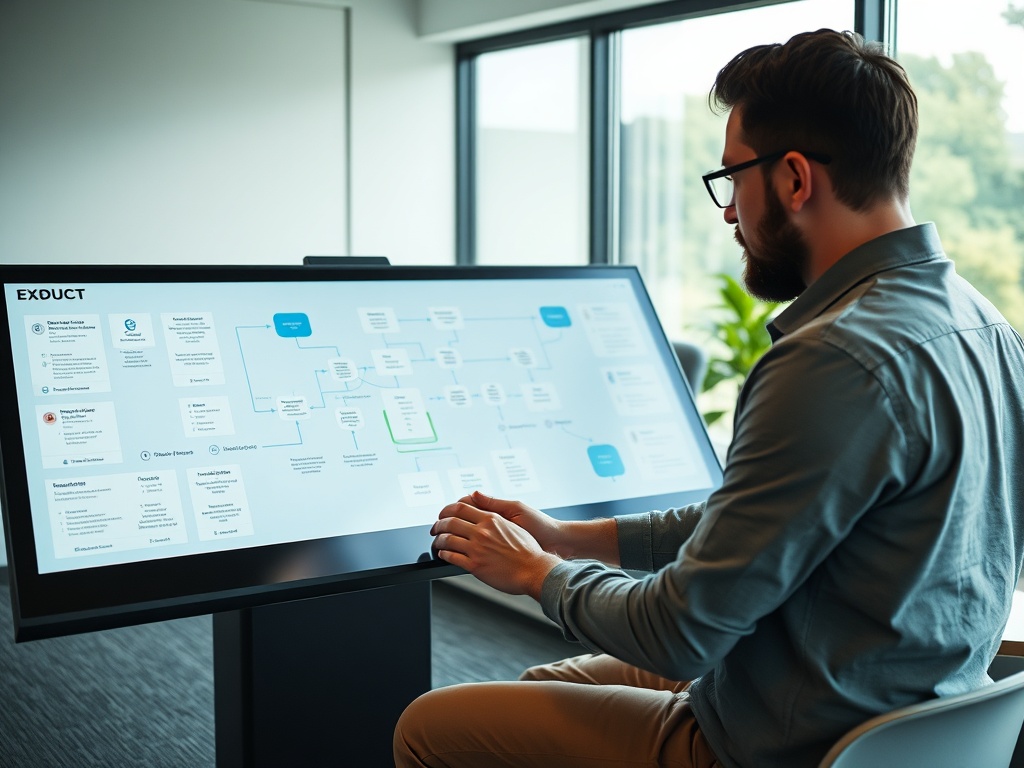
The premise is straightforward. Platforms like Stack AI, Canva Enterprise, Google Gemini, and Slack are integrating visual interfaces, or canvases, that take inputs from meetings, documents, and enterprise databases to orchestrate automated workflows. In Stack AI, teams drag nodes that connect language models with knowledge bases to solve specific use cases: extracting invoices, synthesizing two-hour meetings into actionable decisions, and generating content with brand approval. The canvas stops being just a visual metaphor and becomes the operational dashboard.
The Interface as a Business Hypothesis
What piques my interest here is not the product aesthetics but the implicit bet these providers are making. When a company like Google decides that its AI mode Canvas deserves mass distribution to all its users in the U.S., it is betting that search behavior and project organization can merge into a single interface. That bet has implications for the unit economics of the product: if the Canvas retains users within the Google environment for research, planning, and execution, the cost of acquiring each productive session decreases while usage time increases. Capturing the workflow is, financially, more valuable than capturing the query.
Stack AI operates with a different yet equally calculated logic. Its drag-and-drop canvas lowers the technical barrier for teams without engineers to build automations using language models. This expands the addressable market without proportionally increasing support costs. Clients who previously needed an external provider to implement an automation are now doing it in-house, and Stack AI turns that autonomy into dependency on its environment. This is not generosity in product design; it is a deliberate move to increase exit costs with every additional automation the team builds within the platform.
Canva Enterprise adds a layer that others overlook: governance. Its approval workflows for AI-generated content ensure that outputs undergo brand reviews before publication. This detail is crucial. According to Forbes' analysis, governance is emerging as the critical enabler of these environments—not as a bureaucratic hindrance but as the mechanism that makes organizations confident in delegating decisions to automation. Without governance, the canvas produces noise. With governance, it generates auditable results.
The Risk No One Is Measuring in the Boardroom
Rebecca Hinds from Glean’s Work AI Institute puts it precisely: the overwhelming nature of AI will surpass human systems' ability to process it. Organizations that adopt these canvases without a clear model for which outputs are processed, which are discarded, and who oversees what will generate a backlog of automated content that no one reads, displacing attention from where it should be. This has a real operational cost: meetings to review summaries that no one validated, decisions made based on summaries that missed the nuance that changed everything.
Arvind Jain, CEO of Glean, projects that workplace AI will come to know the employee better than their manager, accumulating behavioral patterns to guide tasks with contextual intelligence. That scenario holds value if the data layer is clean and the governance model is robust. But in most medium-sized enterprises I know, data is fragmented across three different CRMs, two versions of an ERP, and Google Drive folders that haven’t been cleaned since 2019. An AI canvas connected to that reality does not orchestrate workflows; it amplifies existing disorder at greater speed.
Aruna Ranganathan, a UC Berkeley professor, identifies another pattern that boards should be measuring: the voluntary intensification of work. When AI reduces friction in certain tasks, employees do not use the freed time to rest or think strategically. Instead, they use it to add more tasks to the same deadline. The canvas produces more output in the same time, and the organization interprets this as additional capacity available, not as efficiency gained. The result is a quiet expansion of scope without resource adjustment or compensation. Sustaining this pattern over time has direct implications for retention and the hidden costs of turnover.
The Canvas Doesn’t Replace Customer Validation
In September 2025, Jakub Bareš developed the AI Implementation Canvas, a framework of ten categories that maps AI deployment from objectives to workforce impact, risks, and generated value. What I find relevant about this framework is not its comprehensiveness but its starting point: it forces the organization to articulate what hypothesis it is testing with each automation before building it. This is what most corporate implementations overlook.
Companies deploying these canvases in 2026 are making the same mistake I have seen repeat during product launches for years: they build the interface, configure integrations, design automated flows, and then try to get teams to adopt them. The correct order is the reverse. First, identify what specific decisions take the most time or generate the most errors in your actual operation. Then, build the minimum experiment that validates whether an automation reduces that cost. Only after that should you scale the architecture.
RapidCanvas.ai, in its February 2026 report, describes AI as the structured memory of the organization. Bain, cited in that same report, adds that successful adoption requires concurrently modernizing workflows, the workforce, and governance. None of these three elements can be modernized with mere product demos. They require short implementation cycles, measuring real impact on specific operational metrics, and continuous adjustment based on what the data says, not what the vendor's roadmap promises.
AI canvases hold genuine potential as infrastructure for compressing operational cycles that currently consume disproportionate resources. But that infrastructure only delivers returns when the organization knows exactly what it is measuring before activating it. The leader who installs the canvas without that clarity is purchasing speed to a destination that still lacks coordinates. Sustainable growth in this adoption cycle belongs to those who replace the illusion of mass deployment with the discipline of validating operational hypotheses one at a time, with real metrics and users confirming value with their actions, not just their words.