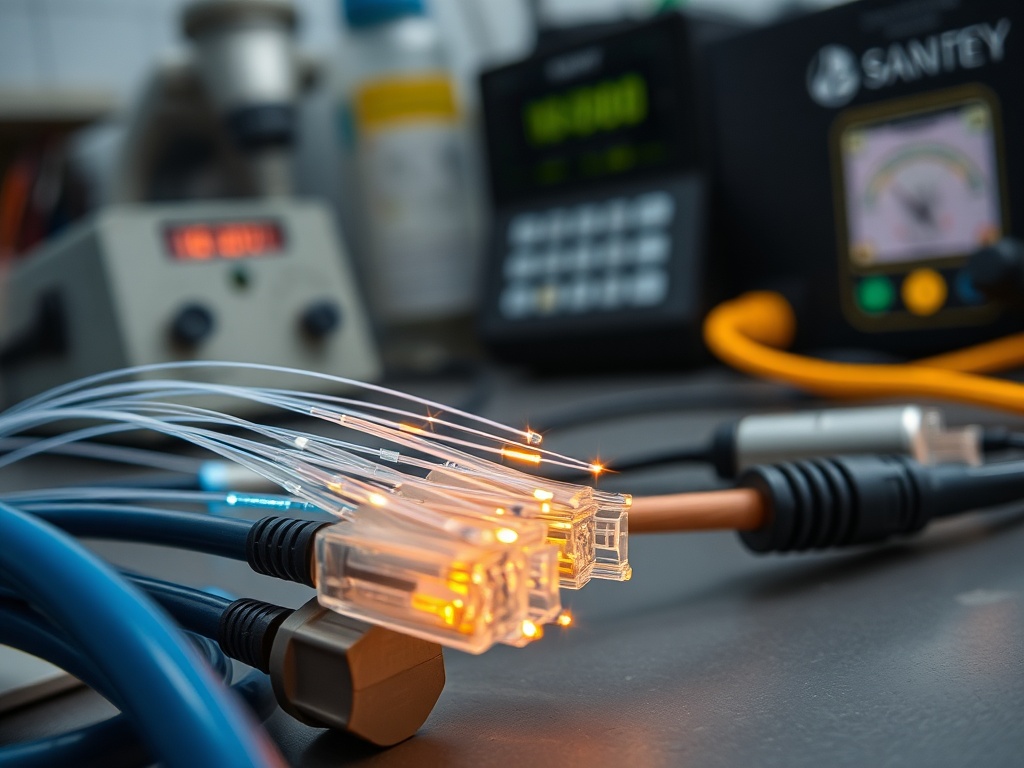

The Physics of the Problem No One Wants to Solve
Every time a company transfers data between servers, it incurs a cost that rarely appears on its quarterly report: the heat, latency, and energy consumption of the electronic converters that translate electrical signals into digital information. This bottleneck has been tolerated for decades because, until now, the cost of solving it exceeded the immediate benefits.
Polaris Electro-Optics is tackling exactly this issue. Founded by graduates of the University of California, San Diego, this startup is developing an electro-optical device that allows for faster data transfer, lower energy consumption, and reduced costs compared to conventional pure electronic solutions. The company operates within the facilities of the Qualcomm Institute at UC San Diego, giving it access to top-notch laboratory infrastructure without having to capitalize that fixed asset on its own balance sheet.
This is not a minor detail. From a portfolio design perspective, it is an intelligent architectural decision: turning a fixed cost into variable access. Instead of building its own lab— which would immobilize capital at a stage where the sole mission should be validating the technological hypothesis—Polaris outsources infrastructure and focuses its resources on the problem only they can solve. It’s the kind of decision that distinguishes teams that understand what phase they are in from those that act as if they have already reached the next one.
Why This Technology Matters Beyond the Laboratory
Electro-optics is not new. What is new is the ability to manufacture electro-optical devices that are compact, efficient, and inexpensive enough to compete with standard electronic modules in commercial data centers. For years, the gap between lab performance and industrial production costs kept this technology in the realm of academic research and high-budget military applications.
What Polaris is attempting to do is bridge that gap. The context couldn’t be more favorable: the demand for bandwidth in data centers is growing at a pace that conventional electronics are struggling to keep up with, especially with the expansion of artificial intelligence workloads that require moving massive volumes of data between hardware accelerators with minimal latency. Every millisecond of latency and every extra watt of energy has a direct operational cost for any large-scale infrastructure operator.
In this context, a device that simultaneously improves speed, energy efficiency, and unit cost is not a technological luxury. It is a value proposition with clear operational math: if the device works at scale, potential buyers—hyperscalers, network equipment manufacturers, telecommunications operators—have tangible economic incentives to adopt it, not just technological enthusiasm.
The risk, as always in such bets, is not in the physics. It lies in the execution.
The Exploration Model and Its Invisible Tensions
Polaris is, by definition, a company in a phase of pure exploration. It has no mature business to defend, no recurring revenues to protect, and no captive customers demanding operational stability quarter after quarter. This gives it a massive structural advantage: it can take technological risks that an internal division of a large company would never dare, because that division will always be competing for budget against the already cash-generating business.
This is exactly the logic that leads to the frequent failures of corporate innovation labs. When a large company tries to incubate frontier technology within its own structure, the exploratory unit ends up measuring its success with the same indicators used by the main business: margins, return on capital, revenue growth. Applying mature business KPIs to a hypothesis-phase project is the most efficient mechanism to destroy legitimate innovation before it can prove its value.
Polaris, by operating as an independent startup with access to university infrastructure, avoids that trap by design. Its only relevant metric in this stage should be the verifiable technical progress: demonstrating that the device functions to the promised specifications, that it can be manufactured reproducibly, and that its production cost has a realistic trajectory toward commercial competitiveness. Everything else is noise.
The question worth asking—and that investors assessing this company should answer coolly—is how the governance of the project is structured in terms of decision-making autonomy and access to capital for the next phases. A startup with promising technology and a funding model that forces it to show premature profitability faces the same problem as a corporate lab suffocated by bureaucracy: external pressure distorts technical decisions at the moment clarity is most needed.
The Moment Exploration Must Transition to Scale
Assuming Polaris validates its technological hypothesis—that the device works, that it can be produced, and that the cost is competitive—the next organizational challenge is completely different from the current one. Transitioning from a laboratory with access to university infrastructure to operating as a supplier of components for the data center industry requires capabilities that no research team naturally possesses: supply chain management, industrial-scale quality certification, commercial relationships with institutional buyers, and capital to finance inventory and production cycles.
That moment of transition—from exploration to scale—is where most hardware startups with legitimate technology fail. Not because the technology fails, but because the organizational model that served to invent does not work for manufacturing and selling. Both phases require different leadership, different metrics, and different capital structures. Confusing them or assuming that the team that solved the technical problem also knows how to execute industrial commercialization is the most common and costly mistake in such bets.
Access to the UC San Diego ecosystem—which includes not only infrastructure but also talent, alumni networks, and potential exposure to venture capital—partially mitigates that risk. But only partially. The variable that will determine if Polaris ends up being a component company with market positioning or a technology licensed to a larger industrial player is the founding team's ability to recognize when they need to incorporate operational profiles that complement, and in some cases replace, the researcher profile that dominated the initial phase.
The device that moves data at the speed of light is the visible result. The organizational architecture that gets it to market is the work that no one sees and on which everything else depends.