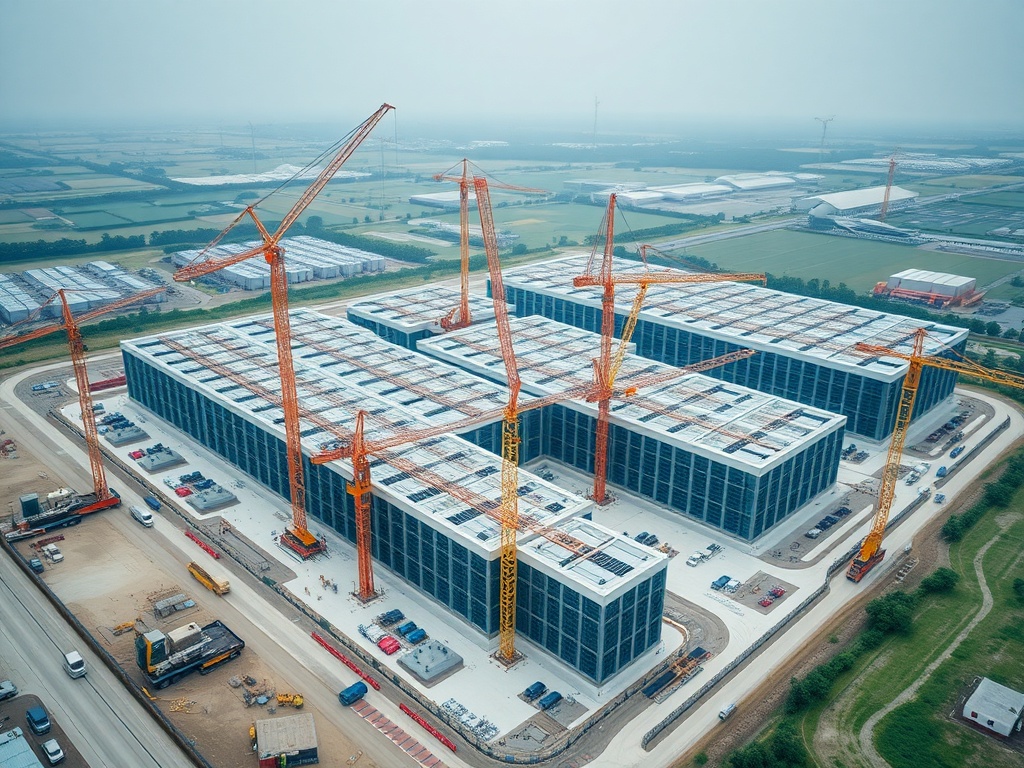

Data Center Construction: Exponential Risk and Abundant Opportunity
A recent report by Moody’s highlights a significant financial risk in the construction of data centers, estimated at $662 billion, by tech giants like Meta, Amazon, Alphabet, Oracle, and Microsoft. However, this risk is not merely a threat; it signals a tectonic shift towards a new era of digital abundance.
The Expansion Strategy and Its Risks
The aforementioned companies are leading a massive expansion in digital infrastructure, a move that initially seems like an enormous financial burden. Moody’s warns that these obligations may not reflect certain plausible future scenarios, suggesting a potentially underestimated risk.
Nonetheless, this move also reveals a strategy aimed at transforming fixed costs into variable ones, a crucial component for adapting to economic fluctuations. By investing in their own infrastructure, these companies are not only looking to control long-term costs but also to consolidate their position in an increasingly competitive market.
The Opportunity of Digital Abundance
Through the model of the 6Ds, we can see how this massive investment serves as a gateway to the digitalization and democratization of access to technology. The creation of these data centers has the potential to dematerialize entire industries, reducing the marginal cost of data processing and storage to nearly zero.
This democratized access to digital infrastructure benefits not only large corporations but also empowers startups and solopreneurs, facilitating the creation of new technological solutions and promoting scalable innovation.
Augmented Intelligence: Enhancing Human Judgment
The key is that these infrastructures should not be used solely to automate meaningless processes, but to enhance human intelligence. AI, treated as a thought partner, can transform these investments into tools that improve decision-making and operational efficiencies in a conscious and ethical manner.
Companies must resist the temptation to use artificial intelligence solely to cut personnel costs. Instead, they should focus on how AI can complement and enhance human capabilities, creating an ecosystem where technology and humanity coexist harmoniously.
Shifting Corporate Power
The concentration of resources in the hands of a few companies may seem like a consolidation of power, but in reality, technological convergence is shifting control toward decentralized networks. This phenomenon allows more agile players, such as startups, to challenge and compete in markets traditionally dominated by giants.
This democratization of access to technology represents a paradigm shift that redistributes power, enabling individuals and small businesses to innovate and compete on equal footing. The ability to rapidly adapt to technological changes is now a crucial competitive advantage.
The Future of Digital Infrastructure
Investing in digital infrastructure is not merely an expansion of capacity; it is a strategic transformation towards a future where technology is accessible to everyone. However, companies must be cautious not to fall into the trap of excessive efficiency, where cost reduction becomes the sole objective.
The true sustainability and success of these investments will depend on their ability to create real and equitable value, not just for shareholders but for all stakeholders involved.
Empowering Humanity Through Technology
In conclusion, the data center market is at a stage of disruption and democratization through the 6Ds. Investments in digital infrastructure should be viewed as an opportunity to empower humanity, allowing technology to serve as a tool for creating a more equitable and sustainable ecosystem.
The key to success lies in ensuring that these investments drive not only efficiency but also equity and universal access to technology, empowering individuals and communities around the world.