
China Lowers Growth Target to Shield Its Economy: The Real Cost of Prioritizing Security
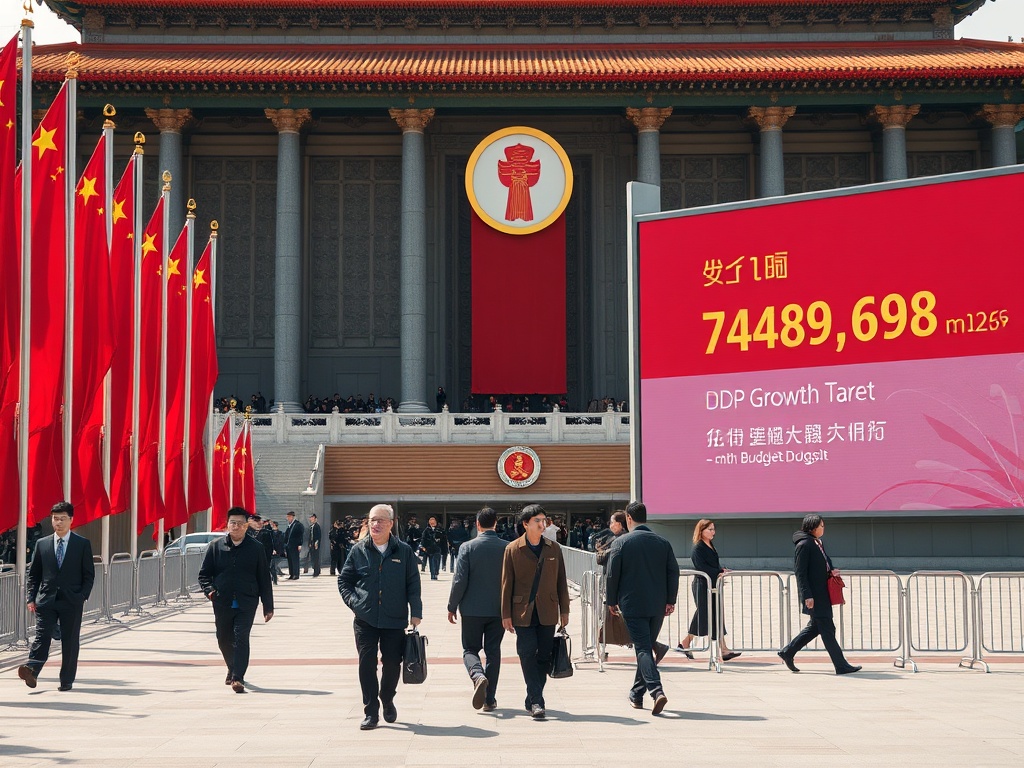
China opened 2026—the first year of its 15th Five-Year Plan (2026-2030)—with a signal that markets read as a regime change rather than just an adjustment in forecasts: the official GDP growth target was set at 4.5 to 5%, the lowest level since 1991. This announcement came on March 5, 2026, at the opening of the National People's Congress, accompanied by yet another familiar but suspicious phrase: "more proactive fiscal policy," alongside a budget deficit of 4% of GDP and a target inflation rate (CPI) of around 2%.
The simple interpretation is that Beijing is resigned to lower growth due to aging, trade tensions, and a real estate crisis. However, the useful interpretation for a CEO or investor is different: China is redefining what macroeconomic “success” means. Economic security—the ability to withstand tariffs, sanctions, shocks in external demand, and financial fragility—now ranks equally with prosperity. This pivot alters the distribution of value within its economy: which sectors receive capital, which lose oxygen, and which players bear the cost of a more defensive model.
This plan does not resemble the 2008 approach of opening the tap without looking. The focus is on structural investment, industrial chains, technology, and infrastructure, with the promise that jobs and wages will do the delicate balancing act regarding consumption. The uncertainty is whether this transmission works in China of 2026, characterized by deflationary pressure, household confidence weakened by real estate issues, and a 9.5% decline in foreign direct investment in 2025, marking three consecutive years of contraction.
The New Contract: Less Growth, More Risk Control
Setting a 4.5 to 5% growth target is, above all, a credibility decision. In an economy significantly larger than that of the nineties, this figure does not indicate “failure”; it signifies that the government publicly acknowledges that pursuing higher rates comes at a cost: more debt, more bubbles, greater external exposure, or a reallocation of resources that compromises social stability. The plan suggests that Beijing prefers somewhat slower growth if it can reduce vulnerabilities.
This shift in priority is not abstract. In terms of value chain on a country scale, economic security means raising the “willingness to invest” in sectors that reduce external reliance: advanced manufacturing, industrial digitalization, physical and technological infrastructure, and emerging technologies (such as future energy, quantum, robotics, brain-computer interfaces, and 6G). Concurrently, the tolerance for discomfort at other nodes in the system is being rearranged: greater labor market weakness is accepted than in previous cycles, and it’s acknowledged that consumption may take longer to recover if investment comes first.
The issue is that when security is prioritized macroeconomically, it typically gets financed through a combination of three levers: increased deficit, reallocation of credit toward “strategic sectors,” and discipline over segments deemed unproductive or speculative. Each lever has clear losers. The real estate sector, which holds household wealth and affects confidence, is implicitly subordinated. Consumption, declared a priority, competes for resources against the industrial agenda. And foreign capital, which seeks predictable rules and risk-adjusted returns, reacts to any sign that economic policy rewards non-financial objectives.
This creates a gap in credibility that the market has already expressed: the promise of a “more proactive” fiscal policy has been heard before, without a proportional leap in consumption or growth. With a 4% of GDP deficit, Beijing is on the move but isn’t saying “stimulus at any cost.” It is saying “stimulus with direction,” and that direction is security.
The “Proactive” Fiscal Policy as a Dispute Over Value Distribution
A larger deficit can signify expansion or it can be rebranded. The point isn’t semantics; it’s about transmission: where the spending lands, who captures the value, and what secondary effects it creates. If fiscal momentum is concentrated on infrastructure and industrial upgrading, the first beneficiaries are the manufacturing-technology complex: automation companies, equipment suppliers, industrial software integrators, and local governments with ready-to-execute projects. This architecture tends to elevate production and capabilities, but does not guarantee that households will increase their spending at the pace needed for an economy to rebalance toward domestic demand.
In fact, the plan tries to cover this gap by declaring “consumption revitalization” a priority and listing measures: improving the supply of quality goods and services, developing cities as international consumer centers, removing restrictions on car and housing purchases, promoting staggered paid vacations, and increasing public financing of social welfare. The approach reveals a tension: part of the consumption reactivation is sought through the supply side (more and better goods/services) and institutional architecture (licenses, restrictions, permits), not necessarily from immediate disposable income.
From a distribution logic, the operational question is whether the plan increases the value perceived by citizens without elevating their total living costs in the system. If real income does not rise, or if households perceive that their real estate assets remain under pressure, consumption will not take off just due to better “supply.” And if consumption does not take off, the private sector will defer non-subsidized investment. In that scenario, the state becomes the buyer of last resort via infrastructure, reinforcing the bias towards budget-favored sectors.
The market senses this: it does not dispute whether the deficit is 4%; it questions whether spending will be direct enough to break the inertia of confidence. Beijing, for its part, seems to prefer a path where employment and wages, created by industrial investment and infrastructure, gradually rebuild demand. It is a gamble of economic engineering: changing the composition of growth without provoking a social shock.
Technology and Advanced Manufacturing: Strategic Strength with Side Effects
The 15th Plan marks “the final consolidation” of the pivot towards technology as the engine of growth. The ambition is to produce competitive robots and competitive consumer goods, using artificial intelligence to elevate productivity, withstand external pressures, and compensate for demographic decline. This triangle is coherent: fewer future workers require more output per worker; greater trade tensions demand less dependency; and more industrial complexity demands more robust supply chains.
However, the transition incurs coordination costs. If productivity rises rapidly and the labor market does not absorb it at the same pace, the result could be social pressure in vulnerable segments and, paradoxically, increased caution among households when spending. The plan attempts to address this with “common prosperity” as a framework for stability: reinforcing equity and cohesion while reorganizing the model. It also seeks to tackle a micro problem with macro impact: localism. Building a “unified national market”—reducing bidding barriers, standards, and local protectionism—enhances efficiency and scale, in turn increasing the return on capital invested in industrial capacities.
For global companies, the message is twofold. On one hand, a window opens to participate in segments where China seeks capital and know-how: advanced manufacturing, logistics, and green technology, with “phased” liberalization in modern services like finance and healthcare. On the other, the competitive environment is likely to harden: if the state pushes for industrial productivity, margin pressure will shift to suppliers and competitors, requiring differentiation based on technology, quality, or access to channels rather than on regulatory arbitrage.
The drop in foreign direct investment in 2025 is not an isolated data point; it is a thermometer. If capital perceives that returns are sacrificed for security goals, it demands a risk premium. To reverse this, it’s not enough to invite investment; it’s essential that the rules for capturing value are clear and sustainable.
The Crucible of Consumption: Confidence, Housing, and Disposable Income
China acknowledges that domestic consumption has been weak since the pandemic and that the prolonged crisis in the real estate market hits hardest where it hurts the most: household balance sheets. With a reported GDP per capita of $13,800 and the goal to climb towards levels of high-income developed countries, consumption is not a “sector”; it’s the mechanism that converts productivity into well-being and, by extension, into the legitimacy of the model.
That’s why the sequence matters. If the government prioritizes industrial security first and then consumption, the bridge between the two is employment. The target of 12 million or more jobs for 2026 is part of that promise: sustain employment while reallocating resources. The risk is that the jobs created by infrastructure and manufacturing upgrades may not be equivalent, in quality and salary, to those lost in sectors tied to construction, local services, or activities reliant on real estate wealth.
Furthermore, the plan avoids—at least in what has been communicated—the kind of direct consumer stimulus that many Western analysts would expect, such as massive demand subsidies. It prefers more structural tools. This choice reduces the risk of financial overheating, but leaves consumption depending on an improvement in expectations that takes time to build.
In terms of value distribution, slow consumption means that households continue to absorb part of the adjustment: accepting slower growth, less wealth effect from housing, and a gradual recovery of real incomes. In the meantime, “strategic” sectors receive investment and implicit protection. The economy becomes more resilient, but citizens finance the transition with patience.
The Strategic Direction: External Resilience in Exchange for Ordered Internal Adjustment
The 15th Five-Year Plan makes explicit something many companies learn too late: maximizing short-term growth can weaken the structure that allows it to be sustained. China is trying to buy resilience against “dangerous storms”—trade tensions, geopolitical shocks, demographics—with a mix of moderately larger deficits, industrial policy, and an internal market reordering.
Execution will define whether this contract works. If “proactive” spending remains in investments that do not improve disposable income, consumption will remain fragile and the economy will depend on the state as a driver, with the cost of efficiency and trust that entails. If, on the other hand, investment in technology and industrial chains translates into quality jobs and wages that compensate for lost real estate wealth, the pivot toward security will not only become sustainable but also competitive.
The economic distribution behind the plan is already visible: real value is gained by industrial and technological sectors aligned with the self-sufficiency agenda and regions capable of executing investment; relative value is lost by households as the immediate anchor of growth and capital reliant on a rapid recovery of real estate, because the only inexhaustible competitive advantage is for all players to prefer to remain within the system that pays them steadily.