
Starbucks' Shift Towards the 'Coffeehouse' Model: $150,000 Per Store to Counter Mobile Erosion
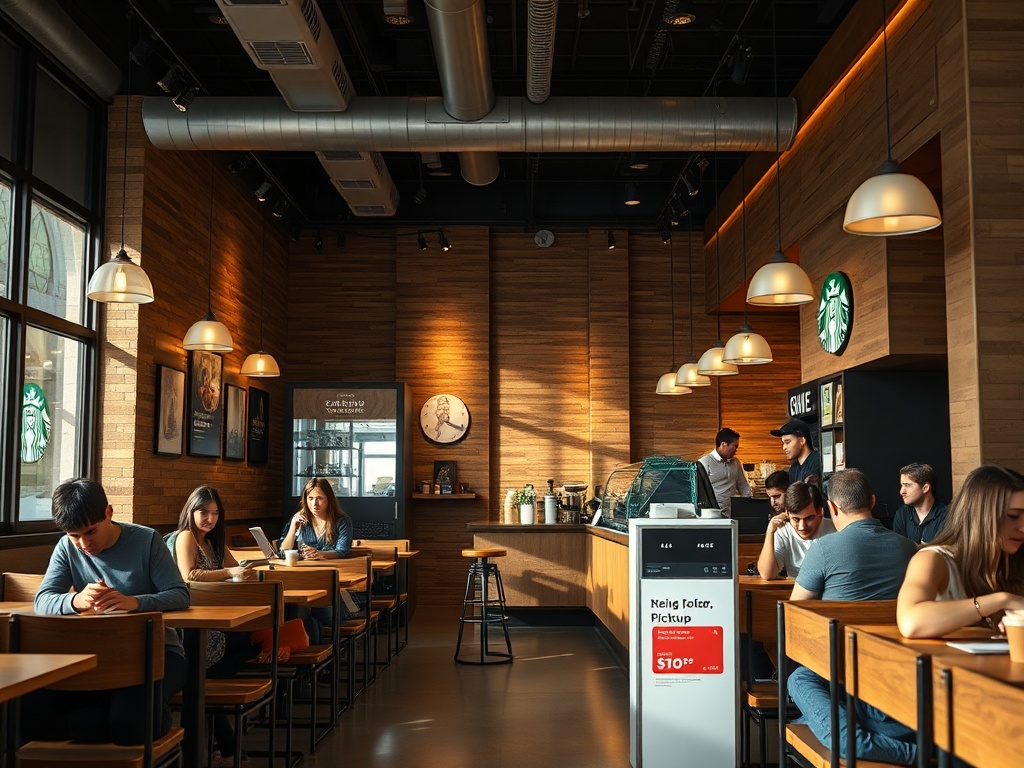
Starbucks is preparing a move that seems aesthetic but is strictly financial. The company plans to complete 1,000 renovations in North America by the end of 2026, with an investment of $150,000 per store. The program aims to bring back seating that had been removed, introduce a sense of warmth, and enhance the design with more texture and layers, all with minimal operational disruption to avoid harming speed and experience metrics.
The complementary initiative is just as revealing: Starbucks will gradually eliminate between 80 and 90 mobile order and pickup locations during fiscal year 2026 (starting October 2025) because this format has become “too transactional” and lacks the human connection associated with the brand. In parallel, it will develop prototypes: one “coffeehouse of the future” with 32 seats, featuring a drive-thru and 30% lower construction costs, and another smaller model with 10 seats currently under construction in New York.
When a company with 40,990 stores globally decides to slow down the drive for ultra-efficient formats to invest in seating, it is not romanticizing the past. It is acknowledging that extreme digital convenience was weakening the asset that sustains its price: a consistent experience and repeat visits. This shift comes at an uncomfortable time: in Q3 fiscal 2025, Starbucks reported a 2% decline in global comparable sales, with -2% in transactions and just +1% in average ticket; in the U.S., comparables saw -2% with -4% in transactions, offset by +2% in ticket size.
The Hard Data Behind the Seating: When Ticket Prices Rise but Traffic Falls
The short-term math is clear: Starbucks has managed to sustain some revenue by raising the average ticket price, but the strategic signal is the persistent decline in transactions. A chain can endure a temporary drop in visits if it increases spending per visit, but that balance collapses when the decline in traffic becomes structural. The fact that the company is experiencing six consecutive quarters of declines in global comparable sales (as reported for Q3 2025) suggests that the issue is not merely cyclical.
In this context, the remodel program is not just an architectural whim; it's an investment aimed at enhancing customer loyalty and visitation in a coffee market experiencing price fatigue. Starbucks is attempting to correct a drift: converting its offering into a series of quick transactions that function at “peak” but degrade long-term relationships. The decision to reintroduce seating points to a concrete mechanism: greater permanence leads to more consumption occasions and more reasons to choose Starbucks over value-focused alternatives.
Minimizing downtime for renovations is equally important. Starbucks is not just buying “design”; it is buying cash flow continuity. If the company remodels but loses service capacity or congests operations, the solution becomes a double penalty: capital costs plus temporary sales declines. That's why the program's design explicitly protects speed and experience as key performance indicators (KPIs).
In my view, Starbucks is trying to recapture the “invisible margin” that doesn't show up on quarterly financial statements: the margin earned when customers are willing to pay a premium because they perceive consistency, comfort, and a certain level of humanity, even if their order is placed via mobile.
Closing Mobile-Only Formats is a Model Correction, Not a Retreat
Eliminating 80 to 90 exclusive pickup locations in fiscal 2026 is an act of operational honesty. Starbucks tested a format that, in theory, maximizes throughput and reduces friction. In practice, according to the company itself, it became “excessively transactional” and devoid of warmth. I translate that into incentives: if the experience is reduced to a production line, customers compare more on price and less on connection, and the brand loses its ability to maintain ticket size without penalizing volume.
Additionally, these locations tend to concentrate a type of demand that strains operations: peaks in mobile orders, less space to absorb errors, and fewer opportunities for incremental sales associated with permanence. If the corporate goal is to recover transactions, insisting on a format that “depersonalizes” the offering could be a short-term gain that results in long-term erosion.
Here, a key distributive point emerges: a model that is too transactional transfers pressure to baristas and the in-store experience. Lines become bottlenecks, errors become more visible, and the relationship with the customer becomes more fragile. Starbucks is recognizing that efficiency cannot come at the cost of the service’s social capital.
The conversion of some of those locations towards cheaper and more comprehensive prototypes (with seating and drive-thru where applicable) offers another perspective: Starbucks wants to maintain its reach without bearing the cost of a “classic” store in all instances. This means it seeks to recover the “location” component with a more contained investment structure.
Cheaper Prototypes and 1,000 Renovations: The Same Message for the CFO
The combination of 1,000 renovations (at $150,000 each) and prototypes with 30% less construction costs is designed to address two simultaneous tensions: sustaining its value proposition and protecting returns on capital.
In simple numbers, the uplift program involves an estimated $150 million in direct investment in store renovations (1,000 x $150,000). This amount, for a company the size of Starbucks, is not astronomical; what matters is the focus. Instead of expanding frictionlessly, it is reallocating capital towards enhancing the performance of its existing base. It is a bet that improving experience, seating capacity, and warmth can translate into more visits or a smaller decline in transactions.
The prototype “coffeehouse of the future” with 32 seats and drive-thru suggests another intention: to capture convenience traffic without sacrificing the space for lingering. The 10-seat version in New York indicates that Starbucks is not thinking of a single format, but rather a portfolio adapted to real estate costs and neighborhood demand patterns.
From a strategic standpoint, this often marks a point of maturity: when competition is not just about opening more locations but elevating productivity and customer preference for each point. This pivot becomes inevitable when the market is more price-sensitive and growth in “premium” offerings slows.
The key will be discipline. If Starbucks remodels to “feel better” but fails to make service more reliable and faster during peak hours, the investment will dilute. Conversely, if the uplift reduces friction, increases comfort, and improves store flow, the return will arrive through the less glamorous yet more powerful avenue of repeat business.
A Quiet Investment in Workforce: $500 Million to Sustain Service Without Breaking the Store
No remodel can save an operation if service degrades. Starbucks is investing $500 million in “Green Apron Service” for staffing, hours, and technology. The company reports operational signals: minimal turnover at record hours (according to its communication), high shift compliance, and improvements in customer scores. It also mentions advancements like extending hours in half of the company-operated stores in the U.S. (opening at or before 5 a.m.) and the full deployment of a sequencing algorithm for orders.
These details matter because they directly connect to the distribution of value within the store. When volume drops, the typical temptation is to cut hours to protect margins. This often has the opposite effect: it worsens the experience, lowers repeat visits, and the business ends up caught in a spiral of reduced traffic and decreased capacity. Starbucks is trying to avoid this trap by maintaining staffing levels and improving order flow coordination.
From my perspective, the company is recognizing an uncomfortable reality: the brand does not defend itself solely with marketing or apps. It is defended with a system where the worker can execute well, the customer receives consistency, and the store format doesn’t turn every interaction into a micro-friction.
It is also a way to protect the unsung allies of the business: the staff. Not out of altruism, but because the cost of degrading that relationship is paid in errors, turnover, and poor experience. Starbucks is signaling that it prefers to invest in its operational base rather than demand productivity from a system that cannot support it.
Renovation as a Value Redistribution Strategy: Less Extraction, More Permanence
Starbucks' program is better understood as a renegotiation of value distribution. Mobile order and exclusive pickup push the business towards a pure transaction model: speed and convenience as the only attributes. In this scenario, the customer tends to demand more value for their money, the worker bears more operational pressure, and the brand loses its ability to sustain premium offerings without penalizing volume.
With the uplifts and the roll-back of exclusive pickup locations, Starbucks is attempting to shift the center of gravity: to recover permanence, warmth, and space without abandoning the efficiency of Mobile Order and Pay or the drive-thru where possible. The company is also trying to safeguard its execution with $500 million in staffing and technology.
The risk, as noted by its CFO in describing the plan as multi-year and non-linear, is that recovery won’t follow a straight line and that closures and conversions may generate temporary noise in results. But the greater risk would be not correcting the model: continuing to push transactions, raising ticket prices to compensate, and accepting the decline in visits as a “new normal.”
Real value in this decision is created if the customer regains reasons to linger, the worker enjoys a manageable environment, and the company converts investment into experience in sustainable transactions; value is destroyed if the change merely beautifies stores without improving reliability and flow, because then Starbucks will have simply redistributed capital toward assets that do not elevate preference and end up pressuring margins.