
Dubai Uncovers the Hidden Cost of Being a "Haven": When Security Becomes Part of the Business Model
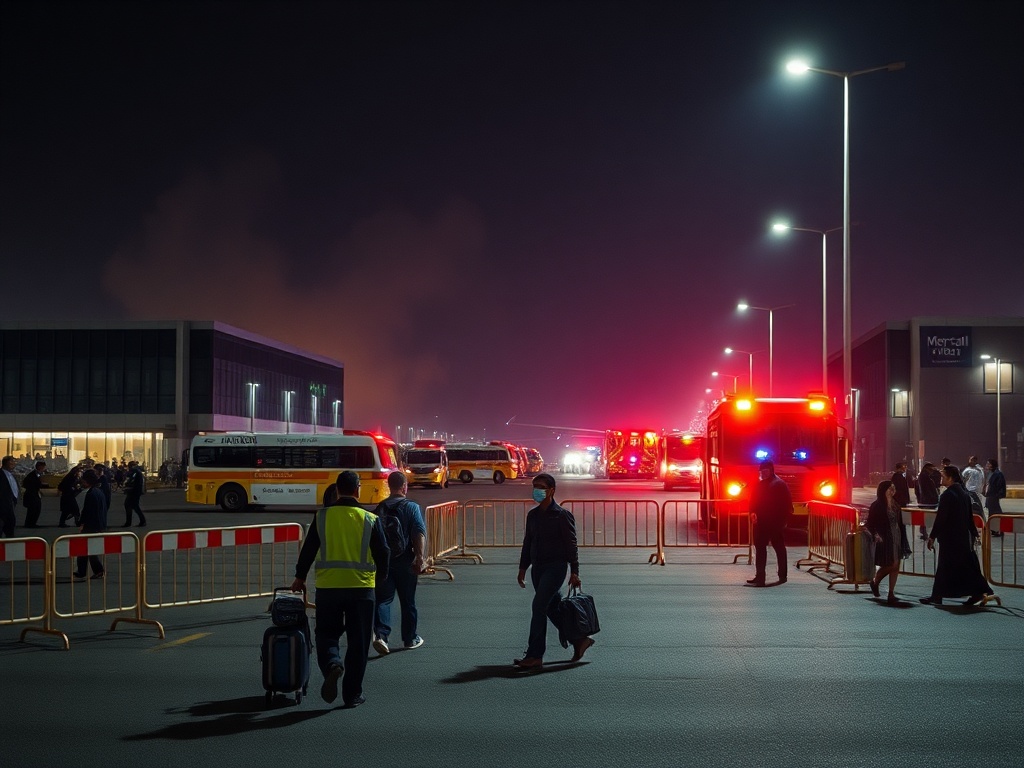
On February 28, 2026, Iran launched a wave of ballistic missiles and drones against the United Arab Emirates in retaliation for coordinated attacks by Israel and the United States targeting Iranian sites that same day. The hard data leaves no space for complacent interpretations: 165 ballistic missiles, 2 cruise missiles, and 541 drones detected. The UAE intercepted most —152 missiles and 506 drones— but what penetrates air defense always finds the right crack: fragments near Abu Dhabi Airport, a Shahed drone hitting Palm Jumeirah close to the Fairmont The Palm, damage from fragments at the Burj Al Arab, and minor disruptions on March 1 at Terminal 3 of Dubai International Airport, resulting in evacuations and personnel injuries. Concurrently, Amazon Web Services reported a fire at a data center in Dubai (mec1-az2) and localized power issues in another availability zone (az3). There were 3 fatalities and 58 injuries, all civilians from multiple nationalities.
A superficial read might suggest Dubai withstood the onslaught. I see something different: Dubai was struck at its value proposition. Because when a city sells itself as a "haven" for global capital, expatriate talent, luxury tourism, and air logistics, the risk tolerance threshold is not that of an average country. It’s a global portfolio that always has options.
Trust Was the Product, and the Product Became Exposed
Dubai does not compete solely with iconic buildings or free trade zones. It competes with an implicit promise: operational predictability. Its status as a "tax haven" and a refuge for the global elite—the central framing of international coverage—depends less on a tax law than on something much more fragile: the expectation of continuity.
Therefore, the reported impacts matter for where they occurred, not just their physical magnitude. Palm Jumeirah and Burj Al Arab are not merely "places"; they are symbols of aspirational security. Dubai International Airport is not just "an airport"; it is a global connectivity machine that supports tourism, business, and international transit. And cloud infrastructure is not merely "technology"; it is the invisible layer that enables seamless financial operations, digital commerce, and corporate services.
In a capital haven, security is not a public expense: it is a component of the business model. The attack made this explicit. A fire in a data center—even if localized—immediately rewrites continuity conversations, redundancy, and regional exposure. The so-called "minor" damage to an airport terminal produces an effect measured not just in delayed flights: it’s measured by the rising risk premiums in insurance, tightening financing costs, paused investment appetites, and the unspoken question in committees: "If it happened once, it can happen again."
There is no need for dramatization to see the mechanism. The city sold minimal friction: simple arrivals, stable operations, low taxes, premium services. The event introduces friction across three layers simultaneously: mobility (airport), experience (luxury hospitality), and digital continuity (cloud). The impact is not on "the economy" in abstract; it’s on the alignment between promise and reality.
Geopolitical Risk Is No Longer External: It Lives Within the Balance Sheet
There is a recurring mistake in boardrooms and investment committees: treating geopolitics as an exogenous variable, a "country risk" managed with a paragraph in the due diligence. This episode pushes the UAE—and particularly Dubai—into a distinct category: direct operational risk on premium assets.
What occurred was not merely a distant military exchange. There was operational causality: interceptions generating fragments, fragments falling in civilian areas, impacts triggering evacuations, which escalates to real interruptions. The mass interception data is a double-edged sword. On one hand, it demonstrates defensive capability. On the other, it confirms that the volume of threats was high enough for the "secondary effects" to become inevitable.
Moreover, the initially declared targets in reports were responses to attacks from the United States and Israel, with Al Dhafra Air Base in Abu Dhabi mentioned among sensitive points. In business language: when allied military infrastructure coexists with civilian hubs that host tourism, aviation, and data centers, the separation between "military theater" and "economy" shrinks.
Here lies a risk regime shift. Previously, Dubai was perceived as a node where capital could park while the world debated. After an attack affecting symbols and critical platforms, the equation becomes more uncomfortable: capital assesses whether a refuge remains a refuge when regional conflict escalates and the city becomes a board.
I don’t need to fabricate numbers to support the point. The news already provides the anatomy of shock: damage to an international airport, impact on luxury hotel operations, and problems in cloud infrastructure. In any business, these three points equate to the triad of continuity: in/outflow, premium income, digital nervous system. When all three intersect within 48 hours, it’s not an incident; it’s a signal.
The Real Issue Is Not the Attack, But the Strategic Response That Will Demand Compromises
The natural reaction of any global hub is to defend its narrative: "We remain open," "Everything’s under control," "The damages were minor." That may stabilize headlines but does not stabilize the system if the threat pattern persists.
The real work begins now, and it’s more unpalatable: rewriting priorities. Dubai built its appeal on a combination of favorable taxation, economic zones, air connectivity, and a brand of premium living. The attack exposes that the next level of competitiveness can no longer be achieved solely through promotion and projects; it must be won with decisions around risk architecture.
This compels political and economic cost decisions. Some are obvious, but not free:
- Real operational redundancy in aviation and logistics: not just contingency plans to evacuate a terminal, but redesigned capacities to sustain flows if the main hub enters cycles of interruption.
- Digital resilience with stricter demands on critical suppliers: the AWS event in Dubai places immediate focus on service continuity, segmentation, failover plans, and communication. For corporate clients, "regional" ceases to be a performance label and becomes a label of exposure.
- Reconfiguration of premium real estate and tourism risk: when a drone hits near an iconic hotel in Palm Jumeirah, the asset not only faces repairs; it faces a conversation about perception, security, and price.
But the hardest part isn't reinforcement. The hardest part is deciding what to sacrifice.
Dubai can try to simultaneously maintain aggressive tourism expansion, the ambition of a tech hub, ultra-luxury real estate growth, and air centrality while also increasing security spending and complexity. That cocktail typically ends the same way: higher fixed costs, more fragile dependencies, and a promise that becomes increasingly costly to fulfill.
The uncomfortable and mature alternative is prioritization. Perhaps it means moderating the pace of expansion in areas where the risk premium no longer offsets. Perhaps it requires tightening the standards of critical infrastructure, even if it slows down deployments. Perhaps it means accepting that certain "fast" capital and high-volume tourism do not justify the added stress on a system that must now operate under threat.
The city that sold ease will have to sell something more complex: ease with discipline. And discipline always includes compromises.
The Right Direction Is to Treat Security as Strategy, Not as a Statement
The headline that inspired this discussion warns about a potential "catastrophic" effect on Dubai's status as a haven and about global ripple effects. That phrase is best understood when translated into business mechanics: when a node concentrates mobile capital, any doubt about its continuity accelerates exits, makes coverage more expensive, and redistributes decisions toward regional alternatives.
There’s no need for the physical damage to be massive for the economic damage to be relevant. In places designed to be magnets of trust, reputational risk is a multiplier. An airport evacuating due to an impact, an iconic hotel with fragments, a data center with a fire: each event is small individually, but together they build a narrative that travels faster than any repair.
The strategic response that matters is not the one that "soothes" but the one that re-engineers. And re-engineering means putting down in writing a hierarchy of priorities: what to protect first, what becomes redundant, what gets decentralized, what is contractually secured with critical suppliers, and what is deprioritized for a period.
This episode also leaves a lesson for non-Emirati companies that use Dubai as a regional platform. Having offices, treasury, digital infrastructure, or distribution centers in a single "efficient" node is tempting. Linear efficiency works until the world shifts phases. When it shifts, the company that survives is not the most optimized but the one that has already paid the cost of duplicating and diversifying.
C-Level executives treating this as a PR incident will underestimate the problem. C-Level executives who see it as a redesign of continuity will emerge stronger, even if in the process they must cut back ambitions and close doors that once seemed comfortable. Sustainable success requires the painful discipline of firmly choosing what not to do because trying to sustain it all at once only accelerates fragility and approaches irrelevance.