
When Discounts Stretch Too Far: Grocery Outlet Store Closures Signal a Safety-Net-Less Expansion
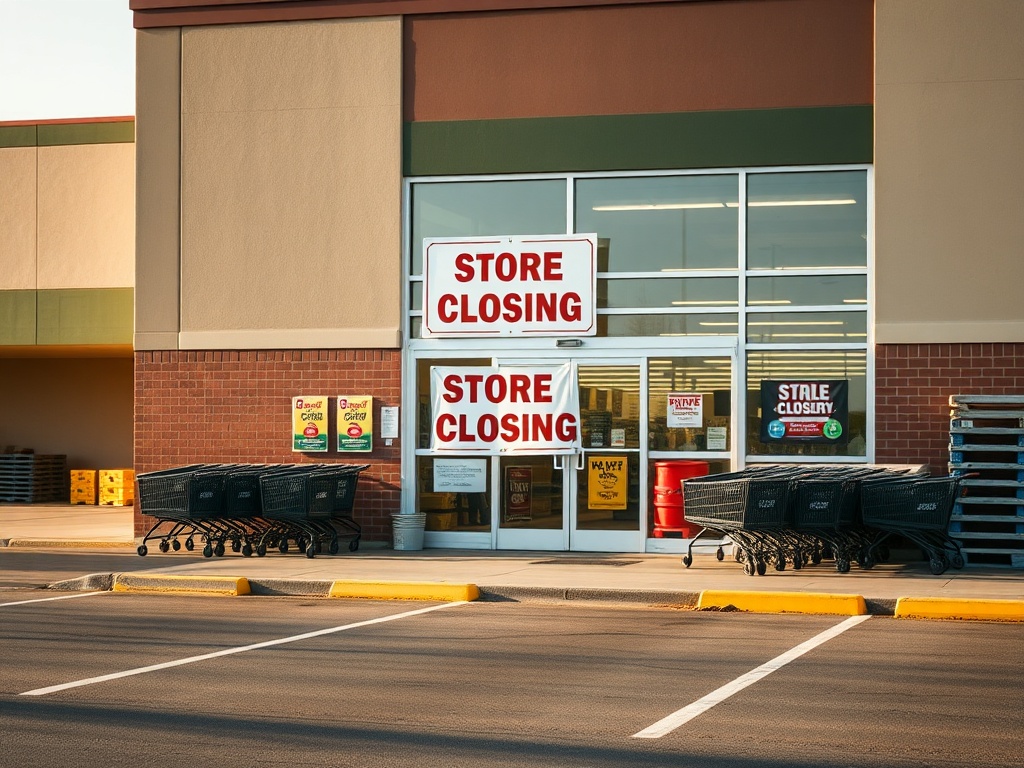
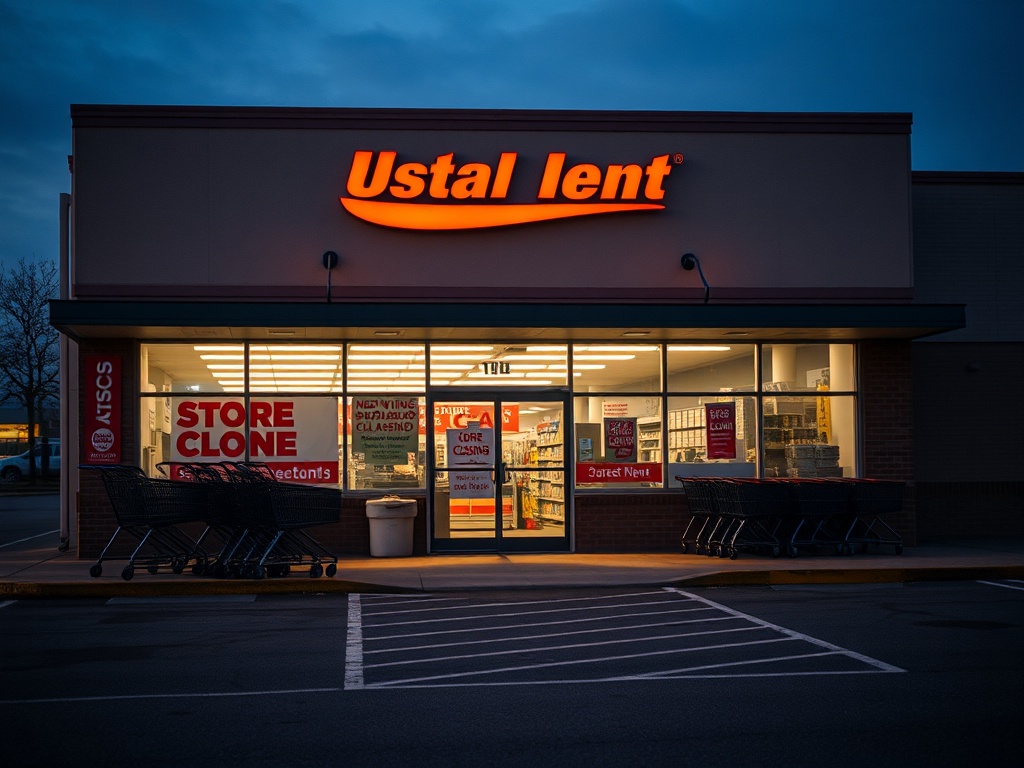
Grocery Outlet, a discount supermarket chain based in Emeryville, California, announced it will close 36 stores before the end of its fiscal year 2026. This represents 6% of its fleet of 570 locations across 16 states. The number is less shocking than its distribution: 24 closures are on the East Coast, accounting for 30% of its 80 stores in that region. The company insists it will not exit any state.
The announcement came during its fiscal Q4 2025 earnings call, revealing the hard financials behind the pivot: quarterly net sales of $1.2 billion (up nearly 11% year-over-year), but comparable sales down about -1%, with fewer units per transaction and declining foot traffic. Even more concerning, the quarter closed with a $235 million operating loss and a $218 million net loss. For the full fiscal year, sales rose 7.3% to nearly $4.7 billion, but the bottom line flipped to a $225 million net loss, compared to a $39 million profit the previous year.
CEO Jason Potter publicly acknowledged that the fourth quarter performance was “unacceptable,” admitting the company “expanded too quickly” and that he is taking responsibility for fixing the issues. CFO Chris Miller framed the plan as an economic correction: they project $12 million of annualized improvement in adjusted EBITDA from the closures, despite expected restructuring costs of $14 to $25 million in 2026 and an additional $4 to $6 million hit to gross margin from inventory liquidation.
For SMEs, this narrative goes beyond food retailing giants. It reveals a pattern: when a business scales without solidifying its social and operational architecture, it loses its “buying reason” precisely when it needs to retain it the most.
The Painful Metric Isn’t the Closure, It’s the Erosion of Value Promise
In discount retail, the core asset is not the store. It’s the perception of value reinforced with each visit. Grocery Outlet stated it plainly: part of the issue was an eroded sense of value, even with competitive base prices. In their model, customers come for the “treasure” of the week, the so-called “WOW deals.” If that sensation diminishes, customers don’t necessarily stop entering but buy less. Quarter data is consistent with that mechanic: units per transaction are falling and traffic cooled heading into January.
This deterioration has a swift accounting effect. A smaller basket negatively impacts operational leverage and makes any supply inefficiencies, shrinkage, or upticks in costs more visible. In a discounter, margin is often a daily discipline, not a cushion to absorb extended mistakes. That's why when management claims that certain stores “do not have a viable path to sustained profitability,” they’re stating something more specific than “they’re not selling”: they’re admitting the format has stopped translating its value proposition into repeatable profit.
Simultaneously, the company projects net sales for 2026 of $4.6 to $4.7 billion and comparable sales between -2% and 0%. It’s guidance that assumes a demanding environment and an ongoing operational turnaround. The market perceived execution risk: after the results, shares hit a historic low and dropped over 20% in after-hours trading.
For an SME, the translation is operational. If customers perceive that your “special offer” has stopped surprising or solving a specific problem, the decline rarely manifests as an immediate total leak. It appears as fewer items per ticket, less frequency, and decreased tolerance for errors. This is the prelude to drastic decisions.
Rapid Expansion Exposes a Classic Blind Spot: Supply Chain Without Local Density
Grocery Outlet attributed another part of its poor performance to supply chain tensions, stemming from improving stock levels and adding range. Theoretically, this sounds reasonable: more availability and variety should boost sales. Practically, in a buying opportunity model, each adjustment to assortment and supply incurs coordination costs. If that coordination doesn't scale in tandem with geographic footprint, the results are predictable: it becomes more expensive to operate, agility is lost, and the in-store experience becomes inconsistent.
Here, the concept that I am keen on auditing emerges: network density. In retail expansion, the “network” is not just a slogan. It is the sum of repeatable relationships with suppliers, operators, logistics, and local knowledge about purchasing habits. A robust network reduces friction, lowers correction costs, and accelerates learning.
The East Coast illustrates the cost of expanding without that density. Closing 24 stores there, without exiting any state, suggests that the issue was not “the East” in the abstract, but the fragility of certain locations or clusters that failed to reach profitable scale or achieve operational consistency. The company, even while closing, plans to open 30 to 33 stores in 2026 using a cluster growth model to gain logistical and marketing efficiency, and remodel 150 locations to a standardized format. This detail matters: it’s an acknowledgment that dispersion kills margin.
For SMEs involved in retail, food, or any business with physical operations, the lesson isn’t “don’t expand.” It’s to expand where continuity of supply and execution can be built, with accumulated local learning. Growing without that network equates to buying complexity on credit.
Social Capital as an Operational Advantage: When Intelligence Resides at the Periphery
Grocery Outlet possesses a component that many chains envy: independently operated stores. This can become a motor for distributed learning, provided the center treats the periphery as a source of intelligence instead of just another point of sale.
The briefing mentioned recent internal initiatives: hiring new executives, ordering guides for independent operators, and focusing on restoring opportunistic mix and in-store experience, with “measurable early improvements.” The leadership is attempting to correct in two areas: recapturing the allure of the “treasure” and professionalizing execution.
The risk is that the correction may become overly centralized, with standardization eliminating local sensitivity. Discount retail relies on subtle signals: what drives customers under economic pressure, which package sizes turn, and which promotions truly change behavior. That information lives in stores and within specific communities.
Social capital is not philanthropy. It’s efficiency. When a company builds trust-based relationships with operators, regional suppliers, and communities, it gains three benefits visible in EBITDA:
1) better conditions and supply flexibility in times of stress,
2) greater speed in correcting assortment and pricing by area,
3) lower turnover and training costs because people want to stay where they feel their knowledge matters.
The news mentions an external factor that hit hard: a drop in EBT sales in November due to a SNAP fund interruption during a government shutdown. This detail is crucial for understanding the segment. If a significant portion of your demand relies on public flows, your model needs to withstand administrative shocks. That tolerance isn’t achieved solely through finances; it’s also through networks: suppliers who adjust, teams that react, communities that sustain traffic.
For an SME, the parallel is direct: when consumption tightens, those who survive aren’t just the ones shouting “low price,” but those with relationships that allow them to maintain service, stock, and consistency without destroying margins.
What This Restructuring Teaches SMEs Growing with Trust Debt
The restructuring presents concrete numbers: charges of $14 to $25 million in 2026, plus inventory liquidation impact, in exchange for $12 million of projected annualized improvement in adjusted EBITDA once the closures are completed. This trade-off reveals discipline but also the sunk costs of prior decisions.
When a company increases sales yet still destroys profitability in a whole year, it signals two common failures: growth with costs that do not decrease through scale and a customer buying less than the model needs. In Grocery Outlet’s case, both elements appear in their explanation: consumer pressure, eroded value perception, supply friction.
For SMEs, the practical application is to build a dashboard that does not fall in love with “openings” or “revenues.” Three metrics often anticipate problems before store closures or restructuring occur:
Grocery Outlet hired Gordon Brothers to market sites and manage subleases in several states, including New Jersey. That move offers another lesson: when entering correction mode, the company needs to convert assets and commitments into flexibility. For an SME, this translates to renegotiating contracts, transforming fixed costs into variables, and maintaining cash for refocusing efforts.
Closing 36 stores is a surgical act. The strategic question isn’t in the scalpel, but in the diagnosis: rapid expansion without a dense local network deteriorates perceived value and escalates execution costs. The mandate for C-Level executives is immediate: at the next board meeting, look at your small table and recognize that if everyone is so similar, they inevitably share the same blind spots, making them imminent victims of disruption.