
Grocery Outlet and the Real Cost of Rapid Expansion: When 36 Closures Signal Financial Restructuring
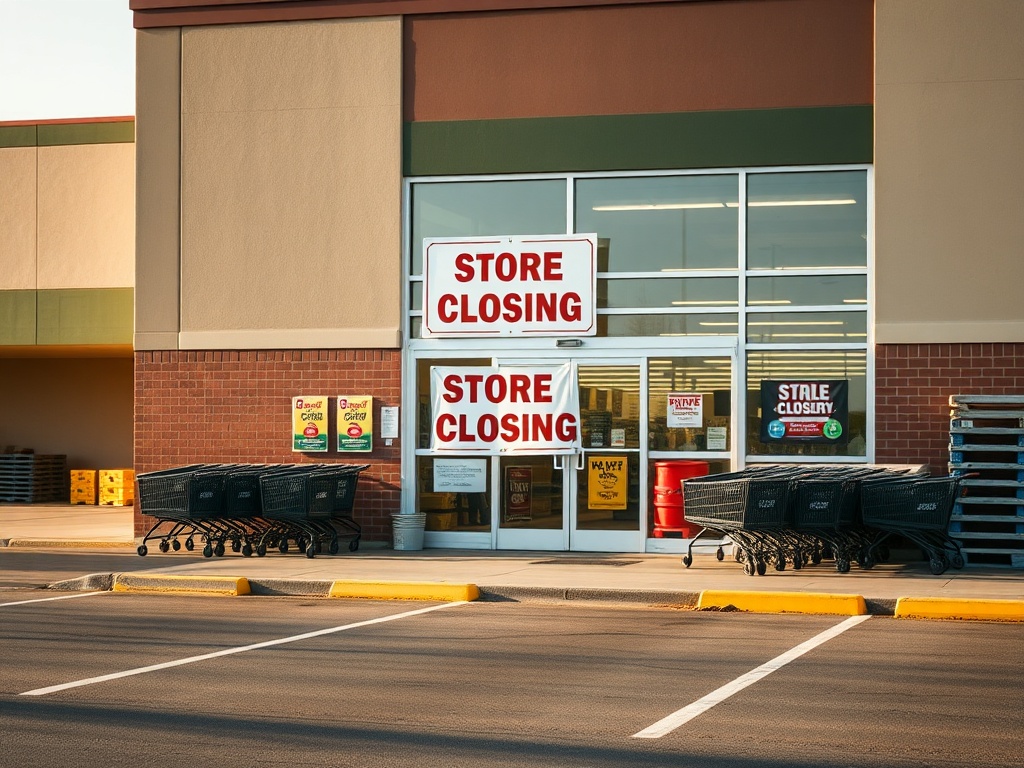
On March 4, 2026, Grocery Outlet Holding Corp. announced the closure of 36 stores—approximately 6% of its network of 570 locations—as part of a plan for "optimization and restructuring" aimed at regaining long-term profitability. The figure sounds surgical, but the underlying issue is financial: sales increasing without translating into cash flow, and a network that, when expanded, raised complexity and costs faster than margins.
Fiscal Q4 2025 (ending January 3, 2026) exposed their struggles: net sales of $1.2 billion (up nearly 11%), but comparable sales nearly -1%, and most troubling, an operating loss of $234.8 million and a net loss of $218.2 million. For the entire fiscal year 2025, the company reported nearly $4.7 billion in sales (up 7.3%) with comparable sales at +0.5%, but ended with an operating loss close to $222 million and a net loss near $225 million. The market reacted swiftly: the stock closed at a historic low of $8.79 on March 4.
What is relevant for SME leaders is not merely the anecdote of a large chain. It’s the pattern: when growth is financed by future promises rather than by recurring customer purchases today, the correction arrives in the form of closures, liquidations, and restructuring charges.
Selling More and Losing More: The Arithmetic Explaining Why 36 Closures "Make Sense"
The most common trap in retail expansion is to confuse sales growth with economic health. Grocery Outlet grew in revenue; however, results show that the cost structure and business execution did not convert that growth into profitability.
The pivotal number is the operating loss. An operating loss of $234.8 million in a quarter with $1.2 billion in sales implies that the business didn’t just “have a bump”; it operated with a significant gap between gross margin minus operating expenses. Without speculating on accounting details, the message is clear: with such a magnitude of loss, the network housed stores that did not contribute to absorbing corporate and logistical costs, or directly exacerbated them.
In this context, closing 36 stores becomes a structural decision: eliminating points of sale “without a feasible path to sustained profitability,” as CEO Jason Potter explained. CFO Chris Miller added the numerical part that matters for a financial director: they expect an annualized improvement of approximately $12 million in adjusted EBITDA once the closures are complete. He also disclosed the cost of executing the plan: net restructuring charges of $14 to $25 million during fiscal 2026 and a negative impact of $4 to $6 million on gross profit due to inventory liquidation.
This combo is typical of a serious correction: costs are paid for exiting—contracts, staff, assets, inventory—to reduce future bleeding. For an SME, the translation is straightforward. When a unit—a store, a branch, a product line—does not cover its own complexity, "growth" ceases to be expansion and turns into a multiplication of losses.
The Blind Spot Wasn’t Price: It Was Perceived Value and Basket Size
The company’s narrative is more interesting than the closure numbers because it identifies a commercial failure with financial implications. Potter attributed the slowdown in comparable sales to three factors: increased pressure on consumer spending, deteriorating perceived value despite competitive prices, and supply chain strain stemming from improvements in availability and assortment. He also mentioned a specific setback: a double-digit drop in EBT sales in November 2025 linked to a disruption in SNAP funding.
In retail unit economics, the core issue lies in this phrase from Potter: customers came seeking value and a “shopping experience,” but left with fewer items per visit because the “weight” of attractive offers and breadth of assortment that drive basket size wasn’t delivered. When the number of units per transaction falls, the income statement stiffens by pure mathematics:
In discount chains, moreover, the value proposition isn’t merely to “be cheap.” It’s to be consistently surprising in offer and assortment. If that consistency breaks down, the discount ceases to be a driver of turnover and transforms into margin erosion without volume compensation.
For SMEs, the uncomfortable practical lesson is: when a customer perceives less value, the first symptom isn’t always a drastic drop in sales. It can be something more silent and lethal: smaller tickets, lower repurchase rates, and more operational friction from inventory that no longer turns like before.
Expanding in Clusters vs. Expanding “Blindly”: Logistics as Disguised Fixed Costs
Of the 36 closures, 24 are in the East Coast, representing about 30% of that region's store count, according to information cited in news reports. The company stated that it is not completely exiting any state and still sees an opportunity for growth in the East, but acknowledged the central diagnosis: “overly rapid expansion.”
Here arises a theme of operational design with financial consequences: in retail, the distance between stores and the density of the network determine whether distribution behaves as an advantage or a burden. Grocery Outlet announced plans to open 30 to 33 new stores in 2026 using a cluster opening model for supply chain and marketing efficiency; these stores would start as company-operated and then transition to independent operators.
This isn’t merely a tactical detail: it signals that the previous expansion likely raised complexity before capturing local economies of scale. When opened “scattered” on a map, the cost of delivering, supervising, stocking, and maintaining standards rises. When opened in clusters, the goal is for a single logistical and commercial node to feed several nearby stores.
In terms of financial architecture, a well-designed cluster transforms part of the operating cost into a more “elastic” cost relative to local volume. A poorly designed cluster turns logistics into a fixed cost demanding constant sales to avoid losing money.
The guideline for an SME intending to grow in new cities or channels is clear: each new location is a new “mini-system” of supply, service, and control. If that system doesn't pay off quickly with real sales, it morphs into operational debt, even if it doesn’t appear as bank debt.
Restructuring Costs, But Staying the Same Costs More: What the 2026 Plan Reveals
The market did not punish Grocery Outlet for closing stores; it punished them for the combination of recent losses and a 2026 guidance acknowledging that the work is more profound. The company projected for 2026 net sales between $4.6 and $4.7 billion and comparable sales between -2% and 0%. That guidance suggests "stabilization" more than "rebound."
Moreover, restructuring isn’t free. Between $14 and $25 million in net charges, plus $4 to $6 million in liquidation impact, there’s acknowledgment that part of the adjustment is paid with cash or future profitability. Still, the logic is sound if the alternative was to continue operating stores without a path to profitability.
In parallel, the plan includes 150 remodels during 2026 and the continuation of openings. This combination—closing, remodeling, opening—only works if the company achieves two things simultaneously:
1. Recover productivity per store, particularly in basket and turnover.
2. Prevent growth from reintroducing structural costs faster than margins.
In the context of the sector, this action isn’t isolated. Reports indicated that in 2025 8,100 establishments closed in the U.S. (according to Coresight Research, cited in the coverage), and other chains like Kroger announced closures. This wave of closures is not a “trend”; it’s a consequence of a more pressured consumer, more aggressive promotions, and operational costs that aren’t dropping at the pace of demand.
An SME does not have the "cushion" of 570 stores to absorb regional mistakes. Therefore, it must operate with an even stricter discipline: every expansion must come with an explicit path to positive cash flow per unit and defined exit triggers before entering.
The Discipline that Separates Expansion from Burnout in SMEs
The case of Grocery Outlet is not a story of failure due to lack of sales; it is a story of misalignment between growth, perceived value, and cost structure. Potter said it frankly: fourth-quarter results were “unacceptable” and took responsibility. Miller indicated the expected improvement figure: $12 million in annualized adjusted EBITDA from optimization. This acknowledges that profitability isn’t regained through narrative; it is recovered by removing structural losses.
For an SME, the equivalent of “closing 36 stores” is usually less dramatic but equally decisive: closing a branch, eliminating a product line, ceasing pursuit of unprofitable customers, or halting geographic expansion until the core starts generating cash again. The goal isn’t to become conservative; it’s to become financially sustainable through operations.
The most practical way to interpret this episode is as a reminder of control: when a customer reduces units per purchase, the business stops financing its complexity; when the business stops financing itself with its customers, expansion turns into a dependency on adjustments, restructuring, and external capital. Ultimately, the only validation that preserves survival and control is that the operation is paid for by cash from customers.