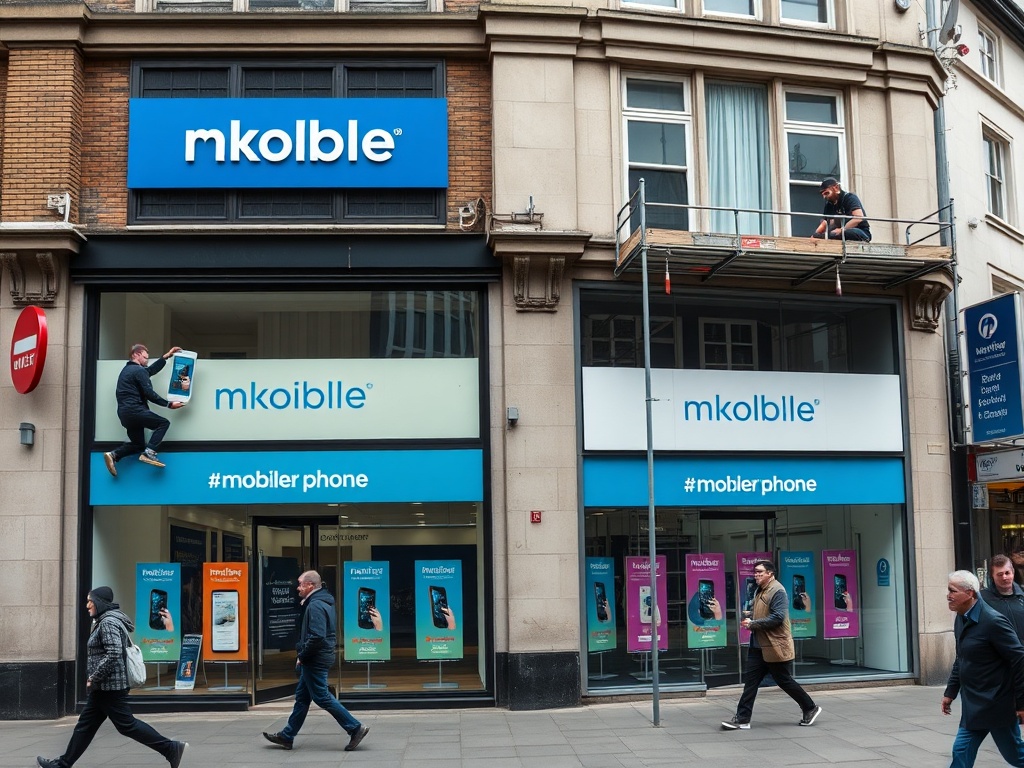

VodafoneThree Merges Stores While Betting £11 Billion on a Single Direction
On May 31, 2025, Vodafone UK and Three UK officially closed their merger and created VodafoneThree, suddenly managing nearly 29 million subscribers in the UK mobile telecommunications market. The immediate market reaction focused on the most visible headlines: the combination of physical stores on the high street. However, focusing solely on the storefront is precisely the analytical mistake made by those who confuse tactic with underlying direction.
The merger had been brewing since 2023 when both companies announced their plans under the watchful eye of the UK Competition and Markets Authority (CMA). The CMA completed a Phase 1 investigation between January and March 2024, concluding that the operation could significantly reduce competition, risking price increases and lower network investment. It wasn't until December 2024, after imposing legally binding commitments on 5G rollout and consumer price protection, that the CMA finally gave the green light. What followed was not just a logo change on storefronts.
Store Consolidation is a Symptom, Not the Decision
When VodafoneThree announces that it will combine its physical outlets into multi-brand format locations, retail analysts interpret it as a sign of reduced operational costs. They are correct in their immediate diagnosis, but they miss the deeper reading. The real decision was made before the first store even closed: the company’s available capital cannot flow toward two simultaneous priorities without weakening both.
VodafoneThree has committed to investing £11 billion in 5G infrastructure over the next decade, with £1.3 billion in capital expenditure in the first year alone post-merger. Those figures do not support a duplicated and fragmented retail network split between two overlapping brands in each city. The release of operational costs in stores is not an end in itself: it is a necessary condition for capital to flow toward where the company has decided its long-term competitive advantage lies, which is network infrastructure.
The fact that reinforces this reading is the magnitude of the coverage problem the merger promises to solve: 16,500 square kilometers of coverage gaps eliminated before the end of 2025, an area equivalent to ten times the size of London. This isn't financed by good intentions. It is financed by sacrificing other items. Store consolidation is one of those sacrifices.
The argument that stores contribute £168.5 million annually to the UK economy through customer traffic in their vicinity is a point the company cleverly uses to manage public narrative. Highlighting the economic impact of nearby retail is, in this context, a way to present consolidation as responsible, not as a retreat. Yet, the economic impact of a nationwide 5G network vastly surpasses any contribution from retail formats.
The Structure of the Operation Reveals Who Bears the Real Risk
Vodafone Group controls 51% of VodafoneThree, while CK Hutchison Group Telecom Holdings (CKHGT) holds the remaining 49%. This share distribution is not cosmetic. It defines who has the decisive vote in capital allocation decisions when tension arises, and it will.
The financial profile of the operation is, in the short term, deliberately negative. The company projects a dilution in its adjusted free cash flow of €200 million on a proforma basis for fiscal year 2026. The turning point towards generating net value doesn’t occur until fiscal year 2029. Therefore, there are four years of controlled value burning before the projected annual cost and capex synergies of £700 million for the fifth year post-merger begin to materialize.
This is not a problem of mismanagement. It is the deliberate structure of any large-scale infrastructure gamble. But it has a direct implication for understanding store consolidation: every pound not spent on duplicated retail is a pound available to sustain that four-year interval without destroying the balance sheet. Discipline in retail is not savings; it is the condition that makes the 5G bet possible.
The fact that the store transformation is announced without layoffs directly linked to the consolidation is noteworthy. Maintaining the workforce through reassignments and natural attrition has a higher short-term cost than mass layoffs, but it generates two specific operational advantages: it preserves institutional knowledge during integration and reduces regulatory exposure at a time when the company operates under binding commitments with the CMA. That decision is not generosity; it is risk calculation.
When Scale Forces Choice, Not Coverage
The UK telecommunications market has a structure that leaves no room for the center. EE and O2 operate with scale and consolidated presence. Before the merger, Vodafone and Three were the third and fourth operators, respectively, competing in a segment where neither had the critical mass to finance the infrastructure required by 5G without compromising profitability. The merger is not a story of expansive ambition. It is a response to a threat of irrelevance due to insufficient scale.
What is presented as business strength, 29 million subscribers who will automatically access shared network coverage in the months following the merger, with data speed improvements of up to 20% for Three and SMARTY customers in the first two weeks of network sharing, is actually the operational justification for having abandoned the maintenance of two parallel retail structures, two duplicated management teams, and two overlapping supplier networks.
The pattern emerging from this operation is that of a company that has clearly identified where its sustainable advantage lies, national-scale network infrastructure, and has organized all its structural decisions to protect that wager. Store consolidation, shareholding structure, consciously accepted cash dilution profile, retention of staff without related layoffs: these are pieces of the same decision architecture.
The C-Level That Does Not Feel the Weight of What It Abandons Has No Strategy
The leadership of VodafoneThree has taken a position that very few executive teams have the discipline to maintain under pressure: it has chosen not to optimize the short term to preserve the coherence of a ten-year bet. This means accepting four years of unfavorable cash metrics, an uncomfortable public narrative about reduced physical presence on the streets, and managing a period of integration where coordination errors are costly.
Leaders who avoid such resignations do not do so out of incompetence. They do it because incentive systems, quarterly reporting cycles, and pressure from minority shareholders penalize present pain even as they buy future value. VodafoneThree has structured its operation to force that discipline from the very architecture of the company.
The lesson for any C-level executive observing this operation from the outside is this: strategic coherence is not declared in investor presentations; it is demonstrated in the willingness to accept deteriorated metrics for as long as the transition to the chosen position lasts. Trying to maintain an intact retail network, a parallel network structure, and investment in 5G simultaneously would have produced not three strengths. It would have produced three half-funded weaknesses. A leader who cannot precisely point out what they have stopped doing to enable what they have chosen to do is not executing a strategy; they are managing an agenda.