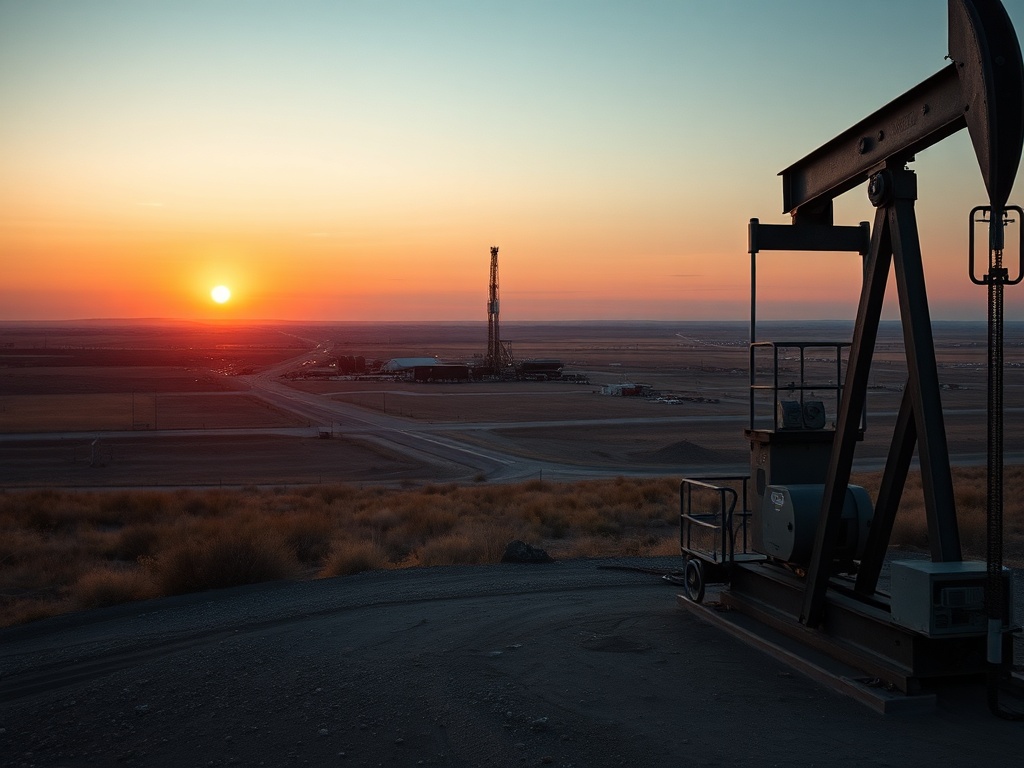

It's tempting to view the decline in U.S. crude imports as merely a victory for energy security. However, the reality is more complex and useful for an executive committee: when an economy stops relying on foreign barrels, it doesn’t eliminate risk; it relocates it. In this shift, there are winners and losers often overlooked in the overall assessment.
A note from Fortune, dated March 10, 2026, describes the cultural and economic break that began in the early 2000s, encapsulated by the old rallying cry ‘drill, baby, drill,’ contrasting sharply with decades when the country sent “billions” abroad to producers in the Middle East, Africa, and Latin America. Supporting data is compelling: crude imports peaked at 10.126 million barrels per day in 2005 and, despite a slight uptick, stood at 6.588 million barrels per day in 2024, approximately 35% below the peak. Concurrently, the crash in OPEC-related purchases marks a structural change in the supply mix, rather than just a cyclical dip.
From my lens of social business, the relevant question isn’t whether this trajectory is “good” or “bad” in abstract terms. The accurate audit concerns: what model of value creation emerged, who captures margins, and who bears environmental and social costs—and how that landscape transforms when sustainability shifts from being a report to an operational constraint.
Fewer Imports Do Not Mean Less Exposure; It Means Different Exposure
The drop in imports is a verifiable fact, as noted in EIA series cited in the briefing: in 2005, the U.S. was importing around 10 million barrels per day; by 2023, this fell to 6.478 million barrels per day, and in 2024 to 6.588 million. This difference is not a footnote: at high crude prices, it implies that a significant portion of energy expenditure stays domestic, circulating within its own value chain.
In peak dependency years, the risk was primarily exogenous: supply interruptions, maritime routes, regional conflicts, cartel decisions. Fortune connects this backdrop with tensions such as a potential escalation with Iran, emphasizing that reduced dependency lowers vulnerability. In management terms, that is true only to a point.
By replacing imports with domestic production, risk becomes endogenous and manifests in four fronts that a CFO immediately recognizes:
- Marginal cost and volatility: the shale industry reacts quickly but also cools down quickly. Domestic supply buffers geopolitical shocks but remains tied to pricing cycles.
- Regulatory risk: licenses, land access, drilling and water rules. ‘Drill, baby, drill’ isn’t a technology; it’s a political coalition that can change.
- Infrastructure and bottlenecks: pipelines, refining capacity, logistics. Reduced imports do not eliminate physical constraints.
- Social license: when impact hits home, conflicts with communities, workers, and local governments escalate faster and become costlier.
Mature sustainability reading doesn’t celebrate or condemn; it accounts. Energy independence resembles less of an exit and more of an internalization. When a country internalizes, companies become more exposed to their own environmental and labor performance.
Shale as a Cash Machine and a Generator of Externalities
The shale narrative is explained by technology and execution: hydraulic fracturing and horizontal drilling, booming from 2008 onward, enabled volume. The briefing emphasizes that there is no single "announcement" causing this; it’s an accumulation of advancements and market conditions. This matters because, if there’s no switch, there’s also no “clean reversal”: change happens in layers.
From a value perspective, the effect is direct: less import means less currency outflow, and that cash is redistributed among producers, refiners, transporters, states, and consumers. For an economy, this redistribution can improve the trade balance and resilience.
For sustainability, the blind spot is different: if the chain strengthens without strict accounting for environmental costs, private margins grow while public costs accumulate. I don’t need to invent figures to affirm the mechanism: shale is intensive in water use, truck movement, land occupation, and emissions associated with production and transportation. When these costs don’t reflect in final pricing, they become an implicit subsidy paid by communities and health systems.
The corporate question isn’t moral; it’s contractual. How much of that cost ends up in litigations, delays, insurance premiums, permitting restrictions, and loss of productivity due to labor turnover? In a market where the “social license” has become a condition for operation, ignoring externalities is an expensive strategy.
What Fortune describes as “something different” since the early 2000s is also this: the U.S. replaced external dependency with tougher internal negotiations. The companies that will best navigate this decade are those that convert environmental risks into operational discipline: measurement, prevention, and transparency—not as a gesture but as loss control.
Corporate Sustainability Is Not Achieved by Domestic Barrels; It's Achieved by Cost Architecture
A common mistake in boardrooms is treating “domestic energy” as equivalent to “secure energy” and, by extension, “responsible energy.” The decline in imports may reduce one type of geopolitical exposure but does not automatically transform the industry into a sustainability-aligned actor.
The briefing presents two useful signals for financial conversation:
- The import price index for fuels and lubricants (base 2000=100) is at 242.7 in December 2025, confirming that price volatility remains alive even in a world with reduced reliance on imported crude.
- The import levels stabilize around 6.5 million barrels per day in 2023-2024, suggesting that the “easy descent” has already occurred and the system has entered a phase of optimization, not automatic transformation.
In that phase, competitive differential is decided in cost design and quality of corporate governance. Practically speaking, energy companies and those heavily reliant on energy can act in three lines which do indeed provide economic returns:
1) Contracts and hedging with resilience logic. If the input remains volatile, the goal is to minimize surprises in cash flow, not to guess prices.
2) Efficiency and electrification where returns are measurable. Not for narrative, but for CAPEX with reasonable payback periods and lower exposure to the import index.
3) Impact control as a risk control. Operational monitoring and safety and environmental standards that reduce shutdowns, penalties, and community conflict.
This is the part many avoid due to discomfort: sustainable growth is not dependent on eternal subsidies or reputation campaigns; it relies on having clients pay and on the model enduring audits. Oil independence has enlarged the space for capturing value domestically. That same expansion raises the obligation to distribute value without turning territories and workers into disposable inputs.
The New Geopolitical Landscape Rewards Those Who Invest in Transition with Discipline
The briefing notes that as OPEC-linked imports decline and exposure to the Persian Gulf reduces, the U.S. mitigates part of its vulnerability to external shocks. It also highlights that the country operates with greater export capacity, and since 2019, the net balance of oil and products has become more favorable.
For business leaders outside the energy sector, this has a concrete consequence: energy ceases to be merely a risk of interruption and becomes a risk of reputation and compliance. The chain is closer, more observable, and more litigable. Simultaneously, the energy transition progresses with a portfolio logic: no large company bets its continuity on a single source.
What’s ahead isn’t a decreed “end of oil” from a podium. What’s ahead is an economy where capital costs, insurance policies, permits, and talent respond to the credibility of the plan. A country can import less crude and still lose competitiveness if its companies don’t control emissions, water, and field safety.
The best executive usage of this news is to use it as a mirror. If your company celebrated energy independence as an excuse to postpone transition, it’s trapped in the past. If it views it as a window for orderly investment, it can win twice: stable supply today, and reduced regulatory risk tomorrow.
A Mandate for C-Level on the Model They Are Building
The drop in imports from the peak in 2005 to the levels of 2024 has reshuffled the political economy of energy in the U.S. It created domestic margins, reduced certain geopolitical exposure, and shifted the center of conflict inward. This is the ground where sustainability is defined as business, not as a slogan.
The mandate for C-Level executives is to perform a cold audit of the value they create: to decide whether their model uses people and the environment as inputs to generate money, or whether it uses money as fuel to elevate people while protecting the territory that makes their operation possible.