
Quest Resource and the Quiet Shift in Recycling Towards Data
Quest Resource closed 2025 with annual revenues of $250.2 million, a 13.3% decrease compared to the previous year, and a fourth quarter that was even weaker, generating $58.9 million, a 15.8% year-over-year decline. However, this straightforward reading fails to capture a deeper shift in the waste and recycling business.
Behind the numbers lies a quiet turn: competition is no longer solely about operational capacity and commercial strength; it is shifting towards orchestration capability. Companies that manage data, suppliers, environmental compliance, and sustainability reporting effectively are capturing a larger share of the customer budget, even as volumes decline. Quest, a national waste and recycling service provider, is navigating a tough macroeconomic cycle with industrial clients producing less volume; nonetheless, it shows selective improvements in margins, losses, and debt structure. This contrast deserves a strategic examination.
Less Volume, More Operational Discipline
In the fourth quarter of 2025, Quest reported a gross profit of $9.1 million and a gross margin of 15.5%, slightly above the 15.3% from the same quarter the previous year, despite the decline in revenue. This detail is more important than it seems: in services, when volume decreases, margins typically contract due to negative operating leverage. Here, the opposite is happening, if only marginally.
Another noteworthy detail is the improvement in quarterly GAAP results: Quest closed Q4 with a GAAP net loss of $1.7 million, compared to a loss of $9.5 million in Q4 2024. This is not a final victory, but it indicates control and prioritization. Simultaneously, adjusted EBITDA rose to $2.1 million from $1.7 million. For the full year, adjusted EBITDA fell to $9.3 million from $14.5 million, confirming that the environment remains challenging.
The executive summary is clear: Quest is trying to maintain operational profitability in a business exposed to industrial cycles. Management attributes the impact to lower volumes from large industrial clients, while simultaneously reporting advances in operational efficiency. This dual approach aligns with a smart survival strategy: if demand cannot be controlled, then controlling costs, service mix, and execution becomes paramount.
In corporate sustainability, this tension is common. Waste management budgets often operate as “inevitable expenses”; when the client goes into cost-cutting mode, they renegotiate fees and reduce activities. A provider that has systems, data, and governance to demonstrate performance and compliance maintains its position more effectively. Here, the margin indicates that Quest is attempting to migrate from pure volume to a more managed operation.
The Balance Sheet as a Weapon in a Market That Punishes Rigidity
The most defensive move of 2025 was financial, and it was substantial. Quest reduced debt by $13.2 million over the year, a 16.4% decrease from 2024 closing levels, including $2.0 million in just the fourth quarter. In a year of declining revenues, such reductions do not happen by accident: they require cash prioritization, capital discipline, and operational decisions that avoid the temptation of buying growth.
At the same time, it refinanced its ABL credit facility with Texas Capital Bank and negotiated covenant easements until 2027 on its term debt. For a CFO, this is a breath of fresh air: greater covenant flexibility reduces the risk of falling into technical defaults just as the cycle turns negative. CFO Brett Johnston frames this as a search for proactive measures to improve financial costs and gain flexibility while profitability and cash flow initiatives mature.
From my perspective, there is a central idea: corporate sustainability is not just measured in recycled tons; it is determined by the financial architecture that allows service continuity when the environment contracts. Environmental services companies have a critical operational responsibility to their clients, and financial rigidity often breaks that continuity.
It is also an uncomfortable reminder for the sector: when demand falls, debt becomes an accelerator of fragility. Quest, with annual GAAP losses of $15.4 million (almost the same as in 2024), needed time and leeway to implement adjustments without being caught by the banking calendar. The refinancing and extended covenants are part of that time-buying strategy.
Surgical Organic Growth and the Battle for Customer Budget
In the same communication, the company highlighted three business vectors: significant expansion with an existing retail client, onboarding a new full-service restaurant client, and expanding “share-of-wallet” with two large clients. No figures were provided for these contracts, so extrapolating financial impact is not appropriate. But the pattern is discernible.
When a provider talks about share-of-wallet, it indicates that the battle is no longer just about winning new accounts, but rather about capturing more categories within the same client: more locations, more types of waste, more reporting services, and enhanced supplier management. This movement aligns with a market where clients seek less complexity and more traceability.
There is a strategic reason for this to be particularly relevant in sustainability. Large corporations are pressured to report and demonstrate environmental performance, which often gets fragmented among multiple operators and contractors. In that chaos, value lies not just in waste removal but in turning the system into a dashboard: what is generated, where it originates, how it is managed, what gets recycled, what is diverted from landfills, and how it is documented.
Quest presents itself as a provider that builds specific “single-source” solutions for clients, delivering quantifiable business and sustainability outcomes. This phrase, if executed correctly, means that the core product is not the container or the route, but the capacity for coordination and measurement. When industrial volumes decline, this layer of control can sustain revenue: fewer tons but more management.
There is also a nuance of power. The waste sector has historically favored players with scale. However, when coordination and data gain importance, spaces emerge for more agile, integrative, and specialized operators. If Quest can convert its operational efficiency into a proposal for control and compliance, it will compete less on price and more on continuity.
Recycling Enters a Digital Phase, Changing Who Captures the Margin
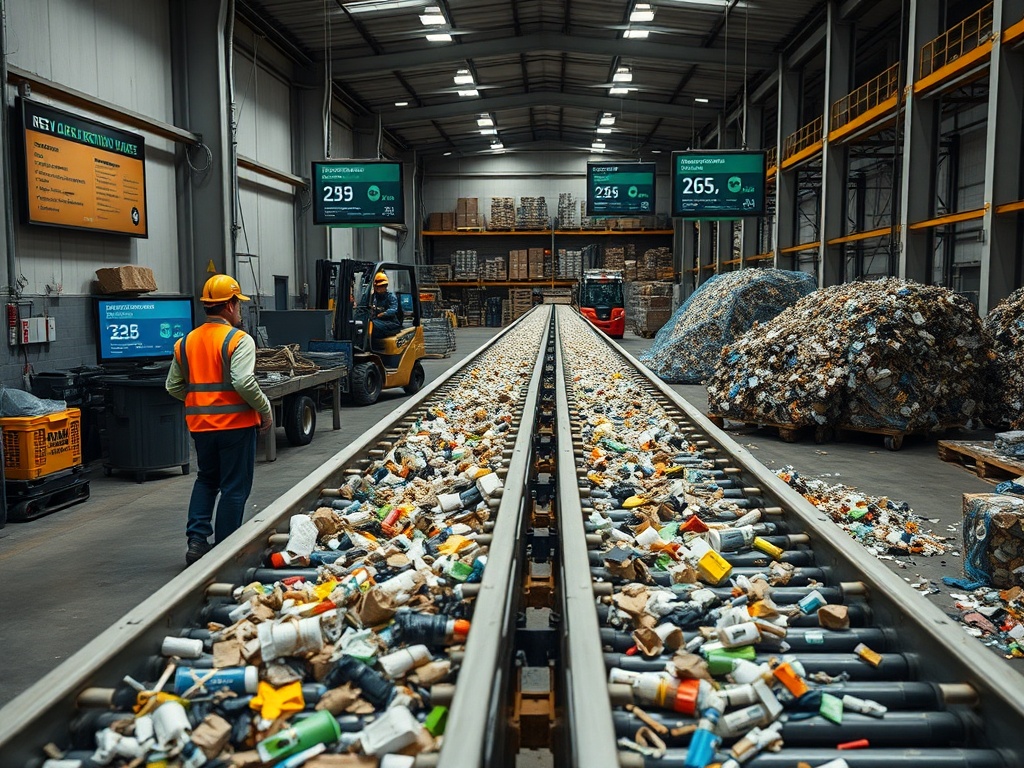
I view this moment as a transition in which the waste business is increasingly behaving like an information business. Here, digitalization is not an accessory; it is the mechanism that transforms an operational activity into a management platform.
The pattern reflected in Quest’s results is typical of an industry in a phase of adjustment: revenues drop due to volume, but margin is pursued through efficiency and mix. Simultaneously, the balance sheet is strengthened to survive the cycle. This combination often appears just before a redistribution of power: the client reduces suppliers, standardizes, demands reportability, and rewards those who deliver control.
There’s no need to romanticize technology to understand this. Digitalization in waste and recycling has a straightforward effect: it lowers the cost of coordination, auditing, and reporting. When that cost decreases, it becomes profitable to offer services that were previously “non-billable” or too manual. In this context, competitive advantage shifts from relying solely on contracts and routes to being based on processes, data, and the ability to demonstrate performance.
Quest claims it is taking “significant and comprehensive” actions across all functions and expresses confidence in an improved outlook for 2026. At the market level, this confidence makes sense only if the model becomes less dependent on pure industrial volume. The annual decline in revenue and adjusted EBITDA signals that the cycle is still dominant; however, the improvement in margin, the reduction in debt, and the focus on account expansion indicate that the company is building resilience.
I conclude with a phase reading: the sector is in the digitalization and dematerialization of value, where margin migrates from physical operation to measurement, compliance, and coordination. Technology must reinforce this transition by empowering human judgment and democratizing access to environmental performance data with operational traceability.