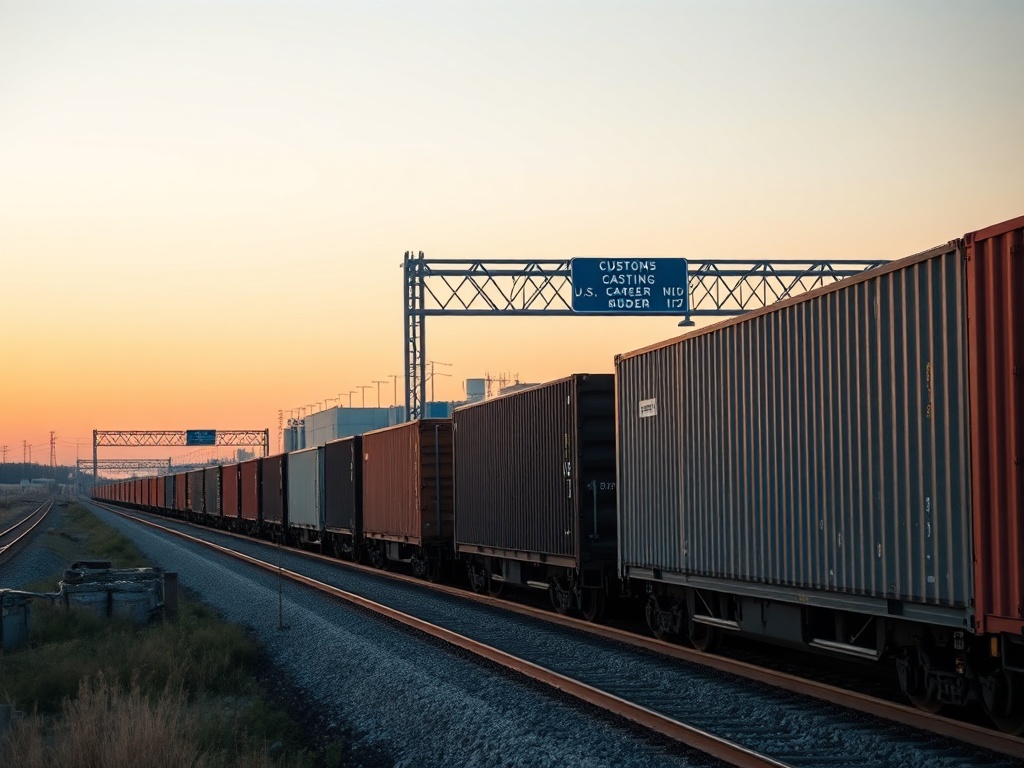

The Real Risk of the USMCA 2026: The Tariff Issue is Not the Only Concern
On July 1, 2026, the USMCA will undergo its mandatory six-year review. On paper, it is a mere procedural step. In practice, however, Scotiabank calls it "the single most consequential macro uncertainty" for Canada in 2026 because the outcome will not only define tariffs but also the level of confidence in making long-term commitments: new plants, supply contracts, inventory localization, corporate debt, and even the appetite for cross-border mergers.
Scotiabank’s report outlines a benign baseline scenario: renewal or extension with limited adjustments. However, what is critical is what follows; it assigns probabilities to less favorable outcomes and models severe impacts if the United States decides to impose tariffs on Canadian exports. In their breakdown, they allocate 10% probability to a renewal by July 1, 2026, 42.5% probability to a renewal before the mid-term elections, 37.5% probability to a period of annual reviews, and 10% probability to a withdrawal. This structure is more significant than the headline. An economy doesn't fracture due to a sudden strike; it unravels from living too long in anticipation of that strike.
The typical C-Level perspective focuses on “how high the tariff might be.” This approach is comfortable as it allows businesses to proceed with the same strategies: cutting costs, renegotiating with suppliers, hedging currencies, and crossing fingers. My thesis is more uncomfortable: the central strategic risk is not the tariff itself but the institutionalization of doubt. A decade of annual renewals, with the agreement technically alive but politically unstable, renders a strategy based on operational continuity irrelevant.
The 2026 Review Turns Trade into a Tool of Pressure, Not a Highway
The USMCA came into effect on July 1, 2020, and its Article 34.7 mandates a joint review on July 1, 2026. If the three countries agree, the agreement extends 16 years until 2042 and is reviewed again in 2032. If they do not agree, a sequence of annual reviews begins in 2027, potentially ending in expiration on July 1, 2036. The mechanics are surgical: there is no need to break anything immediately to make everything more expensive.
Scotiabank quantifies that ambiguity. The annual review scenario (37.5%) is a purgatory with real costs: the agreement continues to exist, but capital stops behaving as if it were. North America’s integrated manufacturing, which operates on synchronicity and predictability, suffers more from administrative volatility than from specific tariffs. A supply chain isn’t redesigned just because of a temporary 10%; it is redesigned when the board can no longer defend a large investment with a regulatory framework that reopens each year.
US policies have already activated their own clock. The Office of the U.S. Trade Representative opened a period for public comments on September 16, 2025, and must report to Congress by January 2, 2026. Furthermore, the reference to temporary tariffs under Section 122, which are exempt for USMCA but expire on July 24, 2026, adds tactical incentive: the tariff is not only a revenue tool but also leverage.
In this context, companies treating the USMCA as an "external factor" are embracing a fiction: that trade will remain neutral infrastructure. It is not. Trade is being reconfigured as a tool to negotiate non-trade issues, and that transition alters the power map. Those who win are not necessarily the most efficient; they are the ones who translate uncertainty into design and design into new demand.
Pricing the Tail Risk Shifts the CEO Agenda: From Efficiency to Exposure Control
Scotiabank runs stress tests with two scenarios. In the first, “disruptive but contained,” a 10% tariff on currently exempt goods under USMCA results in a 0.6% GDP decline for Canada, unemployment rises to 6.5%, and the Canadian dollar depreciates by 1%. In the second, “severe,” a 35% tariff on Canadian goods, with energy and potash at 10% (effective 15% taxation on total exports), leads to a 1.9% GDP contraction, unemployment at 7.1%, a 50 basis point cut from the Bank of Canada that does not make up for the shock, and a 1.5% depreciation of the CAD. For the United States, the macro damage is smaller, at -0.3% GDP, but with a cost that hurts in Washington: +0.3pp in PCE inflation, prompting the Fed to increase rates by 25 basis points.
The most strategic data is hidden in that asymmetry. If the cost concentrates on Canada while the political cost in the U.S. manifests more as inflation than activity, the negotiating incentive becomes distorted. Public conversation will become contaminated with pricing and electoral narratives. And when the conversation turns electoral, the calendar becomes paramount. Companies reliant on "normality" lose years.
Here lies the corporate trap: responding with more internal sophistication. More models, more scenarios, more consultancy, more reports. That over-servicing reassures the organization but does not buy resilience. Resilience is purchased by reducing variables that amplify damage and creating offers that the tariff cannot easily capture.
I translate this into portfolio decisions, not theory.
- Eliminate blind trade dependency disguised as efficiency: contracts that reward volume to a single market, product designs that force specific border crossings, and tax structures that collapse if a treaty changes.
- Reduce unnecessary complexity: too many SKUs, too many imported components, too many cross-border assembly steps for historical reasons, not for buyer value.
- Increase control over exposure: visibility of origin and traceability to reconfigure routes, and contractual capability to move production without overhauling the company.
- Create demand where customers pay for continuity, not for standard products: service and operational guarantees, inventory as-a-service, local configuration, maintenance, and regulatory compliance as part of the package.
When the market goes into "annual review mode," value shifts from unit price to supply continuity. And continuity, well-packaged, ceases to be a cost and becomes a product.
The Most Exposed Sectors are Not the Most Fragile: They are the Most Replaceable
Scotiabank identifies sector vulnerabilities in Canada: electrical equipment, transportation, manufacturing, computers, chemicals, machinery, and plastics. The underlying pattern is uncomfortable: these categories have low U.S. import dependence but high Canadian exporter dependence on the U.S. market. It’s not a competitiveness problem; it’s a bargaining power problem.
This is where many executive teams misidentify the enemy. They compete against the “competitor” when the real risk is being an interchangeable supplier on the spreadsheet of an American purchaser. If the customer can substitute you, the tariff kills you even before it is implemented, because your client uses the threat to renegotiate prices, timelines, and inventory responsibilities.
The report also breaks this down to capital markets: on the TSX, GICS sectors with significant revenue exposure to the U.S., 50% to 70%, include Health, Information Technology, and Real Estate, while Communication Services and Consumer Discretionary appear more isolated. This isn't a moral ranking; it’s a sensitivity map. In a world of prolonged uncertainty, the multiple compresses not just due to margin but also as a result of revenue model fragility.
The typical response is to “diversify markets.” That sounds good, but it is often an empty promise if it means replicating the same product in another geography with different compliance and logistics. The most potent move is another: make yourself hard to replace without becoming expensive. That can be achieved by shifting the object of purchase.
Instead of selling a part, you sell availability. Instead of selling a component, you sell integration and certification. Instead of selling volume, you sell disruption reduction. This allows for two simultaneous things: charging for real value while reducing structural costs by eliminating unnecessary variety and rework. It’s a product design strategy, not a communication plan.
The Winning Strategy in 2026 is Not “Surviving the Treaty”: It’s Redesigning the Offer So That the Treaty Matters Less
Scotiabank concludes that the base case is renewal or extension, yet it still insists on pricing the tail risks. This combination is the message: the market does not need panic; it needs architecture.
If the aggregate probability of eventual renewal exceeds half, as suggested by the 52.5% chance of renewal before the mid-terms plus the possibility of subsequent renewal, many teams will remain still, waiting. That passivity is a bet with hidden costs: every quarter without an offer redesign strengthens the buyer’s position, who does have alternatives. In contrast, the period from 2025-2026 opens a window for reconfiguration without the chaos of an already materialized break.
The smartest companies will treat the review as an audit of their value curve. They will cut industry rituals that no longer buy preference and that also increase tariff exposure: excessive variants, excessive border steps, excessive dependence on a single broker. They will shift resources toward what truly buys preference even amid geopolitical noise: performance-based contracts, regulatory adaptability, and services that transform the customer’s uncertainty into a solved issue.
This is not strategic romanticism. It’s mathematics. In severe scenarios, Canada faces a deeper recession than the U.S., and the currency partially cushions the blow with the CAD depreciation. That cushioning is not a business plan; it’s an airbag. The plan is to design a value proposition that works amid turbulence, not one that denies it.
Real leadership in 2026 will be evident in one thing: who validates on the ground, with customers and contracts, which parts of their offer remain payable under uncertainty and which were merely corporate tradition. The C-Level executive who burns capital to fight for price in a politicized trading corridor ends up competing for scraps. Those who eliminate what doesn't matter and create demand for continuity build their own market even when the treaty enters permanent review.