
Minimum Wage is No Longer Just a Labor Decision: It has Become a Trigger for Automation
For years, the debate surrounding minimum wage was framed as a moral dilemma with economic ramifications. However, that narrative is becoming outdated. Empirical evidence is beginning to sketch a more uncomfortable reality for companies and governments: minimum wage also acts as a price signal that drives investment towards machines.
A working paper by the National Bureau of Economic Research published in February 2026, titled Minimum Wages and Rise of the Robots, adds hard data to this puzzle. The study, led by Stanford economist Erik Brynjolfsson along with co-authors from UBC, the Halle Institute, NYU Stern, and Stanford, analyzes confidential data from the U.S. Census Bureau linked to customs records to identify when a manufacturing firm adopts robots: specifically, the moment it begins importing machinery from suppliers in Japan, Germany, and Switzerland. The sample is large and unromantic: around 240,000 single-unit manufacturing firms in the United States from 1992 to 2021.
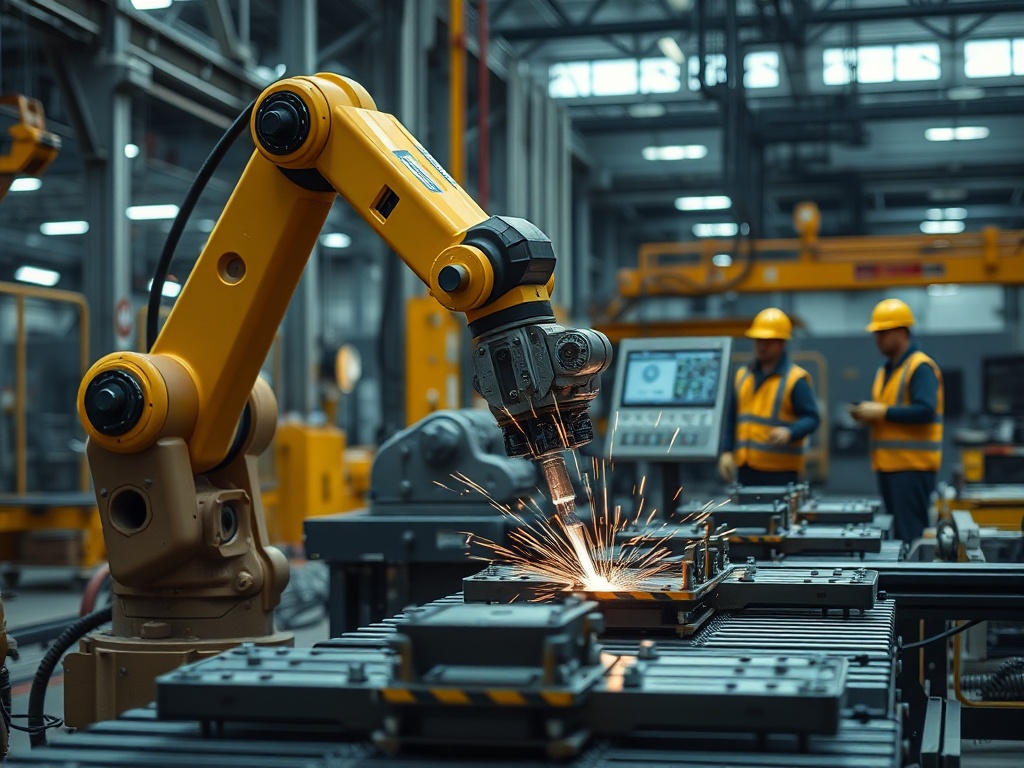
The central finding is straightforward: a 10% increase in the minimum wage is associated with an approximately 8% increase in the probability of adopting industrial robots. Not as a metaphor, but as an observed elasticity. The most valuable aspect is not just the coefficient, but the serious attempt to approach causality: a comparison between counties adjacent to state borders, where local economies are similar on both sides, and the relevant difference is the applicable minimum wage law.
This finding is significant for what it reveals about decision-making mechanics. Automation does not just "arrive"; it is purchased. And it is purchased when the cost structure makes the investment sensible.
The Uncomfortable Truth: Minimum Wage Reconfigures Investment Calculations
The paper does not claim that raising wages is inherently "bad". It states something more operational: when the cost of low-wage labor increases, it changes the relative equation between hiring and automating. In manufacturing, where repetitive and standardizable tasks abound, this re-weighting is especially aggressive.
The research estimates that the link remains robust when controlling for firm size, age, industry characteristics, and whether the state has right-to-work laws. Aggregately, the figure holds; even in the most stringent tests. In the border-pairs test, a 10% increase in minimum wage is associated with an 8.4% increase in robot adoption, nearly the same order of magnitude.
The strategic reading is brutally simple. When a CFO sees that labor costs are rising due to regulation and not due to internal productivity, their discussions with operations change tone. Previously, automation competed with other capex priorities. Now, automation becomes a hedge against future increases and a mechanism for stabilizing margins.
And this is the political and corporate trap: the minimum wage aspires to increase worker incomes, but it can simultaneously accelerate the replacement of roles with less differentiation power. In well-capitalized firms, the reaction can be swift. In smaller companies, the reaction may be delayed but more painful, as they arrive late to the shift and pay the price harder.
The paper prudently does not measure the subsequent effects on employment or wages. We do not know from this study whether those who step off the production line find something better or worse. But for business strategy design, the data is sufficient: the cost of labor has ceased to be a passive input. It has become a public policy variable that triggers technological decisions.
The Stranglehold on Employment: Robots Below, AI Above
This research coexists with another line of work by Brynjolfsson, referenced in the coverage: the effect of generative AI on entry-level office employment. Here, the mechanism is not the minimum wage, but the capability of AI to perform codifiable cognitive tasks that had historically been "paid learning" for junior profiles.
According to a study from August 2025 based on ADP payroll records, since the massive adoption of generative AI tools starting at the end of 2022, entry-level employment in professions more exposed to AI has fallen by 13% in relative terms, while more experienced workers in the same fields have remained stable or even grown. In another cited estimate, employment of individuals aged 22 to 25 in highly exposed occupations dropped approximately 6% in the three years following the introduction of ChatGPT.
It is not the same technology or the same industry. But the pattern of pressure on entry-level positions is too similar to ignore. In manufacturing, the routine worker competes with a robotic arm when the minimum wage rises. In professional services and office functions, the junior employee competes with software when AI reaches a threshold of sufficient performance.
For C-level executives, this is not a debate about the "future of work" as a trend. It is an organizational design decision: if the company automates, it must decide what to do with its entry-level talent pipeline. If it eliminates the junior tier, it also eliminates the pipeline for future middle-management. Then it is surprised when it cannot find supervisors, plant managers, quality leaders, or senior analysts with business acumen.
The stranglehold has another consequence: the labor market may become more polarized. Low differentiation roles are pressured by industrial automation; learning roles in offices are pressured by AI. What remains in the middle requires reconfiguring training, mobility, and real productivity. Not with slogans, but with budget.
The Unspoken Strategy: Automation is Not a Project, It’s a Stance
The most naive approach I see in boardrooms is treating automation as an isolated "project": a business case for each cell, line, or plant. This may suffice to justify the first robot or the initial AI copilot but fails as a strategy. The NBER paper pushes us to recognize something: the regulatory environment can change the relative cost of labor from one year to the next, and the company needs a consistent stance.
This stance requires three uncomfortable but clear sacrifices.
First, to give up the idea that productivity can rise without redesigning jobs. If a firm adopts robots because the minimum wage has risen and does not make an explicit redesign of roles, training, and mobility, then its "gain" will be short-term margin and mid-term chaos. Automation displaces tasks; someone must handle exceptions, maintenance, quality control, safety, programming, and internal logistics. If the company does not build that capability, the robot becomes an idle or underutilized asset.
Second, to give up managing people with a variable cost logic while investing in assets that rigidify operations. Robots and automation typically raise fixed or semi-rigid costs. This demands financial discipline: the ability to maintain utilization, flexibility of shifts, and resilience against demand shocks. If the company automates to "defend" against the minimum wage but has no stable sales or customer diversification, it is purchasing fragility.
Third, to abandon the complacent narrative that AI and robots merely "free people for higher-value tasks". Sometimes yes. Sometimes no. The difference is made by the system design: if there is a career path, training, and real reassignment, work is elevated; if not, it is expelled. A company that does not want to bear the cost of transition ends up paying another cost: turnover, reputation, quality issues, labor conflicts, and operational failures.
At the same time, for governments and policy-makers, the paper puts pressure on the complete package. Raising the minimum wage without complementary strategies may accelerate substitution. The authors themselves suggest considering retraining programs or targeted support for small firms. It is not a matter of intentions; it is a matter of incentive engineering.
Executive Discipline: Choosing Winners, Accepting Losers
The NBER finding does not force a single ideological stance. It compels businesses to stop improvising. A manufacturing company exposed to low-wage labor must decide what it is competing in: cheap labor, intensive automation, or a combination that demands processes, quality, and technical talent.
Each option comes with verifiable sacrifices. Competing on labor costs implies accepting regulatory and reputational vulnerability, and usually a ceiling on productivity. Competing on automation implies accepting capex, fixed costs, and a perpetual need for engineering and maintenance. Competing on differentiation and quality implies accepting learning curves, investment in training, and a business model that captures price premiums.
The worst path is also the most common: trying a bit of everything. Raising prices without differentiation, automating without operational redesign, and promising "reconversion" without a budget. This approach does not create productivity; it creates friction.
The C-Level executive who understands this moment will operate under a simple rule: when minimum wage rises, not only does payroll rise; the clock on automation speeds up. The mature response is to choose a bet and make it consistent across cost structure, training, and value chain. Success requires the painful discipline of firmly deciding what not to do, as trying to do it all will not save any organization from irrelevance.