
Closing 80 Stores Is Not a Strategy: It’s the Cost of a Late-arriving Structure
The public narrative surrounding a mass store closure is often wrapped in the language of "transformation". It sounds active, decisive, almost heroic. But in retail, closing stores is rarely the founding act of a new cycle; it often serves as a late recognition that the structure has grown larger than the market that sustains it.
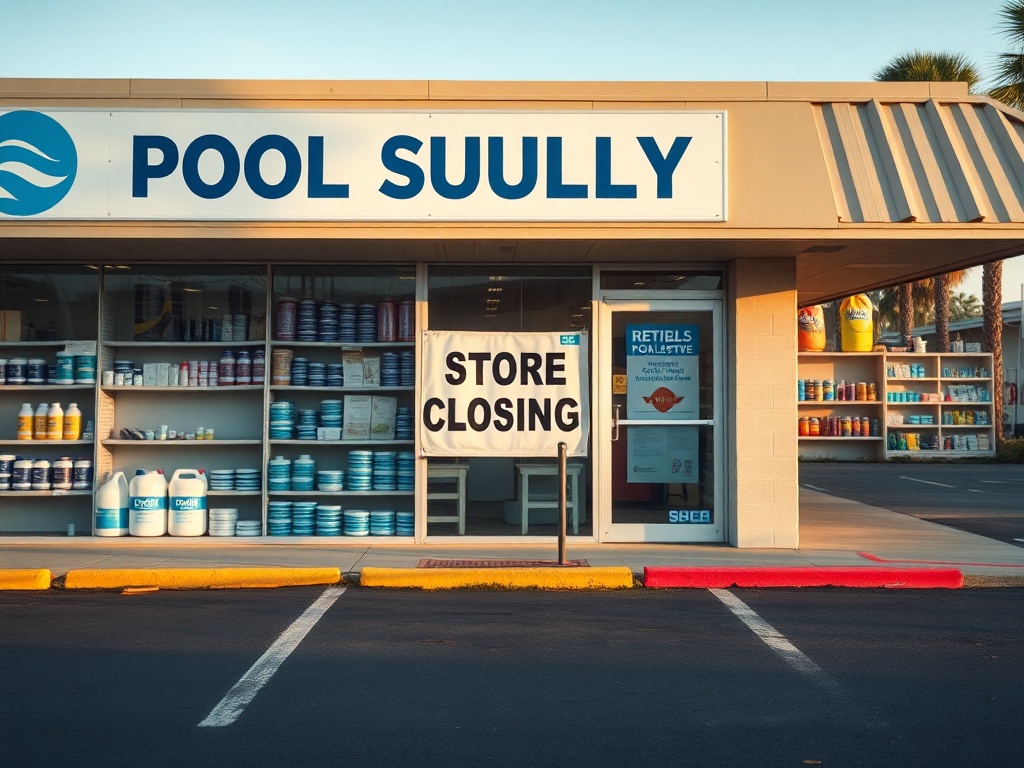
This is what the announcement from Leslie’s, Inc. (NASDAQ: LESL) suggests: the largest direct-to-consumer seller of pool and spa care in the United States is closing approximately 80 underperforming stores during the first quarter of fiscal year 2026 (ending January 3, 2026), and has also shut down a distribution center in Illinois to streamline its supply chain. The company recorded $10.1 million in non-cash impairment charges related to store closures and assets. This news comes alongside a quarter that cannot be prettified: net sales of $147.1 million (-16.0% year-over-year), comparable sales down 15.5%, a gross margin of 18.4% (down from 27.2%), and a net loss of $83.0 million. Shares fell by 17.0% after the report, despite the company reiterating its annual guidance.
The management, led by CEO Jason McDonell, stated that the "transformation" is gaining momentum and that the company will implement a price transformation towards value, supported by the campaign "New Low Prices, Same Great Quality" for the 2026 season. This is a logical bet in a price-sensitive consumer market. It is also an admission: the previous model ceased to work.
Store Closures as a Symptom: When Fixed Costs Eat the Strategy
The key figure is not “80 stores.” The key figure is that the closure comes alongside a sharp deterioration in economic engine metrics: plummeting gross margin and operating losses that can no longer be explained solely by seasonality. In a recurring maintenance business, the drop in gross margin from 27.2% to 18.4% in one year signals structural stress: price has ceased to be an instrument and has become a lifebuoy.
Closing "underperforming" locations is, in theory, a portfolio quality improvement. However, in practice, it often results from having tolerated a network with heterogeneous productivity, rigid costs, and business decisions that did not align with demand for too long. Leslie’s acknowledges part of this when referring to optimizing stores, distribution centers, SKUs, and costs. This list is telling: it is not just adjusting a lever; it is cutting an entire system to make it breathe again.
The closure of the distribution center in Illinois suggests that the company is trying to convert complexity into simplicity. Fewer logistical nodes may mean lower costs, but also greater dependence on the remaining nodes and less tolerance for failures during peak seasons. If the supply chain becomes more fragile, the low price becomes a trap: selling more at lower margins requires impeccable execution in availability, replenishment, and service.
Inventory, for its part, fell by 23% year-over-year to $210.0 million. This figure can be interpreted as a discipline of working capital or as a correction of prior excess. In either case, the message for C-Level executives is the same: the business is trying to regain financial elasticity by cutting what was previously accumulated as “security” and ended up being ballast.
“Low Prices” Won’t Fix a System: It Changes the Type of Expectation
The pivot towards value with "New Low Prices, Same Great Quality" makes sense in the macro context. The briefing cites a Bankrate survey: 54% of American adults plan to spend less on leisure in 2026 than in 2025, pressured by rising inflation, high rates, and credit card debt. In this framework, the retail that survives is not the one that states intentions; it is the one that can uphold promises with unit economics.
Lowering prices, in a business involving chemicals, accessories, and replenishment, is not just a marketing decision. It necessitates reengineering the relationship between demand, margin, and costs. With a gross margin of 18.4%, the company has less room to absorb mistakes: poor inventory planning, a stock break in peak season, or an oversized store structure immediately reflect on cash flow.
Here lies the typical risk of these campaigns: they are presented as repositioning but operate as reactions. If the market has already become more price-sensitive, arriving late means competing with less breathing room. Moreover, if consumers perceive the product as more “commoditized,” the differential shifts to service and availability. In other words, low price does not buy loyalty; it buys testing. Loyalty is built through repeated execution.
The company itself seeks to uphold the recovery thesis with reiterated annual guidance of $1.10 to $1.25 billion in sales and $55 to $75 million in adjusted EBITDA. The contrast with an adjusted quarterly EBITDA of -$40.3 million imposes a silent condition: the plan demands that the 2026 season be operationally superior to 2025, leaving no room for improvisation.
True Transformation Lies in Operational Governance, Not in the Press Release
Media often personalizes these stories around the figure of the CEO and their “journey.” This framing is convenient and, at the same time, dangerously incomplete. A closure of 80 stores and a restructuring of SKUs does not depend on charisma; it relies on portfolio discipline, on a cadence of decisions often cultivated in the operations room rather than the press room.
McDonell states that the company executes “with precision and urgency.” Precision is measured by how decisions are made regarding which stores close, how demand is reallocated to remaining channels, how service to pool professionals is protected, and how cost-cutting avoids destroying critical capabilities. Urgency measures whether the internal incentive system rewards early correction or punishes uncomfortable messages.
The fact that Leslie’s was removed from the S&P SmallCap 600 in 2025, and that the market reacted with a drop of 17% upon announcement, suggests damaged external confidence. Regaining it will not happen by promising “value,” but through reducing performance volatility quarter by quarter. In retail, mature governance is shown when the organization can accomplish three things simultaneously: cut fixed costs, sustain customer experience, and protect logistics muscle.
It is also noticeable when the company stops relying on salvation narratives. A transformation that leans on a “savior” figure often leads to quick but fragile decisions, as it centralizes judgment and, along with it, concentrates risk. Robust transformation, on the other hand, is designed so the system continues to function even when leadership is not engaged in every decision. This involves processes, coherent metrics, and teams that can contradict institutional optimism with data.
What This Story Forecasts for Specialized Retail in the Age of the Cautious Consumer
The pool business experienced a boom during 2020-2022, only to normalize afterward. The briefing notes that the decline in pool permits continued, albeit at a decelerating pace, suggesting stabilization. This is the terrain where specialized retail that hardens its model separates itself from those merely cutting to survive.
Leslie’s has a structural advantage: an installed pool generates recurring maintenance. This recurrence can act as a buffer, but it is not a guarantee. When consumers cut back, they don't eliminate chlorine, but they do switch brands, postpone accessories, and migrate to perceived equivalents. Hence, the pivot to value makes defensive sense. The challenge is that value, in technical categories, demands operational credibility: consistency in quality, availability, and support.
Store closures can enhance profitability if they achieve two effects: reducing fixed costs and increasing the average productivity of the remaining network. However, they can also lead to demand leakage if customers lose proximity or if professionals perceive friction. Reducing SKUs might free up capital and simplify processes, but it can also impoverish the proposition if cuts are made without understanding which products drive visits and baskets.
The overarching pattern of this news is not a “retailer transforming,” but an organization renegotiating its size and promise with the market. That renegotiation is always cultural: it requires that store teams, supply chain, pricing, and finance operate with the same definition of success. When each area optimizes its own indicator, the low price becomes an internal war.
Sustainable corporate success arises when the C-Level builds a structure so resilient, horizontal, and autonomous that the organization can scale into the future without ever depending on the ego or the indispensable presence of its creator.