
Hormuz Turns Oil into Idle Inventory: The Financial Mechanics Behind Cuts in Kuwait and Pressure on the Emirates
The energy market often narrates its crises as a story of prices. This week, the real story is more basic: stopped logistics, full tanks, and forced production cuts. Following Iranian attacks and a de facto halt to maritime traffic in the Strait of Hormuz — which carries about a fifth of the world's crude and LNG — Kuwait initiated "purely precautionary" production cuts and reduced its refining capacity, declaring force majeure as well. The adjustment began with approximately 100,000 barrels per day starting early on Saturday, March 7, 2026, and according to sources cited by Bloomberg in reports collected by Fortune, it could nearly triple by Sunday.
The signal is clear: this is not a decision of marginal optimization, but about operational continuity under physical restriction. When the bottleneck is not at the well but in the strait, the barrel ceases to be a “product” and becomes “inventory.” Once inventory is immobilized, it turns into a financial problem: it consumes space, working capital, contractual flexibility, and eventually forces shutdowns.
Meanwhile, the shock spread across the region: Iraq cut its production by nearly 1.5 million barrels per day with a risk of escalating to over 3 million due to storage limits; Qatar declared force majeure on LNG exports and halted most production from its largest export plant; Saudi Arabia shut down its largest refinery following drone attacks. The United Arab Emirates, which produced over 3.5 million barrels daily last month, claimed that its listed subsidiaries were operating normally mid-week, but the consensus among analysts and operators is that storage pressure will ultimately force cuts if maritime exit does not normalize.
The True Trigger Is Not Price, but Storage Saturation
Under normal conditions, a producer can tolerate price volatility and continue pumping if they have an exit route and contracts to monetize. The blockade of Hormuz reverses this logic: the dominant risk shifts from the market to balance sheet. Oil produced without the possibility of export accumulates. This accumulation is not neutral: each barrel immobilized competes for capacity with the next barrel.
Kuwait produced around 2.6 million barrels daily in February 2026, making it the fifth largest producer in OPEC. An initial reduction of 100,000 barrels may seem modest against that total, but its importance is operational: it marks the beginning of a curve of cuts conditioned by how quickly tanks fill up. JPMorgan, according to reports cited in coverage, estimated that Kuwait had about 18 days before it was forced into cuts due to storage, and the Emirates about 22 days since the conflict began, assuming the flow was not redirected.
This calculation assigns a number to an industrial reality: upstream production cannot ignore midstream and export capacity. When the system saturates, cutting production ceases to be optional. Even with political will or price incentives, pumping more may be impossible or economically destructive if it forces extreme discounts, leads to suboptimal storage conditions, or results in disorderly operational interruptions.
The financial implication is twofold. First, the cut protects the integrity of the system: a controlled shutdown is usually less costly than an emergency interruption when there’s nowhere left to place the crude. Second, revenues plummet before the market “discovers” the new equilibrium, because the unexported barrel does not generate income, regardless of international prices.
Force Majeure: More Than Just a Legal Technicality, A Cash Signal
Force majeure is often seen as a legal footnote. In this case, it signals a first-order insight into the risk structure. The Kuwait Petroleum Corporation activated this clause to excuse itself from contractual obligations due to circumstances beyond its control. This does two things simultaneously.
On one hand, it buys time. If a producer cannot load ships, contractual failure becomes an immediate risk of penalties, forced renegotiations, and litigation. Force majeure reduces that expected cost, thereby limiting financial hemorrhage in an environment where the problem is already significant.
On the other hand, it reshuffles the negotiation power along the entire chain. The buyer that counted on stable supply is left with a supply “gap”; the seller is left with production they cannot move. At that point, real economics come into play: those with logistical alternatives or strategic inventories grow stronger, while those depending on a single bottleneck become exposed.
The coverage also notes an operational point that many executives underestimate until a crisis strikes: Kuwait is not only cutting extraction; they are also reducing refinery throughput. This is coherent. If crude and refined products’ export routes are blocked and storage is also filled, refining more does not solve the problem; it merely shifts it. Business continuity then becomes a synchronization discipline: upstream, refining, inventories, and contracts must move in tandem.
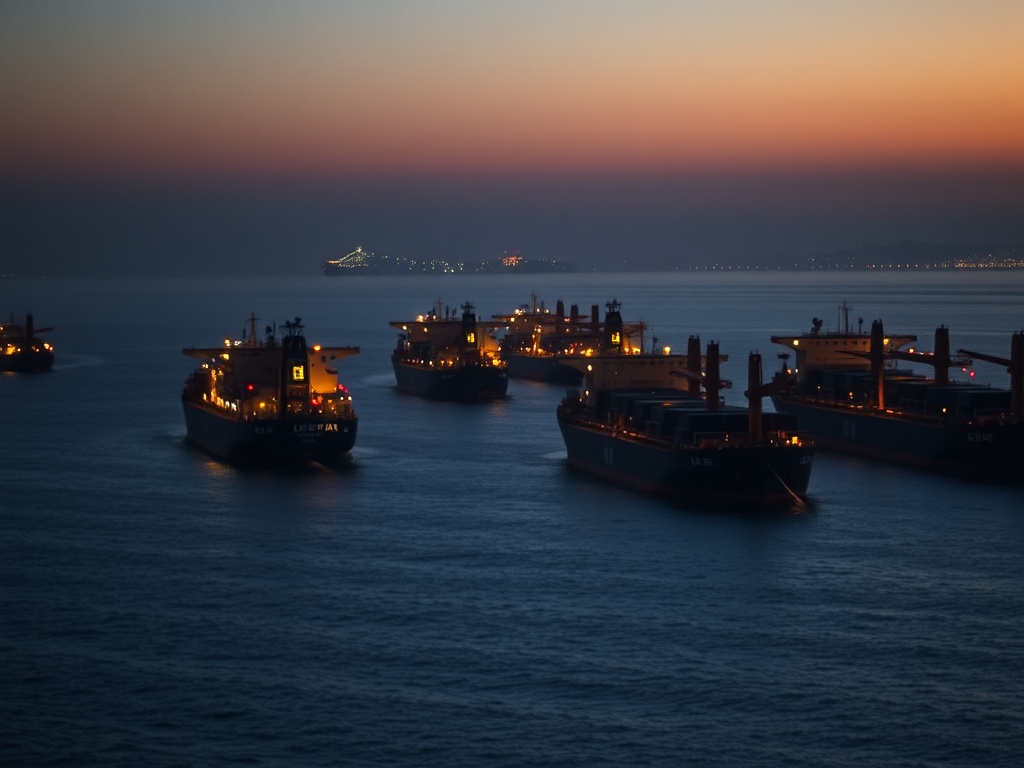
Meanwhile, the paralysis of navigation — with reports of around 300 stranded tankers within the strait and traffic nearly halted — suggests that we are not facing a simple delay of days. Each additional day raises the probability that the precautionary cut will turn into structural rationing until the maritime corridor is reopened or alternative routes with sufficient capacity are established.
The Bottleneck Turns Producers into Operational Risk Managers
When the critical point is a maritime passage, the producer resembles less a “factory” and more a risk management organization with industrial assets. Performance no longer depends on how much can be extracted, but on how much can be evacuated and billed.
The Emirates offer a relevant contrast. Their recent production exceeds 3.5 million barrels daily, and the country has export routes that, according to coverage, could bypass Hormuz in certain cases. This doesn’t eliminate the problem; it merely defers it. An alternative route with limited capacity acts as a pressure valve, but does not replace a corridor through which a large fraction of global energy trade passes. If the blockade persists, storage once again becomes the arbiter.
This is the central mechanism explaining why cuts contagion occurs. Iraq has already cut 1.5 million barrels daily and could exceed 3 million within days due to storage limits. Qatar, with force majeure on LNG, has halted much of its exporting production. Saudi Arabia shut down a major refinery following attacks. Each event has its specificity, but they all converge on the same result: effective supply falls not only due to direct damage but due to the inability to move the product.
For the market, this increases the likelihood of price spikes. But for CFOs and operations managers, the practical point is different: the shock reveals which continuity models were designed for a “conventional” disruption — price rises, partial sanctions, occasional delays — and which were prepared for a prolonged physical restriction.
In this context, the most valuable capital is not financial, but logistical: access to storage, contractual flexibility, route diversification, and the ability to prioritize clients. Those who can maintain minimum deliveries preserve commercial relationships and reduce long-term damage. Those who cannot, enter defensive mode: force majeure, cuts, and asset preservation.
What Changes in Corporate Finance When 20% of Global Flow Is Blocked
There is a common mistake in analysis: assuming that the primary impact is macro, via energy inflation. It is, but at the corporate level, the transmission is more immediate and mechanical.
First, supply risk and replacement cost. Importers and energy-intensive companies shift from optimizing price to ensuring continuity. When supply is restricted due to physical reasons — and not only due to OPEC discipline or cycles — contracts indexed to spot prices become a double-edged sword: they may reflect high prices but do not guarantee delivery if the supplier activates force majeure.
Second, working capital. In the commodities industry, inventory is a financial tool. But when inventory ceases to rotate, it becomes a trap. Companies in the chain — traders, refineries, shipping companies, industrial consumers — may face more guarantees, larger margins, and greater liquidity needs to sustain positions until logistics normalize.
Third, repricing of geopolitical risk in the cost structure. A blockage in a bottleneck through which 20% of crude and LNG flows halts being an “extreme scenario” and becomes incorporated as a structural premium. This impacts hedges, insurances, freights, and safety inventory decisions.
Fourth, reconfiguration of investment priorities. The news is not just about barrels; it’s about operational resilience. The industry will tend to privilege projects that reduce dependence on single points: additional storage capacity, route redundancy, blending flexibility, and clearer contracts regarding interruptions.
The operational message behind Kuwait is that the cut is a consequence, not a goal. The goal is to avoid a disorderly system failure due to saturation. The fact that the Emirates are under pressure from time — with estimates of days until storage limits — indicates that the region is not opting to cut for price strategy but for physical reasons.
The Likely Direction Is More Unintentional Cuts and Higher Interruption Prices
With maritime traffic nearly paralyzed, ships stranded, and multiple producers activating cuts or force majeure, the balance is shifting toward a regime where supply is defined by exit capacity, not extraction capacity. Kuwait has already begun a cut that is expanding within hours; Iraq and Qatar are already showing the pattern of escalation; the Emirates appear to be the next candidate if congestion does not ease.
For executives and investors, the operational learning is specific: in commodities, the competitive advantage in a crisis is not to produce cheaper, but to maintain system rotation when the channel is blocked. Those who preserve routes and executable contracts protect cash, commercial reputation, and strategic optionality. Those who rely on a single corridor end up managing shutdowns.
In this episode, the decisive variable is not the barrel price; it is the speed at which inventory becomes immobilized and forces production cuts.