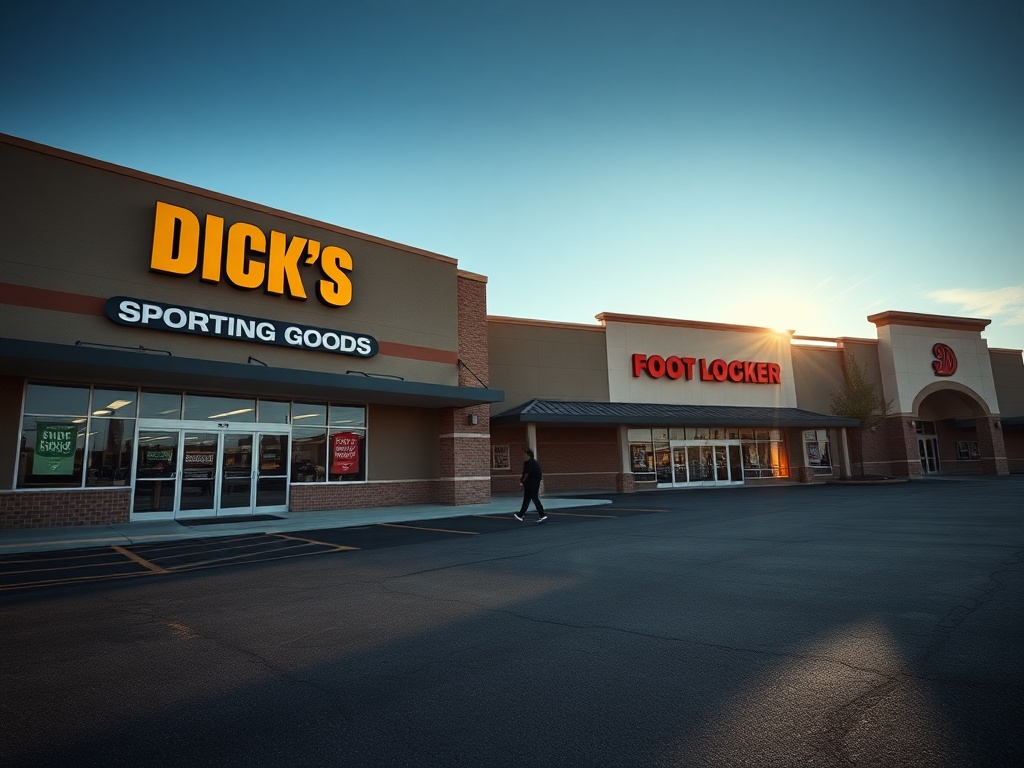

Dick's Acquires Foot Locker, Analysts Adjust Their Models
Dick's Sporting Goods delivered a seemingly flawless narrative during its fiscal Q4 2025 earnings presentation: consolidated revenues of $6.23 billion, a 59.9% increase from the same period last year, and adjusted earnings per share of $3.45, beating the consensus estimate by 17.4%. The stock jumped nearly 5% in pre-market trading. Any casual observer would have likely closed their terminal satisfied.
However, beneath this surface lies a dynamic that analysts carefully scrutinized, prompting them to lower their forecasts for the upcoming quarters, even after the beat. This apparent contradiction is not an anomaly. It's precisely what happens when a company grows through acquiring volume rather than creating new demand.
The Number No One Celebrated in the Boardroom
Net GAAP income for Q4 fell 57%, to $128.3 million, down from $300 million in the same period the previous year. The stated cause: $235.5 million in pre-tax costs related to the acquisition of Foot Locker, completed about six months before the quarter's end. For the full year, net GAAP income dropped 27.1%, to $849.2 million, down from $1.165 billion in the previous fiscal year.
The consolidated non-GAAP gross margin declined 303 basis points year-over-year, directly impacted by the Foot Locker mix in the consolidated financials. Dick's own segment, however, expanded its gross margin by 67 basis points, affirming that the original business remains healthy. The issue lies not with what Dick's built over decades but with what it just purchased and how much it will cost to integrate.
Ed Stack, Executive Chairman, expressed measured optimism: "We have owned the Foot Locker business for about six months, and our conviction in the long-term opportunity continues to grow." Six months is a brief period for a definitive verdict, but it is enough for financial models to start reflecting operational realities.
Guidance for fiscal 2026 projects consolidated sales between $22.1 billion and $22.4 billion, with the midpoint exceeding prior consensus by 2.2%. However, the adjusted earnings per share range of $13.50 to $14.50 fell short of the market's estimate of $14.67. That gap, minor in absolute terms, is sufficient for an analyst to recalibrate their model downward, especially as the denominator of shares grew by 9.6 million shares issued to finance the acquisition of Foot Locker.
Bought Scale versus Created Demand
This is where the strategy becomes legible in a different light. Dick's jumped from $13.44 billion in consolidated sales in fiscal 2024 to $17.22 billion in fiscal 2025, a 28.1% increase. That growth did not stem from turning non-customers into frequent buyers or from opening a new market segment. Instead, it came from acquiring a chain that already had its own revenues, costs, and structural challenges.
Foot Locker reached Dick's after years of struggles prior to the acquisition. The mere fact that the brand was available for purchase is already a strategic indicator. Its historical strength in urban and youth culture footwear does not naturally overlap with Dick's perfected mass sports retail model. They represent two distinct value curves now sharing a consolidated balance sheet.
Dick's own segment closed fiscal 2025 with record sales of $14.1 billion, achieving 4.5% same-store sales growth for the full year and nearly 10% over the last two years in Q4. These numbers indicate a business with genuine traction in traffic and average ticket size. The pilot of 11 Foot Locker stores that management mentioned for scaling in 2026, internally dubbed "Fast Break," aims to accelerate that integration, but a pilot of 11 stores is precisely that: a hypothesis pending validation, not a confirmed growth lever.
Guidance for comparable sales growth for Foot Locker in fiscal 2026 is projected between 1% and 3%, compared to the 2% to 4% projected for the Dick's business. The difference is not dramatic but indicates that the acquired brand starts from a low-dynamics base that will require capital, managerial attention, and time to improve.
What the Analysts' Cuts Really Indicate
When an analyst lowers their projections following a quarter that beat estimates, they are not punishing the past. They are recalibrating the future with information they previously lacked. In this case, that information includes: the dilution impact of 9.6 million newly issued shares, the consolidated margin compression stemming from the Foot Locker mix, and an EPS guidance midpoint implying that fiscal 2026 will end below the standalone EPS for Dick's in fiscal 2025, which was $14.58 in its own segment.
In other words: Dick's spent capital and issued shares to grow revenues, and the visible result for shareholders in the short term is that they earn less per share than before the acquisition. This does not render the acquisition a mistake; integration takes time, and the strategic arguments about the convergence of sports and youth culture make plausible logic. However, it turns the argument of "long-term opportunity" into exactly what it is: a bet on an uncertain future financed with present resources.
The U.S. sports retail market faces a known secular pressure: e-commerce fragments demand capture, competitors like Academy Sports and major digital platforms aren’t disappearing, and the urban young consumer, Foot Locker's natural territory, has more options than ever to access the culture footwear they once found solely in those stores. Buying that physical distribution makes sense if accompanied by a differentiated proposition that those channels cannot replicate. The question that analysts are incorporating into their trimmed models is whether Dick's management has that proposition ready, or if they are betting that scale alone will generate enough inertia.
Leadership that Builds Demand Doesn’t Buy Borrowed Volume
Dick's Sporting Goods' management possesses a genuine operational asset in its own segment: four consecutive years of capturing market share, sustained same-store sales growth, and margin expansion in its original business. This is not trivial and deserves accurate recognition. The risk does not lie in what they built, but in confusing the size of the consolidated balance sheet with the strength of the proposition to the buyer.
A business growing 28% due to the purchase of another business hasn’t created new demand; it has merely shifted existing demand under its roof. The litmus test for fiscal 2026 won’t be whether consolidated revenues hit $22 billion, but whether the Foot Locker segment starts to demonstrate a genuine reason for consumers to choose that store over any other alternative available on their phones or down the street.
Leadership that generates lasting value does not accumulate assets to compete for the same purchasing decisions that were already occurring in the market. It creates the conditions for purchasing choices that did not previously exist by eliminating the variables that the industry takes for granted instead of replicating them at greater scales.