
The Value of Industrial Humanoids: Capturing Risk Savings Over Strength
Noble Machines steps out of stealth mode with Moby, a humanoid designed for heavy-duty tasks. The decisive factor isn't just lifting 60 pounds (27 kg); it's about how value is distributed among clients, integrators, workers, and the startup when automation enters hazardous environments.
From the Lab to Reality: The Real Message Behind Deployment with a Fortune Global 500 Company
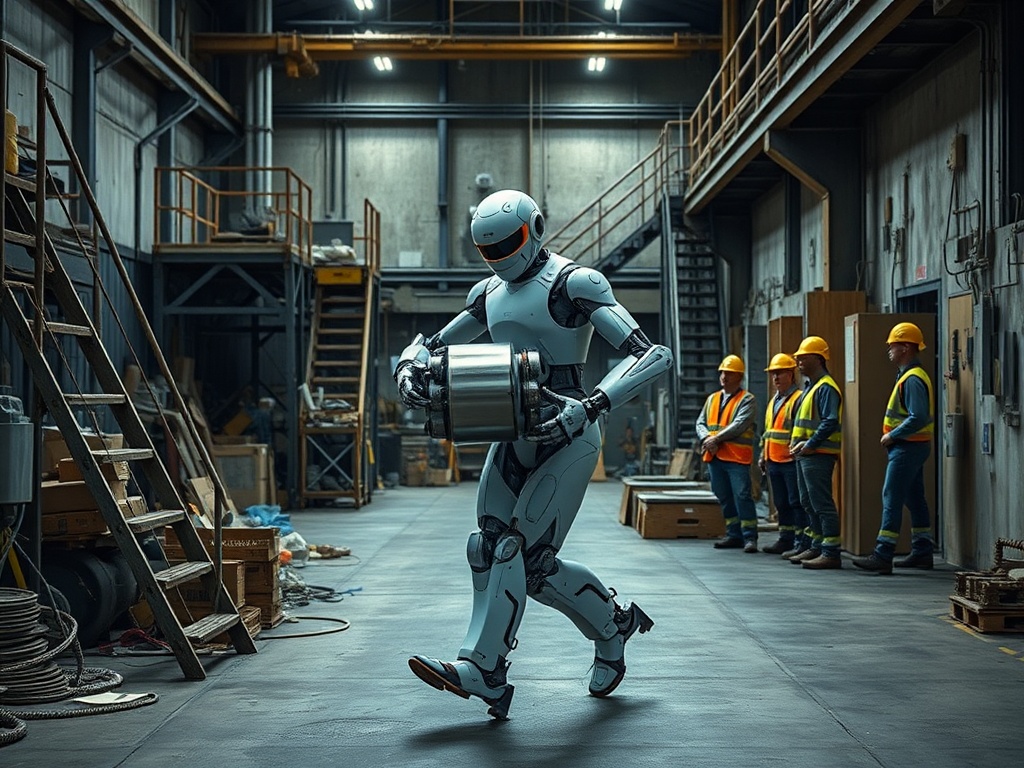
The new wave of humanoid robotics aims to transition from lab videos to actual shifts in hostile environments. In this context, Noble Machines — a startup founded in 2024 and based in Sunnyvale, California — publicly debuts Moby, a general-purpose humanoid for heavy industry. The company (formerly Under Control Robotics) claims to have shipped and deployed its first units, reaching a pilot phase with at least one Fortune Global 500 client within just 18 months. In its most noted public demonstration, Moby lifts 60 pounds (27 kg) and navigates less-than-perfect conditions: steep slopes, outdoor settings, stairs, and scaffolding are part of its selling point.
The technical aspect is appealing, but in industry, buying metrics hinge less on amazement and more on the cost structure and risks that can be eliminated. An industrial humanoid doesn't compete with 'not having a robot'; it competes against a mix of overtime, turnover, training, incidents, downtime for safety, and simpler solutions (wheeled robots, fixed arms, specialized tools). Therefore, Noble Machines’ announcement matters more as a marker that the market is starting to test, with real money, an economic question: who retains the value created when a robot reduces physical risk and stabilizes operations.
The Need for Reliability Over Generality
Noble Machines has yet to disclose the client’s name or contractual figures, but simply stating an early deployment has strategic implications. In robotics, the cost of ‘being close to the client’ can be massive: adapting to existing processes, ensuring safety, maintenance, retraining, integration with tools and systems, and the unavoidable friction of the real world. If a company claims it has units already operating, it seeks to demonstrate something more valuable than its engineering prowess: its capability to support the full implementation cycle.
Positioning Moby as a humanoid for manufacturing, construction, logistics, energy, and semiconductors signifies a bet on environments where the 'cost of failure' is high. This is where automation can justify premium pricing, not just by saving human hours, but by reducing exposure to accidents, stoppages, and operational penalties. In that regard, Noble’s emphasis on navigating stairs, scaffolding, and uneven terrain addresses a classic problem: much of industrial infrastructure is designed for humans, not specialized robots.
However, the market does not reward the promise of generality; it rewards reliability with a restricted set of repeatable tasks. Speculative gaps in coverage appear: no degrees of freedom (DOF) are stated, nor a clear operational energy scheme for Moby, and even discrepancies in payload (60 pounds in demos vs. another mention of 50 pounds). For an industrial buyer, these omissions are not details; they’re the difference between budgeting for a pilot and budgeting for a production line.
The Economic Focus: What Costs Can Be Avoided?
The economic takeaway is straightforward: Noble is trying to shift the conversation from “what it can do” to “what costs can I avoid or what risks can I lessen.” If it can anchor returns in reduced incidents and downtime, its pricing power increases. If it gets trapped in comparisons of specifications, it will end up competing on muscle and unit cost—the easiest ground for value to leak to the client.
Focusing on Operational Value Capture
In comparative coverage, Moby's public lifting capacity of 27 kg stands against reported figures of 35 pounds for Digit (Agility Robotics) and 44 pounds for Figure 3 (Figure AI), while Atlas (Boston Dynamics) has demonstrated higher loads in certain scenarios, but these are often more for show than practical use. This mental table of payloads is useful for headlines but inadequate for adoption decisions.
In industry, the value equation is formed by four factors: total cost of ownership, availability (uptime), risk (safety and compliance), and flexibility (how many useful tasks per week the system can absorb without ad hoc engineering). Payload contributes but doesn't solely define savings. A humanoid that lifts more yet requires significant supervision or halts due to limited autonomy could ruin the business case.
Here lies an intriguing claim attributed to Noble's platform: skill acquisition in hours instead of months, using language instructions, demonstrations, and gestures; full-body control; and a training pipeline based on NVIDIA Isaac with a Real2Sim and Sim2Real cycle, claiming a 95% success rate in deploying simulation models to physical robots. If this figure holds across various sites and tasks, the economic impact is substantial as it reduces integration costs, often the hidden tax of automation.
Yet, this same promise creates distributive tension. If teaching new tasks becomes fast and inexpensive, clients may attempt to seize the benefit by requesting more scope for the same price or renegotiating downwards. The startup, on the other hand, needs to monetize that flexibility since it is its differentiation. Healthy balance is achieved when pricing reflects part of the client’s real savings, and when the provider avoids an extractive model of “I sell you the robot and charge you for every minor adjustment.” Such a structure usually collapses into operational and reputational conflict, particularly in environments where safety and continuity reign.
An additional note: a report mentions approximately 5 hours of battery life and integrated computing on NVIDIA Jetson Orin. Even if this data isn’t formally tied to Moby's specs, the order of magnitude matters for a plant manager: 5 hours isn’t a full shift. This necessitates designing unit rotations, battery swaps, or charging windows that affect throughput. If Noble sells “generality” but operations require complex choreography to sustain continuous work, value erodes and the client will demand a discount.
The Real Battlefield: Safety, Integration, and Cost of Maturing the Product
Noble Machines emphasizes that its AI needs to be tested in actual operations, not just in the lab, and asserts it builds an integrated stack of hardware and software. Strategically, this integration is defensive: it reduces dependencies, accelerates iteration, and allows end-to-end performance control. Economically, it also concentrates risk: the company shoulders the cost of maturing mechanics, perception, control, and deployment simultaneously.
At this stage, the typical temptation for venture capital is to subsidize deployment to 'buy' adoption, shifting costs onto the startup’s balance sheet. While this approach can be beneficial for learning, it becomes dangerous if the client internalizes that the provider will always absorb the complexity. In industrial robotics, the cost of field support can eat margins for years.
The report mentions focusing on “4D” jobs (dull, dirty, dangerous, declining). Practically, these are activities plagued by staffing issues, high turnover, or elevated exposure. There, a well-designed opportunity for shared value exists: the robot could take on risky tasks, while workers shift to supervision, preparation, quality control, or maintenance. This distribution creates operational stability and reduces labor friction.
The risk is that the business case is built solely as a staffing cut or wage pressure. If the client attempts to capture all savings as labor cost reduction without reconfiguring roles or investing in training, the system becomes politically fragile: internal resistance increases, turnover rises in critical positions, and operational knowledge deteriorates. In hazardous industries, losing tacit knowledge can be costly, though it may not always show up in the first quarter.
For Noble, the challenge is to convert its proposal into a package that includes safety, procedures, and operations—not just a robot. If the client buys a humanoid and later finds they must redesign processes, train teams, and manage new risks, willingness to pay falls. The most sustainable way to capture value is to sell verifiable results (reduction in incidents, stability in throughput, shorter training times) and share the benefits with the customer in a contract that doesn’t rely on vague promises.
The Winner: Transforming Physical AI into Avoidable Risk Fees
Noble Machines is entering a progressively crowded market for humanoids and platforms geared towards industry, where real differentiation doesn’t hold up against isolated demos. It rests on a combination of repeatable performance, safety, maintenance, and learning capacity that reduces the total cost of deploying new tasks. In that context, breaking stealth mode with already deployed units is a proper move: it indicates the company understands that validation is not media-driven; it’s operational.
Nonetheless, the asymmetry of information is obvious. Without DOF, without a clear energy profile for Moby, and with no explicit payload conditions, a rational buyer will apply discounts or demand guarantees. This pressure pushes the startup to offer more support, more on-site staffing, and more customization. If Noble falls into this trap, the customer captures the value while the provider absorbs the cost, a typical pattern in subsidized early adoptions.
The winning design is the opposite: a model where the customer pays for verifiable risk reduction and operational friction, and where allies—integrators, safety teams, operators, and maintainers—have economic incentives to ensure the system functions and remains in place. If the robot reduces accidents and stabilizes operations, the client wins; if implementation cuts integration costs with rapid learning and reliable simulation-to-reality transfers, the supplier wins; if human labor shifts towards more controlled and less dangerous tasks, operational social capital strengthens.
The competitive edge will not be in lifting 27 kg, but in securing contracts where the savings from avoided risks are distributed in such a way that no one has an incentive to sabotage adoption. In industrial robotics, the real value is captured by the player who ensures everyone prefers that the system continues operating tomorrow, not by maximizing margin in the first pilot.