
The Microgrid Redefining the Power of AI in Europe
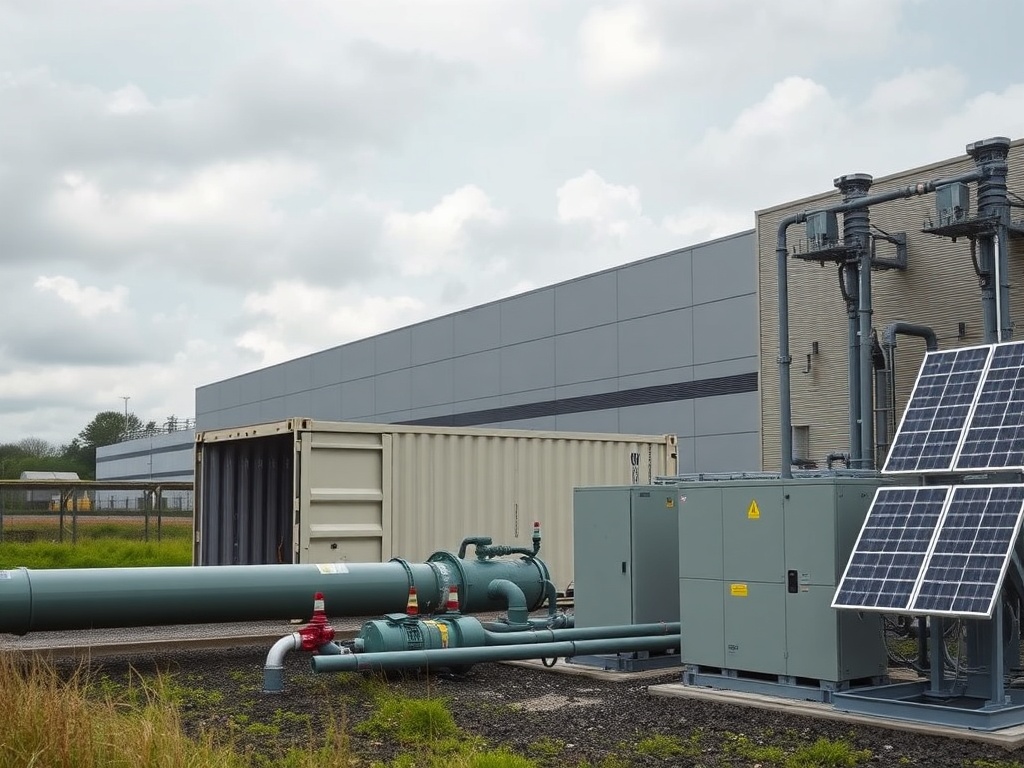
The pressure from AI on Europe's electrical infrastructure has ceased to be merely a sector planning issue and has transformed into a direct barrier to expansion. In this context, AVK and Pure Data Centers have activated in Dublin the first data center in Europe connected to a microgrid, a decision designed to operate independently of the limitations of connecting to Ireland's public grid.
This move carries an uncomfortable subtext for executives. If energy was once a “guaranteed” supply provided by the state and is now becoming a private commodity, the competitive advantage shifts hands. The winner is not necessarily the one with the best cloud or the best AI stack, but rather the one that can secure reliable electricity, predictable pricing, and operational continuity through agreements and assets that do not depend on regulatory queues.
What was ignited in Ireland is not just power; a new type of negotiation has emerged among data centers, energy suppliers, regulators, and local communities. Here lies my perspective: the fragility is not in engineering, but in the social architecture that allows operations without conflict, attracts scarce talent, and maintains social licenses under high visibility.
Microgrids for Data Centers and the End of the “Available Grid” Assumption
The reality is concrete. The Dublin site operates with a microgrid in a country where there was a moratorium on new data center connections to the grid, and where several projects sought alternatives through gas connections for on-site generation. In operational terms, this implies a risk reconfiguration: the unavailability of the grid ceases to be an external bottleneck and becomes an internal problem of design, operation, and maintenance.
AVK positions itself as a specialized provider that designs, builds, owns, and operates these microgrids for data center operators. This matters because it redefines the boundaries of the enterprise. The data center operator purchases electrical continuity as a service, rather than constructing an energy organization within its structure. This separation allows for speed but creates strategic dependency: the contract and governance of supply become as relevant as connectivity agreements or SLAs with clients.
Simultaneously, the technical discourse within the sector is evolving. The joint document from AVK and Wärtsilä (2025) describes models that combine renewables, balancing engines, and storage to achieve dispatchable capacity and stability amid climate variability. The business point is clear: AI cannot tolerate intermittency or uncertainty. If a region cannot provide connection and reliability, investment will migrate towards private architectures.
The consequences for SMEs and contractors are less obvious but crucial. When the data center becomes “owner of its energy” through a microgrid operated by a third party, a new demand chain arises: specialized electrical maintenance, 24/7 monitoring, transitional fuel logistics, battery integration, environmental compliance, and industrial cybersecurity. This is more than just an infrastructure project; it's an economy of services surrounding it.
The Hidden Strategy is Governance and Contracts, Not Just Megawatts
In the available coverage, there are no figures for investment, exact site capacity, or detailed activation timeline. This absence of numbers does not prevent one from inferring the competitive dynamics: microgrids shift the debate from “how much energy is there” to “who controls the asset, with what incentives, and under what dispatch conditions.”
AVK claims to have designed and built microgrids for data centers with over 250 MW of dispatchable capacity in the last five years. That number, while aggregated and not specific to the Irish project, reveals an industrial thesis: private dispatchable capacity is becoming a repeatable product. In markets with grid restrictions, that product is sold for something more valuable than just kilowatts: it's sold for deployment speed and reduced risk of getting stuck waiting for permits.
However, the contract dictates the terms. If the provider “owns and operates,” the operator purchases an output. This may be efficient, but it also concentrates power. The typical risks are twofold:
First, price and fuel risk during the transitional period. If the microgrid relies on gas and engines prepared for more sustainable fuels, the promise of future migration depends on availability, regulation, and cost structures that the operator does not control.
Second, performance and liability risk. When incidents occur, attribution among the data center, microgrid operator, and third parties must be defined in technical clauses, insurance, penalties, and redundancies. In a sector where uptime is monetized, contractual governance is part of the technical design.
In the medium term, AVK posits that these microgrids can become “energy hubs” capable of exporting energy to the grid when sufficient connection exists, providing stability and balancing services. This shift creates an additional incentive: the asset does not only serve the data center; it can also monetize services for the electric system. For C-Level executives, this changes the conversation with regulators: the project transforms from a “troublesome” consumer into a capacity supplier. If the narrative is backed by impeccable operation, it opens doors. If perceived as a shortcut to circumvent restrictions, it closes them.
The Social Blind Spot of the Private Energy Model
Here lies an aspect that many executive teams underestimate. A microgrid in a data center is not just wiring and engines; it's a high-friction network of relationships: permit authorities, neighbors, gas operators, maintenance suppliers, security teams, environmental compliance, auditors, and emergency response. This network defines operational continuity just as much as engineering does.
When energy was “from the grid,” much of the conflict and reputational management was cushioned by public institutions. With on-site energy, the organization becomes more visible. Sensitivity to noise, perceived emissions, logistical traffic, land use, and the narrative of “who gets to keep the electricity” during times of scarcity increases. The social license shifts from being a document to a system of sustained trust.
This system of trust cannot be bought with campaigns. It must be built with social capital: operational agreements where value exchange is tangible and consistent. Practically, this means having the capacity to hire locally, develop suppliers, transparently share protocols, and generate coordination mechanisms with the territory. If the model relies on a closed circle of technical and legal actors, it becomes fragile in the face of any crisis.
There’s also an internal angle. Operating a complex energy asset demands collaboration across disciplines that historically have kept their distance: IT, facilities, energy, security, finance, legal. Homogeneous teams tend to underestimate this interface. They share educational biases and similar intuitions about risk. In projects where risk manifests as operational incidents, regulatory sanctions, or community conflict, that homogeneity can be costly.
The signal for SMEs is clear: the opportunity lies not just in “selling to data centers” but in becoming a reliable supplier within that horizontal operation network. SMEs that understand value lies in reducing friction—response time, impeccable documentation, security, traceability, and a culture that integrates with mission-critical standards—will emerge victorious.
The Opportunity for SMEs is Selling Continuity, Not Components
This news reads quickly as an infrastructure milestone, but its economic effect trickles down. If Europe begins to replicate microgrids to bypass electrical bottlenecks, contracts multiply where the unit of purchase is not equipment, but continuity.
For an electrical, mechanical, or industrial service SME, this requires repackaging the offering. Less one-off sales and more agreements with service metrics: predictive maintenance, critical spare parts, quality management, guaranteed availability. For an industrial software SME, fertile frontiers emerge: monitoring, fault analytics, sensor integration, industrial cybersecurity. For a technical training SME, a market opens for certifications and training in microgrid operations with data center standards.
The conditioning factor remains the same in all cases: verifiable trust. In mission-critical supply chains, price competes, but reputation competes more. This requires documented discipline, compliance, insurance, sub-contractor governance, and the capacity to operate 24/7. The market rewards operational seriousness.
There’s also a strategic reading for SME owners: microgrids accelerate the trend towards longer contracts and more stable relationships, but with higher barriers to entry. The path is not to promise “innovation”; it’s to demonstrate risk control.
For major operators and funds, the implication is even more direct. Energy ceases to be a given and becomes a locational factor. Projects that once were decided based on connectivity, taxes, or latency are now determined by access to gas, permits, the ability to deploy local renewables, and the availability of operators capable of sustaining dispatchable assets.
The activation in Ireland showcases the pattern: when the grid cannot accommodate AI demand, capital builds its own supply. Executives who view this solely as a technical issue are arriving late to the game.
A Mandate for C-Level Leaders Amidst the New Geopolitics of Electricity
The connected microgrid in Dublin crystallizes a power shift. Energy infrastructure becomes part of the product, compelling a re-examination of corporate governance, risk management, and the network of operational allies.
The smart decision for leadership is to treat energy as a strategic capacity with three dimensions: contract, operation, and social license. The contract defines incentives and responsibilities. The operation defines continuity and cost. The social license defines whether the asset can exist without political or community interruptions. All three dimensions live or die by the quality of the human network that supports them.
The mandate is practical and does not allow for cosmetic changes. In the next board meeting, observe the inner circle and accept an uncomfortable fact: if everyone looks alike, they share the same blind spots and risk becoming imminent victims of disruption.