
The Silent Collapse of Butterflies and the Cost No One is Accounting For
On March 6, 2025, Science published the most comprehensive study on butterfly populations conducted in the United States. With over 650,000 observations, more than 9,000 monitored sites, and 342 species analyzed over two decades, the results are striking: between 2000 and 2020, the total abundance of butterflies dropped by 22%, at a steady rate of 1.3% each year. Where there were once five butterflies, today there are only four.
The headline regarding the five species thriving due to climate warming is understandable from an editorial perspective but distracts from the important arithmetic: 107 species decreased by more than 50% in that time, 22 of them by over 90%. Lead researcher Collin Edwards precisely stated, "It may not sound like much, but it adds up quickly and means we've lost more than 20% of butterflies in just twenty years."
This accumulation is precisely the problem that corporate risk models still do not comprehend.
When Biology Becomes Accounting
The standard narrative about pollinator decline stops at ecology. However, the numbers from this study point to something that CFOs in agribusiness should be monitoring.
Pollinator-dependent crops generate between $15 billion and $20 billion annually in the United States, from almonds to blueberries. Butterflies are not the only players in this system, but they form part of the functional architecture that supports it. When one component of that architecture loses 22% of its volume in two decades, the entire system becomes more fragile against climate or phytosanitary disturbances. Biological redundancy—the invisible cushion that mitigates losses in adverse seasons—thins out.
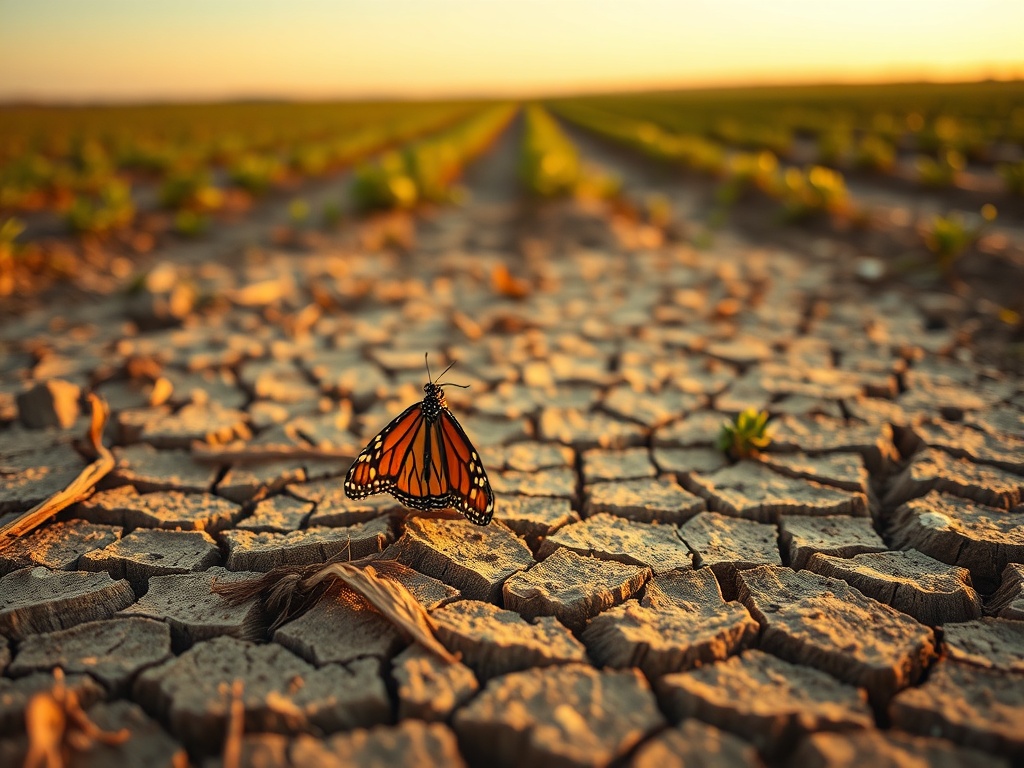
The case of western monarchs illustrates how far this dynamic can go. In 2024, their population was recorded at 9,119 individuals, a staggering 96% drop from the 233,394 counted in 2023. Researchers estimate an extinction risk of between 48% and 99% over a 60-year horizon. California's avocado and almond farms, which together account for about $11 billion in annual production, operate on a pollinator scaffold that is structurally eroding—not just temporarily.
The Midwest reinforces this argument. Data from 1992 to 2023 on 136 species show no net increases; 59 species declined between 1.2% and 6.9% annually, totaling a 40% loss in that region. From 100 individuals per county in the early nineties, only 60 remain now. This is not seasonal variation; it is a structural trend.
The Trap of the Extractive Model Applied to Living Systems
What the study published in Science documents is the deferred cost of a model that treats ecosystem services as if they were free and inexhaustible. For decades, the agribusiness value chain optimized its costs based on the implicit assumption that nature would continue providing pollination, pest control, and soil fertility at no expense. This assumption is being refuted in real-time.
Neonicotinoids—pesticides with a global market of $3 billion annually—appear in the scientific literature as one of the contributing factors to the decline. The European Union significantly restricted these substances from 2018 onward. In the United States, regulatory litigation remains active. As the legal debate drags on, populations continue to decline. For companies like Corteva, which maintain significant portfolios in this segment, regulation equivalent to the European standards would exert pressure on a substantial portion of their revenue, while inaction transfers the risk to agricultural producers dependent on functional ecosystems.
The circular logic here is not poetic; it is accounting. The system that produces the crops partially finances the inputs that weaken the very system producing those crops. This negative feedback loop lacks a market self-correction mechanism because the damage is externalized toward actors—pollinators, soils, rural communities—who do not participate in price negotiations.
Researcher Cheryl Schultz, a Conservation Biology professor at Washington State University and the study's lead author, was direct: "We have a clear picture of the magnitude of the declines and the need to act swiftly in every corner of our territory."
The Capital that Doesn’t Appear on Financial Statements
There is a financial architecture question that few agribusiness companies have systematically asked: how much is wild pollination worth that they are not paying for, and what happens to their margins when that service degrades?
The answer has two dimensions. The first is direct exposure: food processors supplying global retail chains have already experienced losses linked to pollination deficits. Industry estimates place the impact of these deficits on small fruits in 2024 at around $1 billion. Agricultural insurance premiums, sensitive to yield volatility, have risen 15% in recent periods of high production uncertainty.
The second dimension is pressure from institutional investors. Funds with assets under management exceeding $10 trillion have already incorporated biodiversity metrics into their risk assessment criteria. The documented degradation of pollinators is not a benign externality for long-term portfolios; it is an unrecognized liability that will eventually appear in valuations.
In the meantime, the habitat restoration and alternatives to conventional pesticides market projected to reach $1.2 billion globally in 2025, with organic farming in the United States exceeding $62 billion in sales in 2022 and growing at double digits annually. The USDA’s Conservation Reserve Program had enrolled 22 million acres in 2024. These are signs of reconfiguration, but their scale remains marginal compared to the magnitude of the identified problem.
What the Science study demonstrates with 650,000 data points is that nature keeps the accounting that markets have ignored. Twenty years of accumulated decline, with ten times as many species in retrogression as in expansion, is not a reflection of a self-adjusting system: it is the record of a deficit that has quietly built up and now has a name, dimension, and velocity.
Leaders in agribusiness, risk managers, and investors who still treat pollinator biodiversity as a soft variable in their ESG reports face the same categorical error that financial markets made before 2008 with toxic assets: assuming that what is not measured has no price—until it does.