
The Insulator Born from a Coffee Landfill
Every day, more than two billion cups of coffee are consumed worldwide. What remains—those wet, dark grounds ending up in the trash bins of every café, home, or office—has been treated for decades as a waste logistics problem. An invisible cost that has been internalized without question.
The research team at Shenyang Agricultural University in China decided to view this differently. What they discovered isn’t merely a quaint laboratory experiment; it is a material with a thermal conductivity of 0.04 watts per meter per Kelvin, comparable to commercially available expanded polystyrene and six times better than ethyl cellulose used as the benchmark. In construction terms, this means that the residue from your morning coffee can insulate a wall with the same efficiency as the petroleum-derived materials that dominate the global market.
From Grounds to Biochar: The Mechanism That Changes Everything
The process isn't intuitive, and that's precisely what makes it valuable. Raw coffee grounds have a porosity of only 40%, insufficient to effectively trap air—the true agent of insulation in any thermal material. The key breakthrough from Shenyang lies in what they do before arriving at the final product.
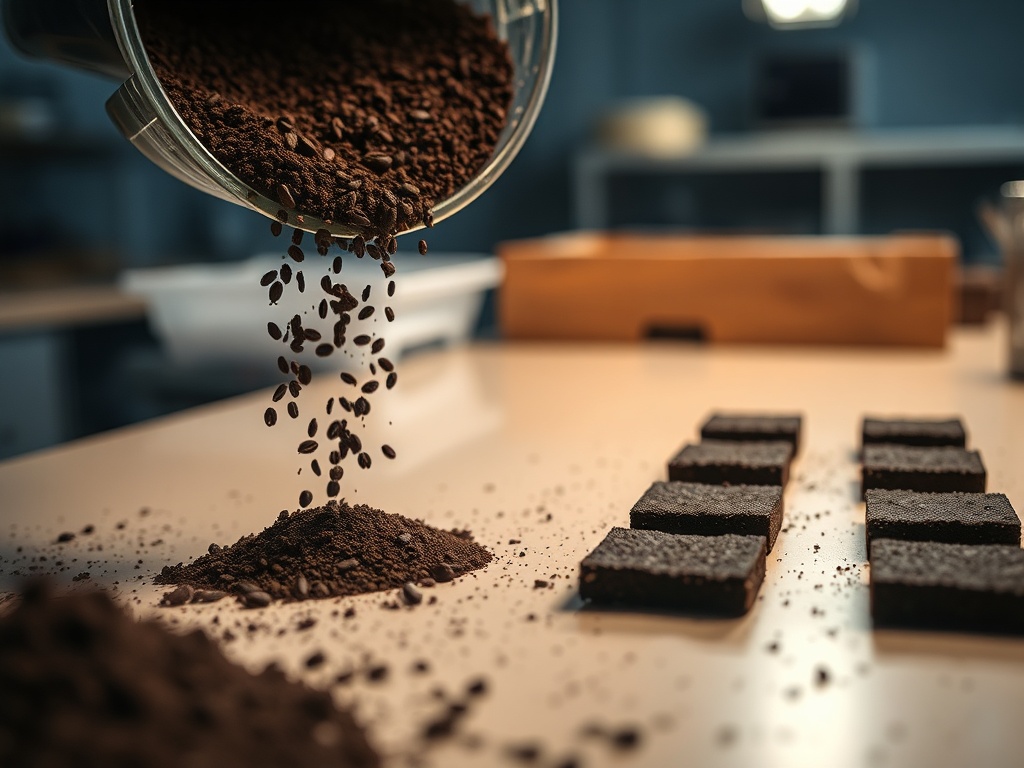
First, the grounds are dried at 80°C for a week. Then they undergo pyrolysis at 700°C for an hour, a procedure that transforms organic material into biochar and increases the material's porosity to 71%. But here comes the more sophisticated part: this biochar is mixed with propylene glycol to temporarily fill the pores, combined with ethyl cellulose to provide structure, molded at 150°C, and finally subjected to vacuum at 80°C to extract the glycol and recover porosity without collapsing the structure.
They call this the "porous restoration strategy." It isn’t a marketing term; it accurately describes the problem they are solving. Most porous materials lose their structure during manufacturing. This method deliberately preserves it. The result is a biodegradable, non-toxic composite with entirely renewable components, which in tests on solar panels showed effective heat transfer limitation.
To grasp the magnitude of the advance, it’s worth comparing it with what existed before. Previous studies had incorporated coffee grounds into fired clay bricks (50% reduction in conductivity with 17% grounds) or plaster (from 0.5 to 0.31 W/m·K with only 6%). A simulation conducted on a house in Marrakech with coffee ground plaster projected a 20% savings in heating and cooling demand, equivalent to 1,500 kilograms of CO₂ per house per year. Shenyang didn’t build on a void; they built on an experimental foundation that was already pointing in this direction.
Why the Insulation Market is the Right Strategic Target
Buildings consume approximately 40% of global energy. Thermal insulation is one of the interventions with the highest returns per unit of investment within that consumption: it reduces both heating and cooling demands without modifying additional infrastructure. The global thermal insulation market is growing, driven by increasingly stringent energy efficiency regulations across Europe, Asia, and North America.
The dominant material in that market remains expanded polystyrene. Its advantages are real: low cost, proven performance, ease of molding. Its weaknesses are also apparent: dependence on petroleum derivatives, inability to biodegrade, and increasing regulatory pressure in various markets due to its waste generation. In the European Union, the circular economy directive is forcing a rethink of construction materials from the design phase. In that context, an insulator that starts from abundant waste, is biodegradable, and performs similarly to EPS is not an academic curiosity; it’s a proposal with a clear market window.
What makes the Shenyang discovery strategically relevant isn't just the number—0.04 W/m·K—but the value architecture it builds around it. The cost of raw material is practically zero: coffee grounds are a liability for those who generate them. Global coffeehouse chains, industrial roasters, and processing plants pay to dispose of this waste or discard it outright. Converting it into a resource flips that equation: the waste ceases to be an operational cost and instead becomes an asset in the supply chain.
Additionally, pyrolysis has a benefit that doesn’t appear in the material’s technical sheets but does in carbon balances: it sequesters carbon in a stable form of biochar, rather than allowing it to oxidize in a landfill or release as methane under anaerobic decomposition. This adds potential carbon value that could be monetized under credit schemes recognized by various regulated markets.
The Pattern Revealed by This Material in the Construction Industry
Viewing this advancement as an isolated case of materials chemistry misses the relevant signal. What Shenyang represents is the acceleration of a pattern that has been brewing in the construction sector for years: the progressive de-monetization of high-performance materials.
For decades, insulating performance was a distinct asset of the heavy chemical industry. Producing a material with conductivity below 0.07 W/m·K required intensive industrial processes, hydrocarbon supply chains, and economies of scale that functioned as barriers to entry. That technical monopoly justified margins. What the researchers at Shenyang are doing—and previously RMIT with their coffee biochar for concrete that increased strength by 30%—is demonstrating that those barriers were not inherent to performance but to the production model.
When the main input is an ubiquitous waste product and the process, albeit technical, is replicable at industrial scale, the cost curve changes structurally. Performance ceases to be the exclusive domain of those who control the petrochemical chain. That’s what happens when technology democratizes access to capabilities that previously required scale or capital intensity: agile players—material startups, recycling cooperatives, local construction manufacturers—can compete on a technical basis that was formerly closed to them.
The path from the Shenyang lab to a commercial production line isn’t trivial. Scaling pyrolysis, standardizing input quality, certifying the material under construction regulations in various markets: each of those steps has real friction. But the vector is drawn. And the insulation industry, which has operated for decades with an advantage built on a dependence on petroleum, now faces a competitor whose raw material is generated daily, in billions of cups around the world.
Technology didn’t eliminate the scarcity of high-performance insulation by decree; it dissolved it by turning a massive waste into a structural resource. That’s why this advance matters beyond the laboratory.