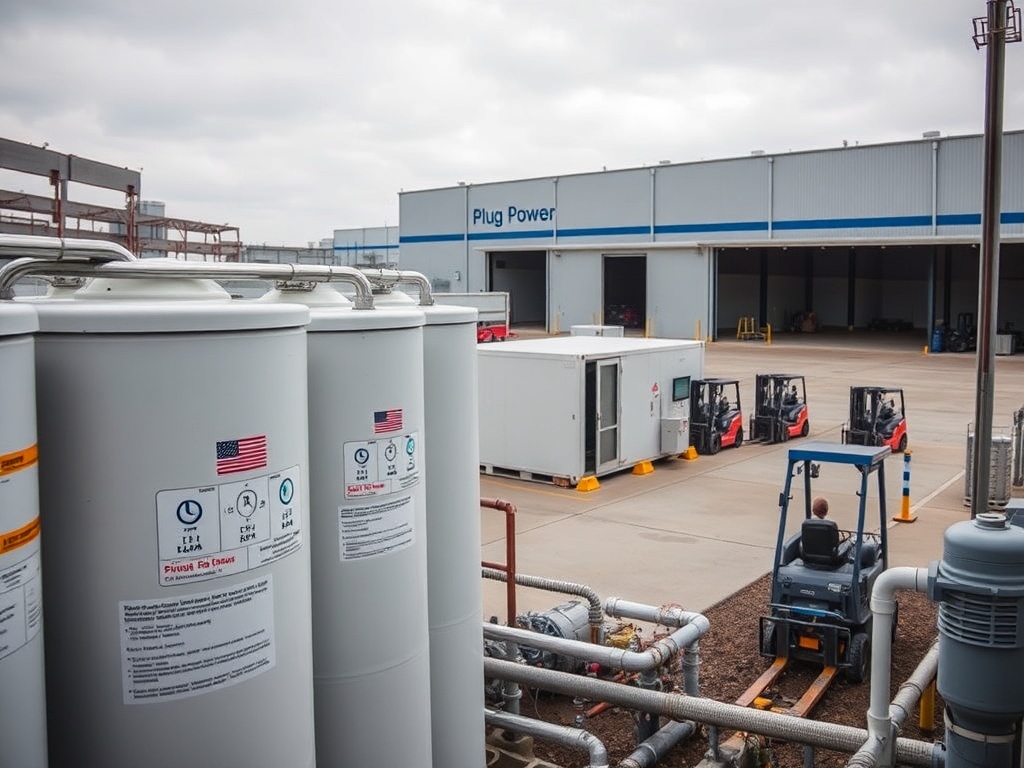

Plug Power Changes CEO to Shift from Promises to Profits
By Ricardo Mendieta
Plug Power, a hydrogen solutions company based in Slingerlands, New York, announced that Jose Luis Crespo officially became Chief Executive Officer on March 2, 2026, succeeding the long-time CEO Andy Marsh, who will now serve as Chairman of the Board. On the surface, this appears to be continuity; however, for executives, the underlying message is that the company is transitioning into a phase where narrative is insufficient, and the board demands measurable financial outcomes.
Key facts are on the table. Crespo arrives with over 12 years of experience at Plug Power, carrying the most critical credential for this moment: leading the commercial expansion that saw the company grow from approximately $27 million in revenue in 2013 to over $700 million by 2025. As Chief Revenue Officer since November 2024, he reported a pipeline exceeding $8 billion in strategic opportunities. However, it’s important to note that the financial context surrounding this leadership shift is challenging: the company itself indicates a decline in revenue from 2023 to 2024, a deeply negative EBITDA, and a deterioration in shareholder returns during that period.
This clash—real commercial scale against absent profitability—explains why this appointment is a leadership decision, and above all, a strategic move aimed at actionable results.
A Transition Announced as the Market No Longer Tolerates Improvisation
The fact that the succession was announced months in advance is crucial because it reduces internal political noise and focuses on execution. Plug Power is not improvising a replacement amidst a reputational crisis; it is completing a well-planned transition. Marsh, who led the company to an integrated hydrogen offering, remains as Chairman, which preserves institutional memory and governance weight. This could be a benefit if utilized to maintain discipline, but also a risk if used to uphold old patterns.
Crespo's arrival indicates that the board favors a profile familiar with the business engine from within. His career trajectory has been about building: he joined in 2014 as vice president of business development and international sales, later led global sales and business units, and became president in October 2025. The implicit message is clear: Plug is not searching for an “external surgeon” to make cuts; it is choosing someone who knows the sales machine, the portfolio, and the operations.
However, this is where many companies fool themselves; promoting the most successful commercial leader does not guarantee a balanced Profit & Loss statement. In fact, it often highlights the real issue: a sales muscle has been built faster than a profitable delivery muscle. Plug operates with over 74,000 deployed fuel cell systems and more than 50,000 GenDrive products in electric material handling equipment. This installed base lends operational legitimacy, yes, but it also creates obligations: service, availability, hydrogen supply, maintenance, warranties, and capex. In asset-intensive businesses, “commercial success” can become a trap if the costs of serving each contract are not kept in check.
Within this context, the appointment is not a reward for the past; it is a mandate to organize the future.
The Real Work for the New CEO: Turning Pipeline into Cash without Inflating the Balance Sheet
An $8 billion pipeline sounds abundant, but for a CEO aiming for profitability, it also poses significant risk. A large pipeline can conceal three problems: low-quality opportunities, contracts with fragile margins, or projects requiring equity capital before generating returns. In hydrogen, the latter point is deadly when combined with unchecked ambition.
Crespo has stated priorities that, in this sector, matter more than any technological promise: disciplined execution, margin improvement, and capital efficiency to achieve profitable growth. This triad suggests that Plug is trying to rearrange its order of operations: first consistent financial performance, then expansion. The company has already set publicly binding dates: positive EBITDA by the end of 2026, positive operating income by the end of 2027, and full profitability by 2028. The significance is that these goals, in isolation, are not a strategy. Strategy consists of the difficult decisions that make achieving them likely.
Here is where the installed base and the integrated portfolio can either work for or against the company. Plug operates through hydrogen production, electrolyzer projects, and supply infrastructure. Integration can enhance margins if the entire chain is controlled and efficiencies captured. However, it can also destroy capital if assets are built before there is firm contractual demand and pricing conditions that justify the infrastructure.
Crespo's most concrete contribution is operational: he highlighted that the performance of the production plant in Georgia strengthens the value proposition of electrolyzers, as producing and delivering hydrogen with proprietary technology “enhances customer value and improves margins.” This statement has executive implications: the CEO is connecting technology with unit economy, not narrative. If this discipline is maintained, the company can prioritize projects where true integration increases margin while minimizing dependence.
The temptation, in contrast, lies in attempting to turn the entire pipeline into announcements. That is where control over capital is lost.
Iconic Clients do not Foot the Bill if the Contract is Poorly Designed
Plug Power has established relationships with major global customers like Amazon, Walmart, Home Depot, General Motors, Stellantis, Galp, and Iberdrola, along with European expansions involving Carrefour in France and ASDA in the UK. This list impresses generalist investors and opens commercial doors. However, from a leadership perspective, it also creates a dangerous bias: confusing “logos” with “margins.”
In material handling, Plug has a proven business: GenDrive in fleets of electric equipment. This provides recurrence and an operational base that many competitors do not possess. The typical risk of this segment is erosion from service costs and contracts that underestimate the real cost of operation just to win the deployment. As the portfolio expands into industrial and energy projects, risks change: longer timelines, regulatory dependencies, deferred investment decisions, and pressure for financing.
During a briefing, Crespo mentioned multi-gigawatt quotes in Spain and anchor projects like 25 MW with Iberdrola and 100 MW with Galp. In this type of project, leadership is measured by two behaviors: the accuracy of conversion—what percentage reaches the final investment decision—and contractual discipline—what price conditions and capex responsibilities are accepted.
Here lies the core of the dilemma: the company is a “first mover” with real deployments, yet it is emerging from a period where financial performance has lagged. This does not discredit the technology; it invalidates tolerance for dispersion. For Crespo, the task is to select which clients and which geographies merit capital and which need to be postponed, even when the sales team may be able to close a deal.
At this point, leadership is not about opening markets. It is about shutting doors in a timely manner.
Marsh’s Transition to Chairman: Useful Continuity if it Becomes Discipline
Marsh stated that leading Plug was “the privilege” of his career and credited Crespo as instrumental in scaling commercial and operational capabilities. This public validation eases the handover. But the structure of power is more important than tone: with a new CEO and the Chairman remaining, governance can function as a stabilizer or a brake.
When a company announces a turn towards financial discipline, it needs the board to be consistent with that shift. Consistency means accepting unpopular decisions: slowing expansion, reorganizing the portfolio, reprioritizing capex, and tightening revenue recognition criteria. In the briefing, Crespo explicitly emphasized disciplined revenue recognition. This is a signal that “growth” will now be measured with stricter rules.
There is also a backdrop that must not be overlooked: the performance from 2023 to 2024 and the deterioration in returns for shareholders intensify the pressure. In capital markets, patience wanes when EBITDA is deeply negative. In asset-intensive sectors, the typical exit strategy to sustain the plan is to finance at higher rates, dilute, or cut back later. A CEO with a commercial background tends to understand an uncomfortable truth: selling more does not fix a business model that loses money on each unit delivered.
Thus, Crespo’s “success” will not be increasing the pipeline; he already has that. It will be about closing the gap between promise and profitable delivery with an organization that does not self-deceive.
The Real Mandate for C-Level Executives: Choose Which Business Plug Power Will forgo
Plug Power positions itself as an integrated hydrogen company: production, storage, delivery, and generation. This ambition makes industrial sense, but only works if the company accurately decides what part of the value to capture and which to externalize. The profitability goals for 2026-2028 imply that margins must improve and that capital must yield. This demands concrete trade-offs: projects that are too large for the balance sheet, geographies with slow investment decisions, contracts with service conditions that destroy cash, and deployments won by price that are lost due to costs.
Crespo arrives with the internal authority of someone who built the commercial muscle and with an added advantage: he knows where the historical concessions were made to secure sales. This gives him the opportunity—if backed by the board—to redesign the standard for what constitutes an “acceptable contract.” Meanwhile, Marsh’s continuity as Chairman can protect the transition, provided it is used to ensure consistency rather than to preserve expansion as identity.
The lesson for any C-Level executive in energy and industrial technology is brutally simple: when the market shifts the criteria for success from growth to profitability, the company that survives is the one that converts its narrative into a decision-making filter, not a poster. The new CEO of Plug Power is entering a period where the work is not to inspire but to narrow options until the economic model closes.
The discipline that separates the companies that reach 2028 from those that erode consists of choosing—painfully and unambiguously—which opportunities to forgo in order for capital and operations to concentrate on the few bets capable of yielding real margins, because trying to do everything only accelerates the path to irrelevance.