
The Electric Car Slowdown in the UK Isn't About Technology: It's a Poorly Marketed Value Proposition
By Camila Rojas
The automotive industry in the UK faces a significant paradox that troubles anyone focused on market share, margins, and regulatory compliance. In 2025, there were over 473,000 BEVs registered, marking a 23.4% market share and an impressive 23.9% year-on-year growth. By February 2026, electric vehicles reached a 24.2% market share with 21,840 units sold. It sounds like progress. It sounds like a trend. It sounds like a transition underway.
However, the benchmark is no longer set by early adopters’ enthusiasm; it’s dictated by the ZEV mandate, which requires 28% of sales to be zero-emission by 2026. As industry leaders prepare for this transition, they claim that the required investment is already “monumental” and cannot be indefinitely sustained without corresponding demand, as warned by SMMT CEO Mike Hawes.
The easy conclusion is to blame infrastructure or technology. However, a more useful analysis reveals that the electric vehicle is caught in a communication strategy aimed at convincing those who are already convinced. Meanwhile, non-customers continue to operate under a perception of cost and risk that cannot be changed by more ads touting range.
The Psychological Gap of Total Cost is Winning Over Engineering
The crucial metric that should dominate boardroom discussions isn’t about chargers or range. It’s this: 65% of drivers believe the total cost of ownership of an electric vehicle is higher than that of a combustion engine vehicle. This perception persists even when maintenance tends to be lower and firsthand experiences generally dispel myths.
Here we see the marketing failure precisely. The industry touts performance, acceleration, “zero emissions,” and flashy displays. Yet the mass market seeks financial peace of mind: predictable spending, tax clarity, resale value, insurance, and zero friction in daily usage. If the majority believe the total cost will be higher, a great product can still fail miserably in the market.
Cox Automotive’s report presents a contrasting insight that dismantles the usual narrative: 95% of EV owners would choose an electric vehicle again. That figure isn’t merely a detail; it’s a diagnosis. When consumers use the product, they stick with it. The leak occurs before the purchase—specifically, at the “I am considering it” stage.
And this stage is being affected by political noise. Reports mentioned in the briefing indicate that the proposal for a per-mile tax starting in 2028 is already eroding confidence. Even if the measure isn’t implemented yet, its mere existence as a possibility alters mental calculations: if customers feel they’re going to face tax changes after signing, they will delay their decision.
On top of this, there’s a problem of poorly communicated incentives: there’s the Electric Car Grant of up to £3,750 for qualifying models, additional charging subsidies, and a tax ruling that might allow public charging VAT to drop from 20% to 5%, pending approval. The operational question for a sales team is direct: how many people understand this in an actionable way when deciding? The briefing indicates that 71% claim incentives matter if understood. It’s not a lack of levers; it’s a lack of clarity.
Infrastructure is Growing, but the Non-Consumer Doesn’t Believe It
By the end of 2025, the UK reached 116,052 public charging points, up from 102,771 at the close of 2024, marking a 13% increase. In 2025, 3,425 ultra-fast chargers (150 kW+) were added, showing a 40% year-on-year growth. Even more interesting, these ultra-fast chargers already handle 45% of sessions, compared to 29% in 2022. This isn’t just decoration; it's about service capacity where range anxiety is felt most.
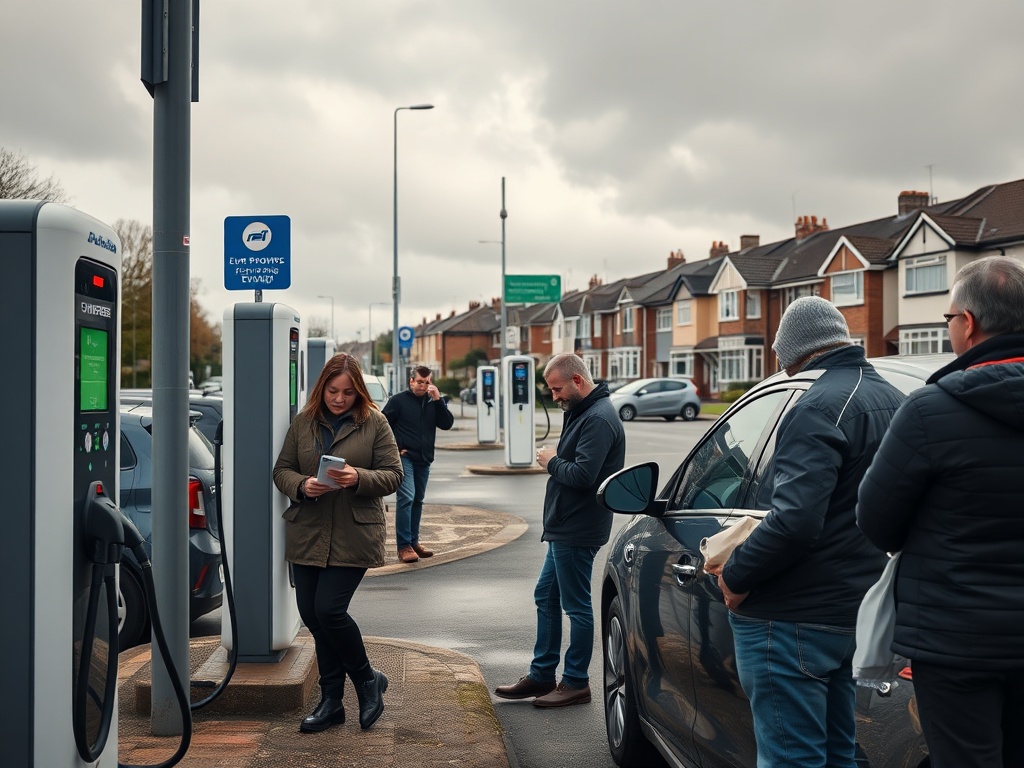
However, the market does not operate based on technical maps but on perceptions. Cox Automotive captures this with a nearly cruel contrast: 47% of non-owners cite public charging accessibility as their main concern, while only 12% of owners do. Meanwhile, 94% of owners rate their local public charging positively, yet only 32% of non-owners agree.
That disparity is gold for marketing but also evidence that the industry is failing in messaging and product design. The issue isn’t merely communicating “there are chargers.” It’s about reducing the cognitive and operational friction of locating, paying for, and trusting the charging process. The non-customer shouldn't have to investigate apps, pricing, and power levels before buying a car.
In its obsession with competing “on specifications,” the industry continues to add complexity: more models, more packages, more configurations, more plans, and more promises. Then it wonders why the mass market sticks with gas or hybrids. Over-servicing becomes a fixed cost and a source of confusion.
Data on range also indicates that fear no longer aligns with the average product: a new EV typically offers 236 miles of range under normal usage. For most driving patterns, this exceeds daily needs. Yet marketing insists on selling range as if it’s the only argument, further reinforcing skeptics’ mental framework: “if they talk so much about range, it must still be a problem.”
The Real Battle Isn’t EV vs. Combustion: It’s Experience vs. Friction
The automotive industry tends to view the transition as a technological substitution. This perspective drives competition that involves copying the competitor: the same variables, the same claims, the same comparisons. The outcome is a category that becomes indistinguishable, where customers decide based on price, subsidies, or fear.
Briefing data suggests another landscape. Adoption is high in certain areas, driven by local investment and clean air zones: Bristol has 55% EV ownership among respondents, Belfast 49%, Birmingham 46%, Nottingham 43%. London sits at 39% in that sample. There’s also a significant generational bias: 65% ownership in the 25-34 age group, 57% in the 34-44 group. Demand exists but isn’t evenly distributed.
For marketing, this has a profound implication: the EV does not sell as a “uniform national product.” It’s sold as a local and demographic solution, scaled by replicating winning conditions. If a region converts because access to charging and the regulatory framework become tangible, the strategy isn’t to shout louder nationwide. It’s to package that experience and export it.
In terms of value curve, there are four maneuvers that could separate leaders from followers without escalating inertia costs:
Eliminate the aspirational “future” narrative as the primary argument. That discourse now increases friction for segments that view it as an “expensive experiment.”
Reduce the commercial complexity catalog that forces research: incomprehensible charging rates, confusing bundles, and engineering-based rather than usage-focused communication.
Increase financial certainty: simple total cost simulations, conservative tax scenarios, and guarantees that address fears of depreciation and regulatory changes.
Create a transitional product for non-customers: not another car but an operational promise. For example, an “electric mobility package” where the customer buys predictability: home charging access, support, and a fixed or limited price per mile. The industry fears this because it seems to sacrifice margin. The reality is it can turn fixed costs into variable ones and, most importantly, turn undecided buyers into sales.
This approach is also the antidote to erosion from the per-mile tax. When the fiscal framework is uncertain, those who package stability, even if partially, will win, particularly if they design contracts that absorb some risk in exchange for volume.
The Transition Unfolds When C-Level Stops Copying and Starts Validating
The UK market is progressing, but not at the pace demanded by the mandate. A 24.2% share in February 2026 still falls short of the 28% required in 2026. When SMMT’s CEO states that the costs of stimulating demand cannot be sustained indefinitely, he describes the limits of a push-product strategy rather than redesigning the offering for the non-customer.
The most uncomfortable evidence for executive committees is that the product works when used: 95% satisfaction, concerns over public charging dropping from 47% among non-owners to 12% among owners, and a “good” local infrastructure perception among 94% of owners. This isn’t a late adoption issue due to performance; it’s an entry problem caused by perceived friction.
In marketing, the focus is no longer on amplifying benefits. It’s about shifting the purchase focus: from “an electric car” to “a surprise-free outcome.” As long as the industry continues to compete on the specifications scoreboard, its fate will be a bloody ocean of discounts, difficult inventory, and regulatory pressure.
The leadership that matters in this transition isn’t measured by how much capital is burned to scrape market share in a saturated market, but by the boldness to eliminate what doesn’t matter, reduce complexity, and create a proposal that non-customers can accept without studying or gambling.