
Anthropic Acquires Six-Month-Old Biology Startup for $400 Million
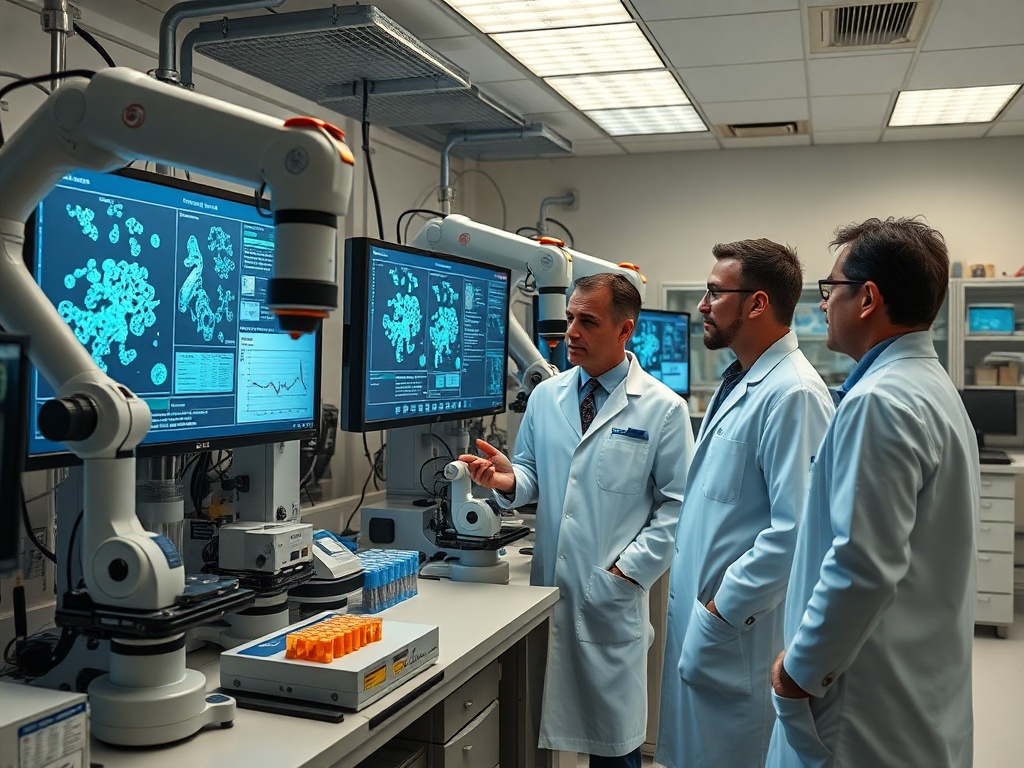
Coefficient Bio was less than a year old when Anthropic signed the acquisition deal. Founded in September 2025 by Nathan Frey and Samuel Stanton—both from Genentech's Prescient Design unit—the startup hadn't even emerged from stealth mode. There was no public product, no confirmed clients, and no available traction metrics. What they did have was a strong institutional track record, backing from the venture capital firm Dimension, and a thesis: to automate complex laboratory workflows using artificial intelligence models, spanning from drug research and development planning to managing clinical regulatory strategies.
The agreed price was just over $400 million in a stock exchange. Anthropic, which is considering an IPO as soon as October this year, has integrated the team into its Life Sciences and Health division, led by Eric Kauderer-Abrams.
The question that media outlets are not asking with enough seriousness is this: What exactly did Anthropic buy for $400 million?
What Anthropic Truly Acquired is Not Technology
In acquisitions of early-stage startups, the technical answer is always the same: talent. However, that word, used so lightly, conceals a much more specific mechanics.
Frey and Stanton did not arrive at Coefficient Bio with a laboratory prototype built from scratch. They arrived with something more valuable in today's AI applications market to biology: institutional networks within the pharmaceutical industry, deep understanding of regulatory workflows, and the credibility of having operated within one of the world's most advanced protein design units. Prescient Design, their Genentech unit, is known for applying machine learning to antibody design. This is not generic AI knowledge; it is domain knowledge accumulated over years that is difficult to replicate by hiring software engineers.
Consequently, Anthropic paid for an acceleration. Not for a finished product, but to leapfrog the three to five years it would take to build from scratch the credibility, contacts, and operational understanding that these two founders already possess within the pharmaceutical sector. At $400 million in stock—not cash, a detail that mitigates treasury risk ahead of a potential IPO—the price becomes a bet on the value that this team can generate within Anthropic's structure, rather than what has already been built.
From a unit economics perspective, this logic only works if Anthropic has the organizational infrastructure to absorb that talent without stifling it. And that’s where the audit becomes interesting.
The Transplanted Founder Syndrome
There’s a well-documented pattern in early-stage talent acquisitions: the founding team enters with the energy and autonomy of someone running their own company, and two years later, they are trapped within the processes of an organization with thousands of employees, producing a fraction of their potential. This is not a failure of intent but a failure of architecture.
The central risk of this acquisition is not technological or regulatory. It is structural. Coefficient Bio integrates into a team led by Kauderer-Abrams within a company that, if it completes its IPO this year, will simultaneously be managing the pressures of public markets, a growth narrative before institutional investors, and the integration of at least one significant acquisition. Rarely do these three pressure vectors resolve in favor of the autonomy of the acquired team.
What Frey and Stanton will require to generate the value that Anthropic is discounting in those $400 million is not access to more computing power or better base models. It is a clear mandate, space to experiment with startup speed, and a decision-making chain short enough to avoid getting buried in layers of corporate approval. In life sciences, where regulatory cycles are long and scientific hypotheses are validated over months, not in two-week sprints, any added bureaucracy becomes an invisible cost multiplier.
The question that Anthropic’s C-level executives should be addressing operationally today has little to do with valuation. It has everything to do with the design of the organizational container where this team will operate.
A Bet on the Future of Automated Labs
Beyond the specifics of this transaction, the acquisition of Coefficient Bio signals a strategic direction that deserves industry-wide analysis.
Pharmaceutical labs face a scaling problem that no budget increase solves linearly: the gap between the speed at which AI can generate molecule hypotheses and the speed at which physical experimental processes can validate them. Automating the workflows of planning, experimental design, and regulatory management is not an operational luxury; it is the necessary condition for the promise of AI in drug discovery to manifest into approved products and not just academic papers.
In that context, Anthropic is positioning Claude not only as a productivity assistant for generic industries but as the reasoning layer upon which specialized agents for high technical and regulatory complexity domains are built. The pharmaceutical sector, with its elevated margins and historical willingness to pay for reduced time in approval cycles, is a coherent target market for that ambition.
What remains unresolved—and what this acquisition alone does not answer—is whether Anthropic has the organizational maturity to simultaneously manage the pace of a biological research lab, the transparency requirements of a publicly traded company, and the competitive pressure from Microsoft, Google, and a dozen well-capitalized startups targeting the same segment.
Management Structure is the Product
Anthropic is not a small company acting impulsively. It has experienced executives, sophisticated investors, and a recognized technical culture. But $400 million in shares for a six-month startup is, above all, a declaration that the company trusts more in judgment about people than in evidence of results.
That bet could be brilliant. It could also be the type of decision that, reviewed three years from now, reveals that a hefty premium was paid for talent that never found the space to operate with the autonomy that made it valuable in the first place.
The difference between both scenarios is shaped not by Coefficient Bio’s technology or the potential of the life sciences market. It is determined by whether Anthropic’s management team can build a sufficiently horizontal structure with real delegation, so that Frey and Stanton can make lab decisions without needing approval from four hierarchical levels for each experimental pivot.
Leaders who build enduring organizations understand that their job is not to centralize judgment but to design systems where the right judgment can emerge in the right place, at the right time, without depending on their presence. Anthropic now has the opportunity to demonstrate that it knows how to do exactly that with the team it has just incorporated. The acquisition’s price will be justified or not based on that structural capacity, not the number signed in the contract.