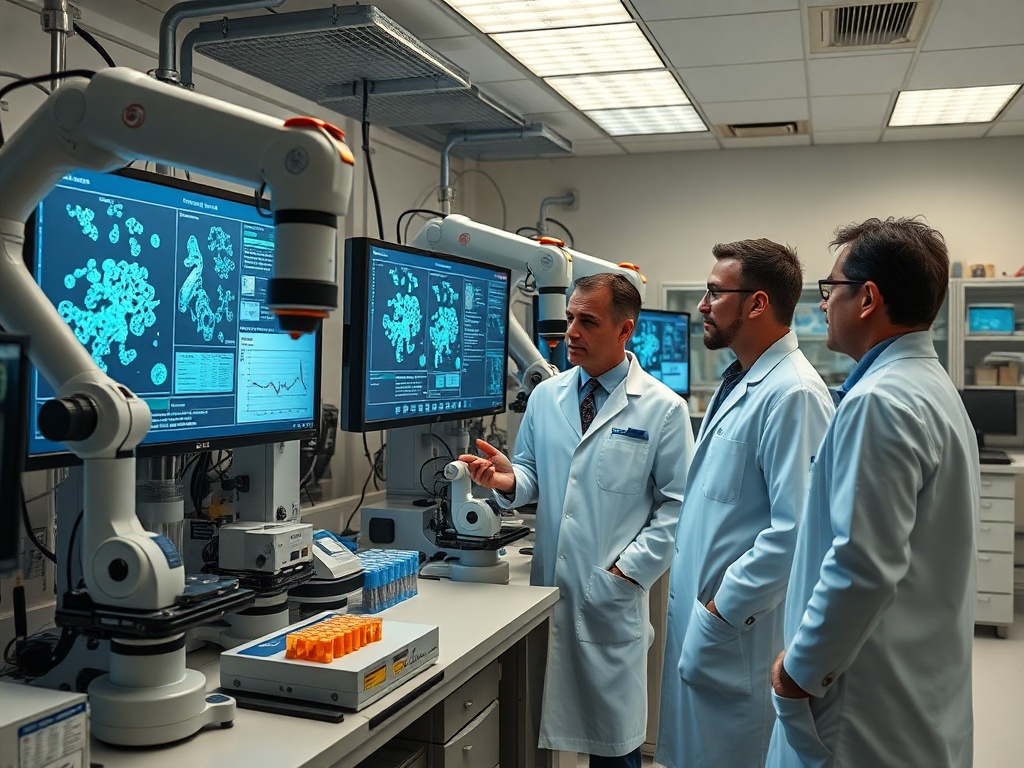

Anthropic's Most Costly Bet is Not a Language Model
Anthropic has just made the most telling acquisition in its brief history. According to reports from The Information and journalist Eric Newcomer, the company acquired Coefficient Bio, a biotech startup operating in stealth mode, in a deal valued at $400 million paid in stock. There’s no official statement. No published revenue figures. No product on the market. Just a nine-figure strategic bet on AI's ability to intervene in molecular biology.
That, in itself, warrants serious analysis.
Anthropic's decision should not be interpreted as diversification of its portfolio. It should be seen as a statement of positioning: the battle for leadership in artificial intelligence is no longer fought solely in the realm of language, but in areas where computational models have physical, irreversible consequences under strict regulation. Moving into biotech is not merely expanding a software business; it is changing the nature of risk, the scale of impact, and, above all, the architecture of value generation.
What I am interested in auditing is not whether Anthropic paid a fair price. What intrigues me is what this operation reveals about how power is being constructed at the intersection of artificial intelligence and health.
Paying in Stock is Not the Same as Paying in Cash
The payment mechanism matters as much as the price. Anthropic structured this deal in stock, not cash. This indicates a company that manages its capital with surgical precision: preserving operational liquidity while offering participation in its future growth as a currency of trade.
For Coefficient Bio, accepting this deal implies betting on Anthropic's future valuation. For Anthropic, issuing stock instead of cash means that the real cost of the acquisition is indexed to its own performance. If Anthropic grows, the cost was modest. If it fails to grow, it paid dearly. It is a financial structure that aligns forward incentives, but also concentrates risk in one direction.
Now, the strategic question that no headline is posing is: Coefficient Bio operated in stealth mode. With no documented public traction, no visible customers, and no published revenue, financially speaking, this means Anthropic did not buy a revenue stream. It bought intellectual property, scientific talent, and possibly proprietary biological data that no public language model can generate on its own.
This completely changes the analysis. We are not facing an acquisition aimed at accelerating revenue. We are witnessing an acquisition meant to build a barrier to entry that money alone cannot replicate. High-quality biological data, annotated and ready to train models, is scarce by definition. And scarcity, in any market, is power.
When AI Meets Biology, the Extractive Model Has Different Consequences
My job is to audit whom a business model enriches and whom it impoverishes. In the pharmaceutical and biotech sectors, this audit has dimensions that extend far beyond operational margins.
The track record of the pharmaceutical industry shows a well-documented pattern: the most costly innovations tend to reach high-paying markets first and at a better price. Middle and low-income healthcare systems receive these innovations late, marked up, or simply don’t receive them at all. If AI applied to biotech is built on that same distribution model, the result won't be democratized access to health. It will accelerate the existing gap.
Anthropic is not a pharmaceutical company, and it’s too early to know exactly what Coefficient Bio was developing. However, the market structure towards which this acquisition is directed has very clear historical incentives: maximize return on investment in R&D by steering products towards high-paying segments.
What makes this bet unique, at least in potential, is that AI models have near-zero marginal replication costs once trained. This opens a possibility that traditional pharmaceutical companies did not have: distributing diagnostic capabilities, molecular predictions, or compound design at a radically lower access cost. The model can be both sustainable and far-reaching simultaneously if the business architecture is designed with that goal from the start.
If it's designed merely to monetize through private insurance and high-income health systems, they will have built another efficient extraction machine with very good public relations.
The Stealthy Startup as Market Signal
There’s something analytically provocative about the fact that Coefficient Bio operated in stealth mode until its acquisition. In the world of high-impact potential startups, stealth has two possible interpretations.
The first is operational: some biotechnology companies work in secret because their scientific advancements require intellectual property protection before public exposure. Talking before patenting can destroy years of work. That is prudence, not opacity.
The second interpretation is more uncomfortable: stealth can also be a positioning strategy for a quick exit. It builds under the radar, generates enough technical depth to be acquireable, and sells before having to demonstrate that the model works with real customers. In that scenario, founders capture value without proving their technology solves anything in the real world.
With $400 million in stock on the table, the structural incentive for that second path is obvious. I point out the pattern because it’s relevant for any company evaluating building in the biotech sector with artificial intelligence: the difference between building a sustainable impact business and constructing an acquirable asset lies not in the technology, but in who you owe accountability to. Startups solely funded by venture capital owe returns to their investors. Startups with paying customers from early stages owe results to the market. These are distinct incentives that lead to different decisions.
Money as Fuel, Not as Destination
Tech and health sector leaders reading this operation as a signal of where to allocate resources are correct to pay attention. The convergence of artificial intelligence and molecular biology will reconfigure discovery costs, development timelines, and distribution architectures across the healthcare industry. That is inevitable.
What is not inevitable is the model under which that reconfiguration occurs. Every company that today decides to enter that market is making design decisions that will determine whether AI in health expands or restricts access. Whether biological data accumulates in the hands of three private companies or if open infrastructures are built to allow health systems from different economic contexts to benefit from the same advancements.
Anthropic just paid $400 million in stock for a startup that nobody knew about. That is the magnitude of capital flowing into this intersection. The mandate for any leader in a position to influence how these models are constructed is clear: audit whether their company is using people and their biology as inputs to generate returns, or if it has the strategic audacity to use that return as fuel to give more people access to what that technology can do.