
The Affordable Vegetarian Shift of EveryPlate: A Scaling Strategy, Not a Value Proposition
EveryPlate, HelloFresh’s low-cost brand launched in 2018, operates under a straightforward promise: $4.99 per serving plus a fixed weekly shipping fee of $8.99. This is the kind of offer that is not aimed at romance but closed, repeatable transactions. In this context, a Wired review highlighting its vegetarian selection as "basic but tasty" is more than just culinary anecdote; it signifies a model design.
When a company competing on price gets a segment to perceive value without raising the ticket, it demonstrates system control: purchasing, portioning, recipes, production, logistics, and demand learning. EveryPlate doesn't need to be aspirational; it needs to be predictable, with the perception of "good for the price" maintained week after week.
What matters here isn’t the sophistication of the vegetarian menu; it's that well-executed vegetarianism can serve as a silent lever to reduce complexity, stabilize supply chain, and protect margins in a fiercely competitive price offering. This directly ties to the group's structural advantage: HelloFresh serves 8.0 million active customers across 15 countries and delivers over 1 billion meals per year, with around 50 weekly options priced between $6-$13 per meal depending on the market and recipe. Such muscle is built not from marketing but from machinery.
EveryPlate Benefits When "Variety" Becomes a Controlled Product
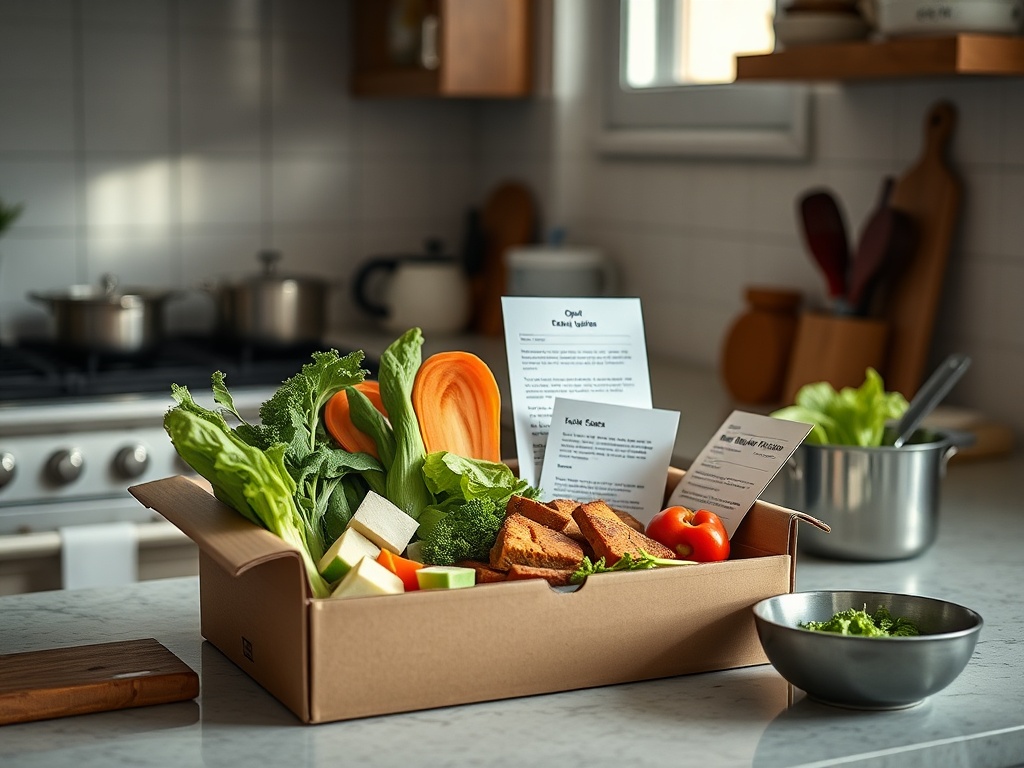
A common mistake when analyzing meal kits is believing they compete on culinary creativity. At scale, they compete on something colder: operational reliability on demand. HelloFresh positions itself with breadth and relative sophistication, while EveryPlate takes a lean approach: 13 weekly recipes, “filling” dishes, step-by-step cards, and portioned ingredients. The Wired review aligns perfectly with that contract: vegetarian yes, but within the bounds of basic.
This categorical difference isn’t aesthetic; it’s architectural. Maintaining 50 rotating options involves more testing, more exceptions, more stock breakage risks, and a less forgiving supply chain. Keeping 13 reduces friction and enables price competition. EveryPlate can use vegetarianism as part of that simplification: lesser reliance on animal proteins, reduced sensitivity to certain input volatilities, leading to a more standardized execution.
Critically, vegetarianism here doesn’t operate as a manifesto but as a menu module. A module works if it meets three conditions: it’s well-procured, easy to produce, and repeatable without exhausting the customer. The review defining it as "basic but tasty" delivers precisely the validation an operator wants to hear: it demands no luxury, requires no rarities, yet delivers satisfaction.
And there’s an important nuance: the perceived value in meal kits isn't only the final dish. It’s the decision relief, the exact portion, and the relative "no waste" against buying complete ingredients. In a budget-conscious household, that psychological package can be as crucial as the flavor.
CustomPlate and the Art of Charging for Deviations without Breaking the Low-Cost Promise
In August 2020, EveryPlate launched CustomPlate, allowing protein or side dish changes for an extra charge of $0.49 to $3.99 per serving, and even a weekly "premium" option for an additional $2.99 per serving. General Manager Yury Trofimov framed it operationally: they listened to customers desiring customization without losing convenience and decided to “put control in the customers' hands.”
Translated into real business language, CustomPlate does two things simultaneously.
First, it defends the base proposal. The entry price remains aggressive. They don't dilute the positioning with an “now we're more expensive,” but introduce a monetization lane for those desiring something different. The standard product remains intact.
Second, it turns customization into a fee-based service, not a right. This is discipline. Customization can often lead to a complexity factory: more SKUs, more picking, more errors, more returns, higher costs. EveryPlate aims to rein it in: limited, chef-tested changes for compatibility within predefined options. The message is simple: there’s freedom, but within designed limits.
In a business where the weekly shipping is fixed ($8.99 for both EveryPlate and HelloFresh), the math gets delicate. That shipping weighs more on smaller orders, pushing customers to increase portions or weeks to mentally “amortize” it. CustomPlate functions as an additional incentive to raise value per box without breaking the “cheap” frame.
Vegetarianism also benefits from this logic: it’s a choice many consumers accept and repeat, allowing for occasional swaps for those not keen on strict adherence. The result is a spending ladder: you enter for price, stay for convenience, and pay extra for controlled whimsy.
HelloFresh’s Real Advantage is Financial and Logistical, and EveryPlate Monetizes It in the Price-Sensitive Segment
HelloFresh has been described as a direct-to-consumer company with a tech DNA and an uncommon scale advantage in meal kits. What matters for this narrative isn’t the adjective, but the consequence: a large-scale leader can operate with a demand logic that reduces relative waste, pressures procurement costs, and learns quickly from preferences.
The group boasts difficult-to-copy dynamics for smaller players: a demand-driven model, a SKU catalog far lower than a supermarket, and procurement cost improvements over years due to volume and negotiation. Such efficiency allows for something that at first glance appears impossible: sustaining a brand at $4.99 per serving without the experience feeling punishing.
Here EveryPlate plays a role often executed poorly by many corporations: real segmentation. It’s not “more of the same” with a different logo; it’s a product designed for another customer pain threshold. HelloFresh, with a cited average of $8.99 per serving, can sell variety and a degree of sophistication. EveryPlate sells sufficiency.
The Wired review matters because it confirms that, even in sufficiency, there's a minimum of enjoyment. This boosts the likelihood of repeat business, and in flexible subscriptions, repetition is the asset. However, the meal kit market carries a structural issue: post-promotion churn. Hence the importance of limited customization and a competent vegetarian menu: not for ethics, but for retention.
There’s also a competitive power component. If HelloFresh dominates the space and also captures the budget segment with a separate brand, it shrinks the space for a competitor to come in “from below.” The competition is no longer just against other recipe boxes; it’s against supermarkets, fast food, and consumer fatigue.
The Strategic Risk: Confusing Menu Expansion with Identity Expansion
Easy growth is the type that demands no sacrifice. And it’s the most dangerous.
EveryPlate can broaden vegetarian options, expand customization, push premium offerings, and imitate HelloFresh’s variety. But each step in that direction jeopardizes its advantage: operational simplicity and value perception. If the budget-conscious customer starts seeing surcharges everywhere, the brand becomes a tollway. If the catalog inflates, stock outages and substitutes appear, and the promise of convenience degrades. If the product becomes too “sophisticated,” it ceases to be credible as an economical option.
The current design suggests a discipline worth preserving: a cheap, stable core, and charged, limited deviations. Within that framework, vegetarianism works because it doesn’t demand EveryPlate to be “everything to everyone.” It’s an offering dimension that can be integrated without breaking the system, so long as it stays within repeatable recipes, purchasable inputs, and standard processes.
For the group, the obvious temptation is to use the budget brand as a volume laboratory and then stretch upwards. That stretch often fails when motivated by growth anxiety and not by system coherence. HelloFresh already has a brand for variety. EveryPlate exists to defend the pricing front.
The challenge for C-Level executives is to uphold a painful renunciation: protect simplicity even when the market applauds new options. Durable growth requires the discipline to firmly choose what to not offer, what not to customize, and what not to turn into “premium,” because trying to please all palates ends up degrading the model and pushing it toward irrelevance.