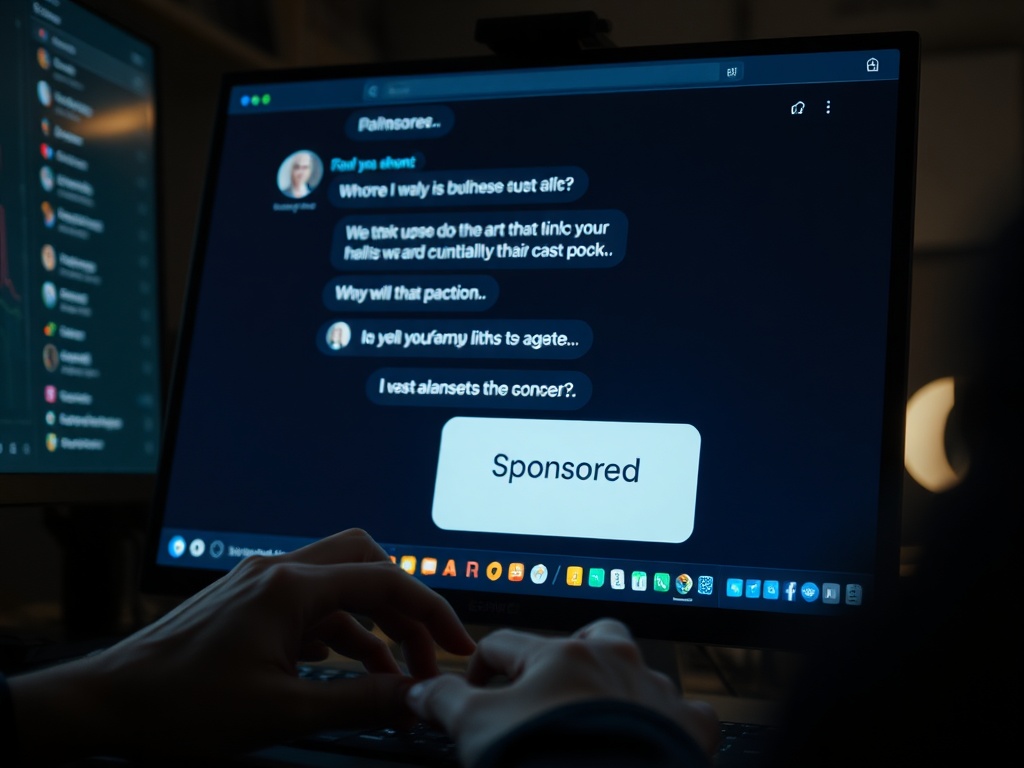

OpenAI has begun trialing advertising on ChatGPT with a deliberately conservative design: a limited pilot in the United States, only for adult users logged into the Free and Go plans, where sponsored content appears below the response and is marked as sponsored. Paid plans remain ad-free. The operational detail matters less than the corporate message: the company is experimenting with a model that historically converts massive audiences into revenue.
The numbers illustrate the urgency. ChatGPT operates at a scale of 800 to 900 million active weekly users, while less than 5% pay for premium tiers. OpenAI reported $20 billion in revenue for 2025, but projections cited in coverage suggest accumulated losses of up to $144 billion by 2029. The discussion around ads is no longer philosophical when the costs of infrastructure and computation dictate the pace. As attributed to Sam Altman, there’s a simple reality: many people want to use a lot of AI and don’t want to pay for it.
The pilot also reveals ambition. Access for advertisers is not self-service: a minimum commitment of $200,000 is required, with a CPM close to $60 being discussed. This isn’t advertising for SMEs; it’s a premium inventory with restrictions on sensitive topics—no health, politics, or mental health—and initial measurement based on impressions and clicks. Everything is designed to maximize control, minimize reputational crises, and, above all, learn quickly.
The Real Economy Behind Ads Marked as Sponsored
This move doesn't stem from a product whim. It arises from the mathematics of sustaining a conversational AI platform at a global scale with a predominantly unpaid user base. With less than 5% on premium plans, the subscription model alone leaves too much demand unmonetized. The company can grow revenue while still failing to close the gap if the marginal cost of serving interactions remains high and infrastructure spending surges.
The advertising pilot tackles this issue: monetizing free usage without touching the key promise of premium plans, which is to remain ad-free. This design also protects a second promise: that the ad doesn’t degrade the core value of the product. That’s why sponsorship appears below the response and reportedly operates in a separate system from the model, using the context of the conversation for segmentation, but without influencing the response. In terms of governance, OpenAI seeks to avoid the most corrosive scenario: users suspecting that the response was “bought.”
For now, the price reinforces the survival thesis with a premium aspiration. $60 CPM is not a timid number; it signals that OpenAI believes the conversational context is worth more than traditional keywords. The conversation contains intention, nuances, urgency, restrictions, and preferences. That is golden for retail, streaming, or connectivity—exactly the mentioned categories—assuming the buyer trusts quality control, activation transparency, and reporting.
A Turn That Demands Explicit Trade-offs to Avoid Contaminating the Product
Here lies the part many companies avoid verbalizing: advertising does not come “without a strategic cost.” It is paid for with trade-offs.
First Trade-off: Limited inventory and strict content rules. Excluding sensitive topics like health or politics minimizes risk, but also reduces the volume and variety of advertisers. OpenAI is stating it prefers to learn slowly rather than capture the entire market from day one. It is a prudent decision and a way to shield the product's positioning from regulators and public opinion.
Second Trade-off: Maintaining paid tiers without ads, including expanding principles so that Education remains ad-free. That’s a line in the sand. It implies accepting that the paying user will not be monetized twice. Many platforms cross that boundary and then cannot return: they either degrade the paid plan or fill it with “light formats.” OpenAI, at least in this pilot, is avoiding that slippery slope.
Third Trade-off: Not turning the chat into a paid ranking system. The coverage notes a crucial distinction attributed to Altman: context yes; pay-to-rank no, because it would be “catastrophic.” Strategically, it recognizes that one thing is monetizing attention, and another is selling the integrity of the response engine. If ChatGPT becomes a search engine where the payer appears, the primary asset—trust—erodes faster than any CPM.
The difficulty is that these trade-offs become more costly over time. As advertising business pressures for performance intensify, the temptation to broaden categories, increase frequency, or bring the ad closer to the response grows. The real test isn’t launching ads; it’s maintaining boundaries when revenue hinges on breaking them.
The Advertising Bet Is Also a Bet on Power and Measurement
The entry model —minimum of $200,000— acts as a power filter. It reduces the number of players, concentrates the pilot on large brands, and allows OpenAI to operate with a small number of business relationships, each with brand, compliance, and reporting requirements. It’s a way of buying time and control.
However, that same barrier reveals a tension: if the goal is to monetize a massive user base, the premium direct sales model scales slowly. In the short term, it’s defensible because the product is in an advertising learning phase, and any mistake costs reputation. In the medium term, it limits growth in advertising income unless a more accessible channel is opened.
The second axis is transparency. Executives and buyers cited in the coverage express doubts about metrics, ad triggers, and placement logic. OpenAI begins by measuring with basic standards—clicks and impressions—and promises to expand. It’s sensible but incomplete. In advertising, when the seller doesn’t accurately explain the “why” of the impression, the buyer assumes the worst-case scenario or cuts the budget.
And there’s a third, more delicate element: the use of conversation context as a signal. OpenAI asserts that targeting uses context and does not access personal data, in addition to separating the ads system from the model. Still, for users, perception matters more than architecture. An ad that's too timely may feel invasive even if technically correct. The pilot in one country and with restricted topics is, in part, a laboratory for perception.
For OpenAI, governance here is not a detail. It’s the core of the asset. If conversation is perceived as a commercial space before an assistive one, usage frequency declines. And if frequency drops, inventory becomes cheaper, and the premium CPM turns into a memory.
What the Market Is Really Buying When It Purchases an Ad in a Chatbot
Buyers are not paying for “an impression.” They are paying for a new unit of intention.
In traditional search, intention is approached with keywords. In a chatbot, intention is exposed with minimal friction: complete travel plans, product comparisons, budgets, constraints, considered brands, objections. This density of signals explains why the market projects a strong jump in advertising associated with AI-powered search-like experiences in the coming years, and why OpenAI is bold enough to set a high CPM from the outset.
But this unit of intention comes with a cost of responsibility. If the user entrusts decisions, sponsorship must be unequivocal. This is why the sponsored label and its position beneath the response are not just aesthetics; they are damage control.
There’s also a competitive effect. If OpenAI proves it can monetize free usage without destroying trust, it pressures the entire sector. Rivals maintaining an ad-free stance will be forced to finance subsidies with subscriptions or enterprise. Those adopting ads without limits risk destroying their own product. The industry won’t split between “with ads” and “without ads.” It will divide between those managing ads with discipline and those turning the chat into a sales shelf.
The final message for C-Level executives is uncomfortable yet clear. Monetizing with advertising in conversational AI is not just adding a channel; it’s about choosing what gets sacrificed to sustain scale. A company that attempts to sell subscriptions, sell ads, please all advertisers, and simultaneously promise absolute trust without operational limits will end up with a mediocre product and a fragile bottom line. Leadership is measured by setting boundaries and bearing the political cost of saying no, as the discipline to choose what not to do remains the only real antidote against irrelevance.