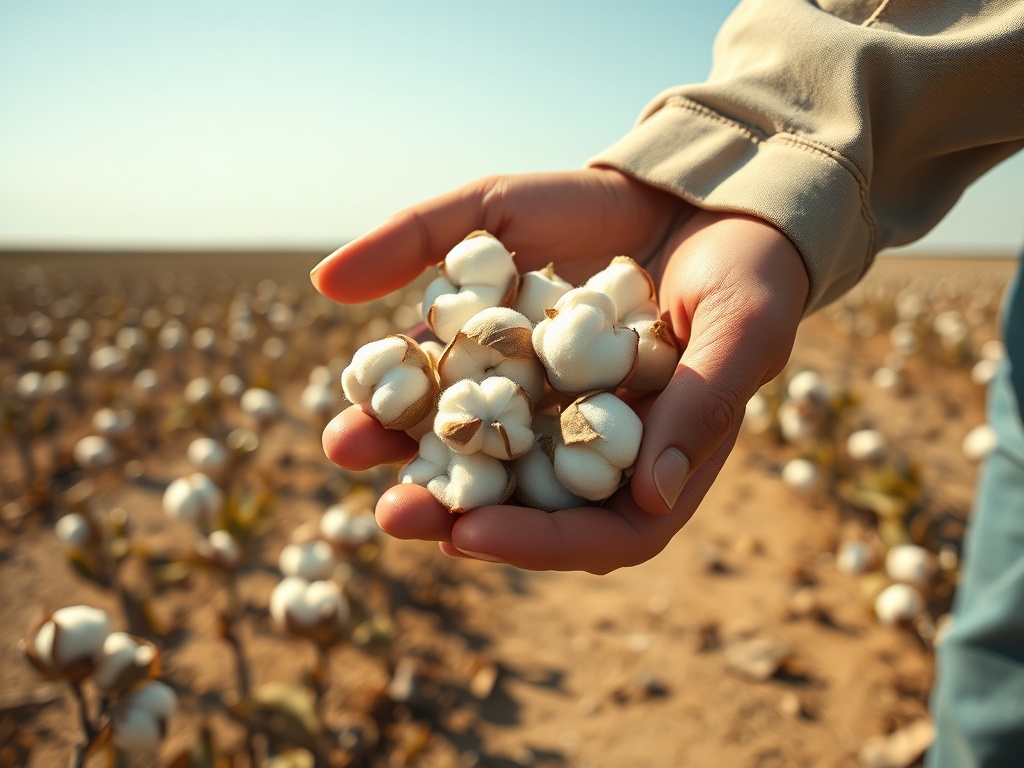

Two Startups Combine Data to Redesign Cotton from Within
On April 7, 2026, FarmRaise and Avalo Inc. announced a partnership that, at first glance, appears to be just another technological collaboration in agriculture. However, from an inside perspective, it represents a structural bet on how to build a competitive advantage when neither party can succeed independently.
FarmRaise operates from Riverside, California, serving as the data infrastructure layer for agricultural programs: it standardizes field information capture and translates it into actionable insights for operators and stakeholders. Avalo, founded in 2020 and headquartered in Durham, North Carolina, develops crop varieties using its artificial intelligence platform called Rapid Evolution Platform™, which analyzes entire genomes through interpretable machine learning. Together, they’re targeting cotton in the Texas Panhandle, with ambitions to scale across the United States. The launch of their first joint product is projected for the third quarter of 2026.
What makes this move interesting is not the technology itself but the logic of mutual dependency that underpins it.
Why Neither Could Progress Alone
Avalo faces a data problem it cannot solve internally without prohibitive costs. Its artificial intelligence models require consistent, audited field information captured under real conditions rather than in a laboratory. Building that infrastructure from scratch would take years of development, diverting budget from the core business while risking the creation of proprietary solutions few farmers would adopt. Moreover, Avalo's model deliberately leans toward traditional crop improvement instead of genetic editing or genomic engineering. This decision is not ideological; it reduces regulatory costs and shortens the cycle from lab to field. However, for it to succeed, continuous and structured field feedback is necessary.
Conversely, FarmRaise has the opposite problem. While its platform already captures data, a data infrastructure without sophisticated applications is hard to monetize and even harder to justify to farmers. Producers won't change their workflows merely for digital promises; they will do so when they see those data lead to more profitable decisions. Having Avalo build predictive models on its platform, including yield projections, irrigation optimization, and pest control, transforms FarmRaise from a data repository into an operational tool with visible returns.
This structure of interdependence is precisely what differentiates a business logic-driven alliance from a mere press release. Each company is conceding something the other needs, and neither is pretending to operate without the other.
The Bet on Cotton and What It Reveals About Validation
The initial geographic focus on the Texas Panhandle is not random. It is one of the most water-stressed cotton-growing regions in the U.S., where pressure on yield per acre is high, and tolerance for technological failure is low. Choosing this market as a testing ground has direct implications: if Avalo's models do not yield measurable improvements under real adverse conditions, the data will be recorded on FarmRaise's platform before either company can modify it.
This is what makes this alliance more honest than most launches I see in the sector. They are not starting in controlled conditions only to publish selected results later. They are beginning where the challenges are greatest. The downside of this decision is that the margin for error is minimal, and the timeline until the launch—set for the third quarter of 2026—leaves little room for pivoting if the initial field data shows mixed results.
Here is where Avalo's model has a structural advantage worth noting: interpretable machine learning. Unlike black-box systems, its recommendations can be explained to the agronomist and the producer in operationally meaningful terms. This transparency reduces the friction of adoption. A farmer in Texas is unlikely to change his irrigation management based solely on an algorithm’s recommendation; he will change if he understands why the algorithm suggests that course and can align it with his own experience. Avalo designed for this readability from the outset, which directly impacts on-field adoption rates.
What This Structure Tells Any Company Building on External Data
There is a recurring pattern in agricultural technology, and also in health, logistics, and manufacturing: companies developing artificial intelligence models often underestimate the cost of building and maintaining the data infrastructure that fuels those models. It is not a technical problem, but a focus and unit economics issue.
Avalo solved this problem by outsourcing the data layer to FarmRaise instead of building it in-house. This decision transforms a massive fixed cost—developing and operating distributed data capture infrastructure—into a reliance on a specialized partner. The risk of this structure is the loss of control over data quality and continuity. The advantage is that Avalo can allocate its engineering capacity to the aspect that truly differentiates its business: the accuracy of its genomic models.
On its end, FarmRaise is executing a classic platform strategy: generating value by connecting those who produce data with those who convert it into decisions. A historical trap of this strategy is that the platform becomes dispensable if either party opts for vertical integration. Avalo could, in theory, eventually build its own data infrastructure. FarmRaise needs that to be sufficiently costly and slow for it never to become a rational decision. Its lasting advantage depends on how many other agricultural app developers build upon its infrastructure, rather than just this one alliance.
The Missing Data and What It Implies
The alliance did not disclose financial terms, adoption target metrics, or commitments regarding cultivated acreage for the pilot program. This absence does not invalidate the strategy but precisely defines where the real risk lies. Both companies are betting that the launch in the third quarter of 2026 will generate sufficient field evidence to justify scaling. If that launch produces performance data that farmers can verify against their own history, growth will follow naturally. If not, they are left with a combined infrastructure lacking proven use cases.
In markets where the trust cycle with producers is measured in crop seasons, not fiscal quarters, that timing is tight. Cotton has a planting window, a harvest window, and a results evaluation window. A season without compelling data could mean a two-year wait before the next large-scale validation opportunity.
The logic behind this alliance is sound. The execution hinges on whether the initial field data will be specific and verifiable enough for a farmer in the Texas Panhandle to decide to change their behavior the following season. That moment, when a real producer alters an operational decision based on the combination of FarmRaise's data and Avalo's models, is the only significant indicator. Everything that comes before is infrastructure. Everything that comes after is scale. And, between the two, there is a single variable that no plan can control: whether the product delivers on its promises when the soil is dry and pests arrive earlier than expected.
Businesses that endure are not necessarily those that designed their initial roadmap best but rather those that had the discipline to allow the field to correct their course before it became too late to change.