
Tesla Turns Its Most Expensive Software into a Daily Streak Game
There are two ways to interpret Tesla's latest update for its Full Self-Driving (FSD) system. The first: a tech company added a minor functionality to its autonomous driving software. The second, which I find more compelling: a company that has been investing heavily in artificial intelligence for years has just acknowledged, with data, that its issue isn't engineering but rather adoption. And to tackle this, it borrowed a page from Duolingo's playbook.
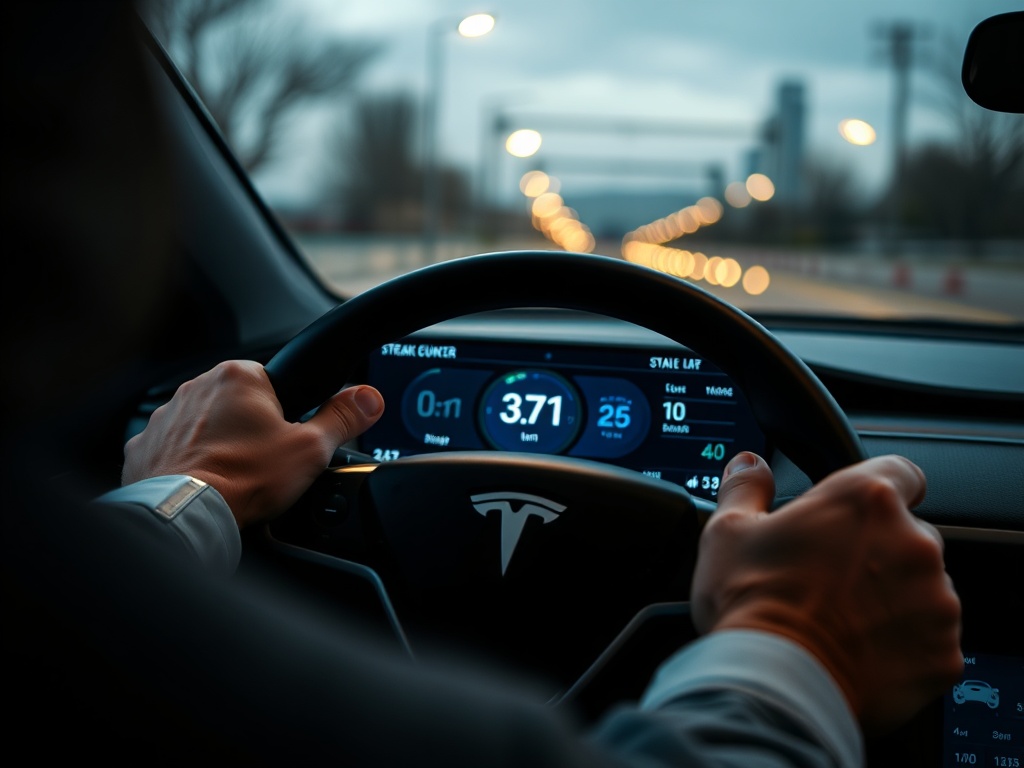
Tesla quietly incorporated a daily streak counter into its FSD interface. Each day the driver activates the system, they accumulate one more day. If they skip a day, the counter resets to zero. Simultaneously, they launched a usage statistics panel and simplified the subscription process, repositioning the $199 monthly option as the most visible in the vehicle's menu. None of this was released through a formal announcement. It was rolled out without fanfare.
This discretion is not negligence. It signifies a team that is testing a hypothesis before amplifying it.
The Real Problem Tesla Is Trying to Solve
From the outside, FSD seems like an engineering achievement that sells itself: the system records seven times fewer collisions than standard driving, is available in nine markets, and boasts a documented case of 12,961 miles of driving without human intervention across 30 states. The technical numbers, at least the ones Tesla publishes, are solid.
Yet, subscription uptake is below the company’s expectations. This movement implicitly confesses that reality.
Tesla has approximately $10 billion invested in AI training infrastructure. For that investment to yield an acceptable return, it needs to convert vehicle owners, who have already paid for the hardware, into recurring software customers. The financial logic is straightforward: the marginal cost of delivering FSD to an existing owner is minimal compared to the $199 monthly income generated by each active subscription. The problem is that people were not subscribing, or they were subscribing and then canceling.
A driver who uses FSD daily develops functional dependence on the system. One who uses it occasionally evaluates each month whether the price is justified. The daily streak is not a design whim; it is a direct lever on the cancellation rate.
That’s the mechanics worth understanding. Tesla isn’t trying to convince anyone that FSD is good. It’s trying to make usage routine before it’s time to renew the subscription.
What the Redesigned Purchase Process Reveals About the Real Funnel
The most underappreciated change in this update isn’t the streak; it’s the simplification of the subscription process.
Previously, signing up for FSD required navigating multiple steps on the vehicle's touchscreen. Tesla eliminated those steps and positioned the $199 monthly option more prominently. This may seem cosmetic, but it’s not.
When a company with Tesla’s resources needs to redesign its menu structure to improve conversion rates, it indicates that the issue wasn’t price or product; it was the friction at the decision moment. Someone, at some point, measured how many drivers reached the subscription screen and how many completed the process, and the numbers must have been disheartening.
This is a classic product mistake: building something technically impressive and assuming the customer will navigate any pathway to access it. Tesla’s empirical evidence suggested otherwise. The redesign of the purchase flow is, in practical terms, an acknowledgment that they were losing potential subscribers in the final stages of the process, not at the beginning.
Interestingly from the product strategy perspective, Tesla is executing two levers simultaneously: reducing entry friction with the redesign of the process and increasing exit costs with the streak mechanics. Both are aimed at the same metric: the monthly retention rate.
For a financial analyst, the arithmetic is straightforward. If FSD has a one-time purchase price of $12,000, a driver subscribing at $199 per month generates the equivalent in revenue in about five years, but with a significant structural advantage: the predictability of cash flow. Investors pay higher multiples for recurring revenue than for one-time sales, especially in cycles where vehicle deliveries fluctuate due to factors Tesla does not control, such as macroeconomic demand or competitive intensity in the electric segment.
When Behavioral Psychology Enters the Income Statement
The parallel with Snapchat or Duolingo is not a casual analogy. It’s a design decision with measurable consequences. Streaks work because they exploit a well-documented cognitive bias: loss aversion. Breaking a 47-day streak hurts more than the satisfaction of building one. That pain is what keeps the user active.
Duolingo knew this when it built its model. Its daily retention metrics are directly correlated with the monetization of its premium plans. The user who maintains a long streak is statistically more likely to pay to protect it. Tesla is betting that the same dynamic applies when the product is a supervised autonomous driving system costing $199 monthly.
There is, however, an important difference. In Duolingo, breaking a streak has emotional cost but zero operational consequence. In FSD, there is a legitimate functional argument for daily use: the system learns from real driving, and its safety metrics improve with accumulated usage. Tesla can link the streak to a tangible benefit beyond pure gamification, giving it a layer of legitimacy that entertainment apps lack.
If the company communicates this well, it turns the streak mechanics from a retention trick into a value proposition with technical backing. The question that upcoming quarters will answer is whether drivers make that connection themselves or if Tesla needs to spell it out.
The Model Being Built Behind the Day Counter
In perspective, what Tesla is assembling is not a gamification feature. It’s the infrastructure of a revenue model that doesn’t rely on vehicle sales volume.
Traditional manufacturers face a structural problem: their revenue is transactional. They sell a car, collect payment once, and the customer doesn’t generate direct cash flow again until they buy another. Tesla has been trying to break this model for years, first with over-the-air software updates and now with subscriptions that monetize the already sold vehicle month after month.
If gamification works, and drivers maintain active subscriptions for extended periods, Tesla will have demonstrated something no automaker has achieved at scale: converting the installed fleet into a source of predictable and growing revenue without needing to sell another car. This redefines the business valuation metric. Wall Street analysts are already paying attention to FSD adoption rates as a leading indicator of stock price, exactly because they understand that number is the cleanest proxy for whether the software-over-hardware model is working.
The streak counter is small. What it measures is not. Tesla is using behavioral psychology to solve a unit economics problem, and it’s doing so with real usage data instead of projections in a spreadsheet. That’s the only way this type of bet is won: measuring, adjusting, and measuring again, with the customer in the process from day one.
Leaders building durable revenue models do so not from the boardroom: they do it from the actual friction that the customer encounters at the moment of payment, and they adjust until that moment is no longer a hurdle.