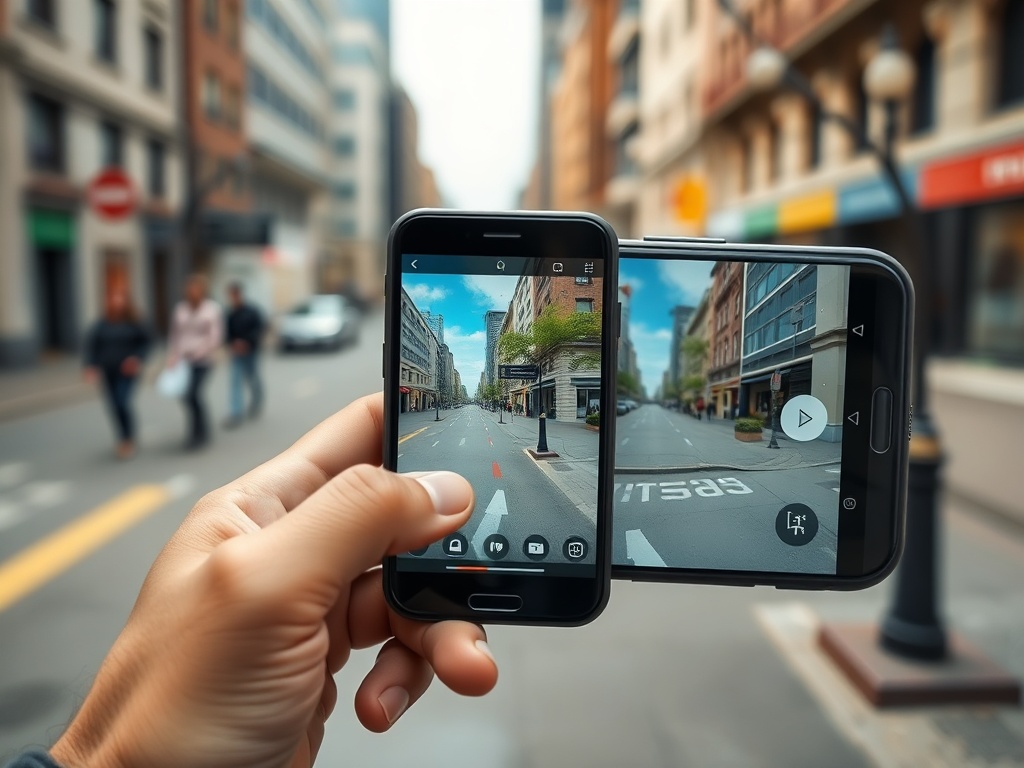

Street View as Canvas: Google Trials AI to Turn Maps into Editable Media
Google Maps started as infrastructure: a massive utility layer for navigating the world. However, in scalable products, utility always seeks the next lever for growth: attention, usage time, and content creation. This is why this test detected in the app's code is significant.
According to an analysis by Android Authority, based on an APK teardown of Google Maps v26.09.00.873668274, Google appears to be preparing an integration between Street View and Nano Banana, its image generation and transformation model, with internal strings such as "Streetview Banana," "Same streets, new styles," "Pick a style," and "Make an image of your favorite places in a fun, new style". No official announcement or date has been provided; it is a hidden server-side function typical of controlled tests.
The superficial reading is "Street View with filters." The strategic reading is more uncomfortable for many incumbents: the map ceases to be just a record and becomes a programmable medium, where the image of the real world can be reinterpreted in styles, packaged for social media, and, eventually, monetized. With over 2 billion active users of Google Maps, even a "cosmetic" change reshapes expectations for products, branding, and governance of visual truth.
From Record to Reinterpretation: Why This Feature Changes the Product
Street View carries an implicit promise: this is what exists. A panorama is, for the user, a visual document. The integration of Nano Banana introduces another logic: this is what it could look like, in the style of your choice. The discovery of strings like "Same streets, new styles" suggests a flow designed to create shareable outputs, not just for navigation. The map transitions from being a “query” to being an “expression.”
The important nuance is the type of AI involved. Nano Banana, described as a model specialized in image transformations with improved Gemini 3 architecture, is oriented toward rapid and efficient editing on-device, and has already been associated with functions such as restoration, object removal, and visual reimagination in other products. In Maps, that efficiency is crucial: Street View is used in mobile contexts, where low latency is essential. If the user has to wait, the habit breaks.
For C-level executives, the strategy makes financial sense even if there are currently no specific public figures for incremental revenue. The incentive is clear: converting a high-frequency product into a creation surface boosts retention and time spent in the app; in turn, it makes Google’s AI suite more “sticky.” This is not a race for a filter; it’s a race for the creative layer over utilitarian services.
There are also product signals: alongside "Streetview Banana," the same analysis points to interface changes like renaming the “3D” layer to “Raised buildings” and redesigning type map selection sheets. These tweaks indicate an intention to clarify and modernize the experience, preparing the ground for features that could confuse users if the interface isn’t explicit.
The Mechanics of Abundance: The Marginal Cost of “Visualizing Cities” Tends Toward Zero
When an AI function reaches a scalable product, the question isn’t whether it’s fun. The question is, what makes it abundant? Here, what becomes cheaper is the production of stylized urban visuals. Previously, to turn a real street into a “cyberpunk” or “watercolor” postcard, one had to know how to edit, use tools, and invest time. With a carousel of styles within Maps, the marginal cost collapses.
This is the classic exponential pattern: first, the input is digitized (Street View already did that since 2007). Then comes the phase where value shifts from capturing to transforming. If Nano Banana integrates as “templates” or predefined styles—the very logic of “Pick a style” suggests this—the result is an industrialization of content: fast, consistent, repeatable.
In market terms, this disrupts several boxes simultaneously:
- Tourism and City Marketing: A destination is not just shown; it is “reinterpreted” for different audiences. The same street can have a winter, nostalgic, or futuristic aesthetic without the municipality having to produce new campaigns.
- Real Estate: It does not replace visits or data, but can raise visual expectations. The tension arises when the “enhanced” look is confused with a real condition.
- Local Commerce: If this evolves to templates for business cards, the visual showcase of a neighborhood could become customizable for campaigns.
Abundance brings a side effect: if anyone can produce a “pretty” image of a place, differentiation shifts to who controls distribution, branding, and trust. And here, Google has an enormous advantage due to native integration.
Controlled Risk: The Credibility of the Map is an Asset, Not a Detail
Street View is not Instagram. It is everyday evidence for real decisions: routes, perceived security, accessibility, façade recognition. Therefore, the main risk is not technical; it is about governance of representation.
The briefing mentions that the outputs would likely include SynthID from DeepMind to label AI-altered content, precisely to differentiate it from “canonical” data and reduce misinformation risks. This point is crucial: if users cannot distinguish between documentary views and stylized views, the product erodes its own trust. And that trust is one of the most difficult functional monopolies to build.
Design also matters. A carousel-style system can limit damage: less freedom in open prompts, more editorial control over results. This fits with a prudent strategy: expand creativity without opening the door to transformations that might seem like “proof” of something that doesn’t exist. In other words, the difference between AI as a toy and AI as infrastructure is managed with intelligent restrictions, not rhetoric.
At the corporate level, the typical temptation is to measure only engagement. That would be a costly error. Here, the silent KPI is the confusion rate: how many people believe the stylized version is real. If that rate rises, regulatory and reputational risks skyrocket, especially as AI regulations advance and demand traceability.
My reading is that Google understands the dilemma: that’s why labeling signals are emerging and why the function is likely hidden and unannounced, suggesting behavioral testing before scaling.
The Power Shift: From Cartography as Monopoly to Aesthetics as Market
For years, the power of Maps resided in capturing and maintaining data. But capture has become partially commoditized: more sensors, more images, more sources. The next frontier is who owns the “layer” where the user creates meaning.
If Street View becomes customizable, it shifts the relationship with competitors. Apple Maps and other players can match coverage over the long term, but the battle shifts to experiences. Additionally, the playing field is no longer just “maps”: it competes with social filters and lenses. The briefing notes that Snapchat and Instagram have normalized the use of filters in real-world views, and that Google, due to its scale, can accelerate adoption in mass consumption.
What matters for companies is that this opens two simultaneous pathways:
1) De-monetization of basic creative production: The stylized image of a place ceases to be a premium product. It becomes a byproduct of navigation.
2) Re-monetization through distribution and templates: The “good” styles can become commercial assets. If the function evolves, it is plausible to envision sponsored styles, seasonal packages, or tools for local businesses. There’s no confirmation of that roadmap, but the economic mechanics push in that direction.
Here lies the humanistic point that matters to me: AI wins when it amplifies human judgment and creativity, not when it dilutes reality. An editable Street View can empower creators, businesses, and small cities that never had the budget for visual campaigns. It can also lead to a uniform aesthetic if the catalog of styles concentrates on a few dominant templates.
This defines the type of market that emerges: one that is democratized or simply centralized with more “skins.” The decision is not philosophical; it’s about product, permissions, and transparency.
Executive Direction: The Advantage Will Not Be the Filter, It Will Be the Control of Context
As there is no launch date or public confirmation, the correct approach is operational: prepare decisions, not celebrate a function. If Google activates this via server-side flags in limited markets, the learning will come from usage data and social friction.
For leaders in adjacent sectors—tourism, retail, real estate, mobility—practical implications are to anticipate a new standard of content: images of “real” places that are no longer strictly documentary. The defense is not to prohibit; the defense is to manage context.
Concrete actions made urgent by this movement, without reliance on speculation:
- Establish internal guidelines on the use of generated or stylized images in brand communication, especially if tied to physical locations.
- Require traceability of content when a visual piece influences decisions (real estate advertising, accessibility claims, security, or place experience).
- Prepare libraries of verifiable real assets to avoid depending on automated aesthetics when trust is the differential.
On the macro level, this case is at a stage where technology transitions from being a “better map” to a “new visual language over the map.” That is already a market reconfiguration.
The integration of AI into Street View fits into the phase of dematerialization and democratization: the city as content becomes editable at a marginal cost close to zero, and the value shifts toward transparency, labeling, and human control of meaning.