
Sandbox VR and the Uncomfortable Truth of Growth: Scaling Experiences Without Breaking the Promise
Some industries don’t recover through speeches but through lines at the door. Location-based VR seemed destined to remain an expensive curiosity post-pandemic following the closure of iconic competitors. However, Sandbox VR made headlines in 2026 with a statistic that cannot be understated: over 5 million players and more than 80 locations globally, signaling that immersive on-site entertainment finally found solid ground. Forbes framed this as a rebound for the sector and a story of well-executed scaling.
The achievement is twofold: selling a physically-intensive experience while also converting it into a repeatable product. In April 2025, the company reported $200 million in accumulated sales after $75 million in 2024 with 1.4 million tickets sold. By March 2025, their stores surpassed 150,000 players in a single month, with an operational goal of stabilizing an average of 150,000 players monthly throughout 2025.
At this point, the standard narrative would be "growth." But that’s the comfortable spot for C-level executives: staying focused on traction metrics without addressing the human and operational cost of failure when the product is, quite literally, a physical and social promise. When a customer pays for a high-intensity group experience, the margin isn’t strictly defined by the ticket price; it’s defined by the ability to deliver that promise without friction, in any city, with any operator, any day.
On-site VR Ceased to Be an Experiment When It Started Selling Tickets
The market validates without mercy. And here, validation didn’t come in the form of demos or enthusiastic opinions, but through tickets and customer repeat rates. Sandbox VR not only accumulated sales; it demonstrated signals of consistent volume. In 2024, it maintained an average of 117,000 players per month, a figure that came after surpassing 100,000 monthly when operating around 50 locations, according to previous reports. This leap is crucial because in physical entertainment, demand isn’t an intangible; it’s logistics.
There’s also a quiet lesson in their portfolio: proprietary content as a financial engine. Deadwood Valley generated $23 million in the 12 months leading up to early 2024 and was projected to exceed $100 million in ticket sales over its lifespan. For a company that needs to refresh experiences to sustain traffic, that figure is not just creative success: it's the capacity to finance production and amortize development across multiple locations.
Another sign of maturity is designing the business around real consumer behavior. It’s reported that a significant portion of bookings are made in advance, and growth is leveraged by word-of-mouth recommendations. This is relevant because in social outings, reputation is an operational asset: a poor experience doesn’t just linger as a review; it morphs into a shared group story.
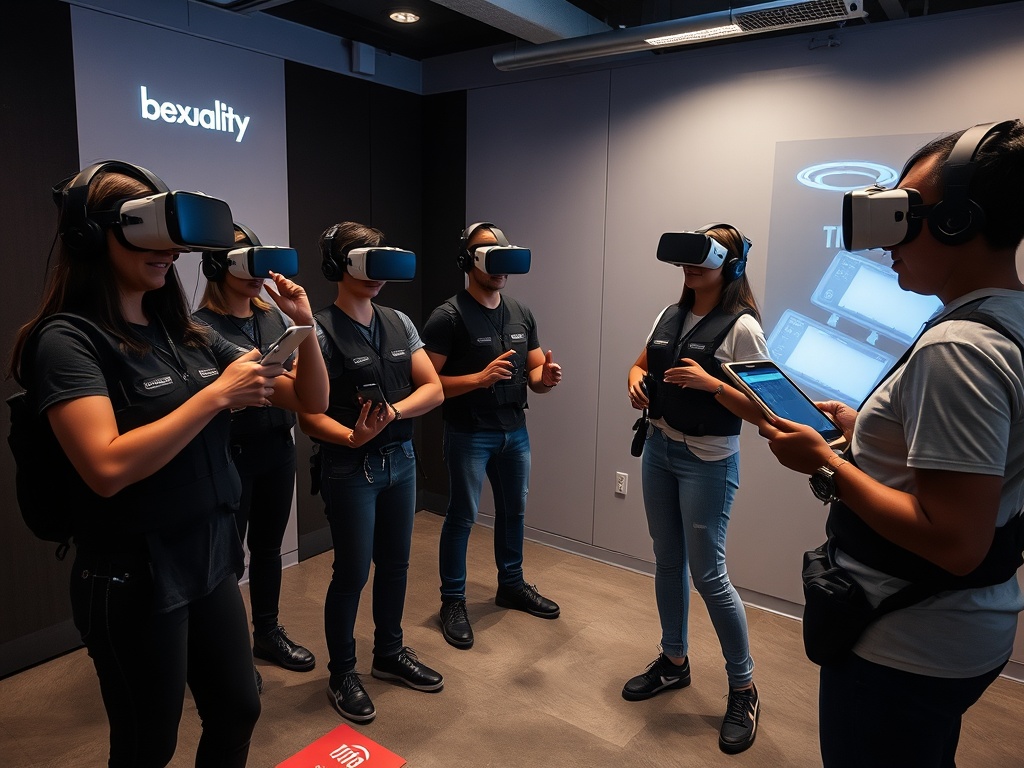
On the VR board, where home experiences seemed unbeatable due to convenience, Sandbox VR played a different game: offering experiences that can’t easily be replicated at home. That is the real frontier of value when utilizing full-body sensors, haptic vests, and purpose-built rooms for groups. It’s not technology for aesthetics; it’s technology to justify the travel, price, and social ritual.
Franchising is a Financial Accelerator, but Also a Multiplier of Broken Promises
Franchise expansion is often pitched as an automatic virtue: less own capital, faster growth, local penetration. In Sandbox VR’s numbers, the acceleration is evident. Since early 2024, it sold 83 franchise units, bringing it to nearly 150 units in development with 34 operators, a sixfold increase in agreements compared to the prior 12 months. In September 2024, the company spoke of 60% growth in franchise agreements in Q2 and projected 280 new locations in four years.
From a financial perspective, the move is defensible: the risk of real estate investment, equipment, and daily operations gets spread out. Moreover, the company reported that its corporate locations — 37 as of mid-2024 — averaged $1.9 million in annual revenue. This figure serves as a commercial anchor for selling franchises and as internal pressure not to dilute the standard.
But here lies the discomfort for boards: franchising also outsources discipline. The customer doesn’t experience “a franchise” or “a corporate location.” They experience Sandbox VR. And in a group experience, the smallest failure translates into a disproportionate loss: delays in room turnover, inconsistent calibration, untrained staff for managing expectations, reactive maintenance.
The company seems to understand that scale finances content. Steve Zhao, CEO and founder, framed the milestone of accumulated sales as validation of their mission to deliver immersive social experiences while linking the achievement to their capacity to sustain that vision. Aylang Lou, SVP of Stores, emphasized the strength of the model and the demand for premium experiences. The strategic subtext is clear: when growth is supported by franchises, the corporate center must become a consistency factory: training, operational auditing, quality standards, technological updates, live support.
The operational question isn’t whether the model scales; it already has. The risk is another: that the speed of unit signing exceeds the system’s capacity to protect the promise.
The Competitive Advantage Isn’t Virtual Reality, It’s Service Choreography
The industry learned the hard way that simply "having VR" is not enough. The Void, a name that defined an era, ultimately shut its doors, and Sandbox VR even acquired a location in Las Vegas connected to that story. That contrast is instructive: technology impresses, but what keeps a physical business alive is choreography: flow, security, timing, maintenance, and designing an experience that makes the group feel cared for and synchronized.
Recent openings and partnerships showcase an expansion with diverse operators: from LOL Entertainment in Philadelphia to agreements with JLG Ventures for Manhattan and Brooklyn, and the case in Osnabrück, Germany, operated by Royal Casinos DGS GMBH, with two private rooms for six players each and specific equipment (VIVE Focus 3, haptic vests, and full-body motion sensors). This mosaic of operators is commercial power but a complexity in governance.
In terms of unit economics, on-site VR has a decisive trait: a significant portion of its costs are semi-variable, but reputation damage is fixed and cumulative. When a location fails, the customer does not discount it as “local issues”; they discount the brand. Therefore, the true margin defense lies not just in ticket prices but in designing a system that minimizes variability. In experiential retail, variability kills faster than a competitor.
There’s another dimension: content and operation feed off each other. Sandbox VR operates studios in Hong Kong and Vancouver and employs nearly 800 people, including retail staff. The pressure from this apparatus is constant: you need to open more to amortize development, but opening more requires not breaking operations. If leadership falls into the trap of celebrating expansion as identity, the company fills with locations that sell once and disappoint forever.
The Conversation Every Hyper-Growth Company Avoids for Administrative Comfort
Most executive committees feel sophisticated discussing expansion. Few feel sophisticated addressing the less glamorous aspects: what to do when an operator fails, when to cancel an opening, how to measure experience without whitewashing, and what sacrifices are made to maintain a standard.
Sandbox VR today is at the stage where the problem isn’t “demonstrating that a market exists” but designing an internal regime that maintains a consistent promise under pressure. The company planned to open 29 new locations in 2025, aiming for more than 50% growth footprint compared to 2024. This pace turns any weakness into multiplication: a training failure doesn’t replicate once; it replicates dozens of times.
There’s a reason on-site entertainment is a harsh judge: it does not forgive the gap between PowerPoint and the real room. A company can hide cultural inconsistencies for years when selling software. In a VR room, the customer feels within minutes if the organization is aligned. Coordination between marketing, operations, content, technical support, and training isn’t an ideal; it’s the difference between a profitable shift and one that erodes the brand.
Forbes’ news describes the rebound of location-based VR and Sandbox VR’s role as a leader in that recovery. My reading for C-level executives is less celebratory and more pragmatic: this story isn’t about VR, it’s about promises. An experiential business scales when its leaders can see the most common blind spot in expansion: the belief that the brand stands on intention when it actually stands on repeated execution and uncomfortable decisions made in a timely manner.
The culture of any organization is simply the natural result of pursuing an authentic purpose or the inevitable symptom of all the difficult conversations the leader's ego won’t allow them to have.