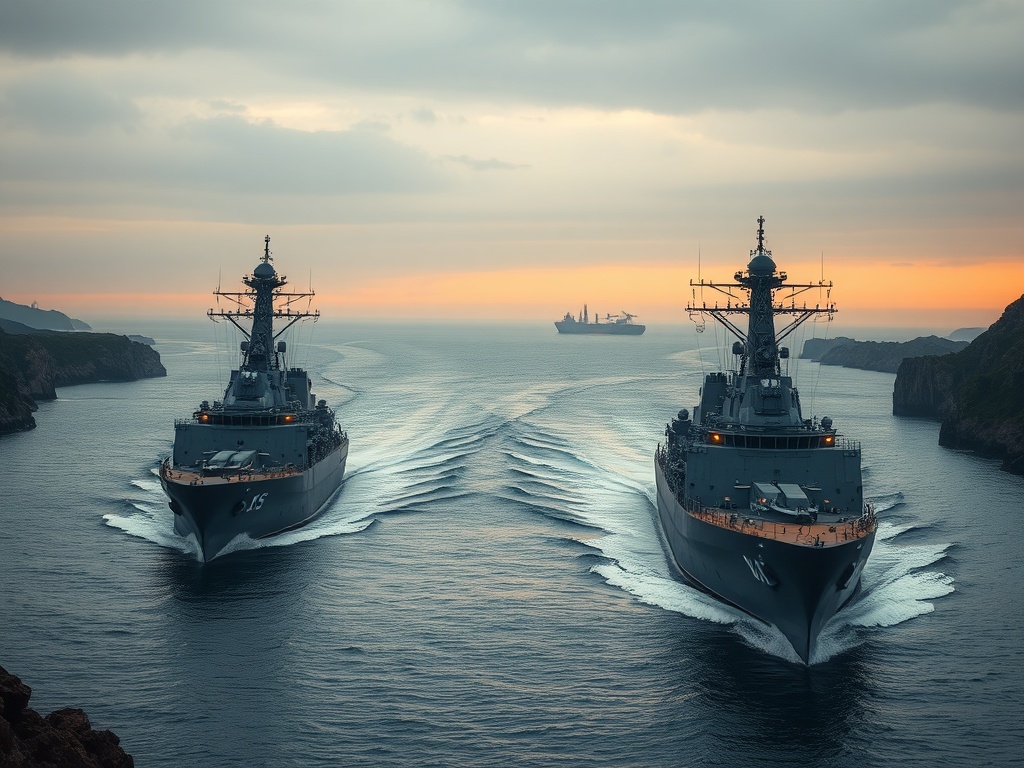

The Strait as Financial Leverage, Not Military Target
On February 28, 2026, following U.S. and Israeli airstrikes that eliminated Supreme Leader Ali Khamenei, Iran closed the Strait of Hormuz. This was not merely a symbolic gesture; it was the activation of the only immediate economic pressure asset Tehran had left. The strait, with a navigable width of just 33 kilometers, accounts for approximately 21% of global oil and 20% of liquefied natural gas. Closing it, even partially, equates to squeezing the nerve that drives energy markets from Asia to Europe.
What followed in the weeks afterward was not a conventional positional war. Iran did not attempt to sink enemy fleets; it initiated a forced payment model. Revolutionary Guards issued warnings over VHF frequencies, deployed warning drones, laid mines with approximate locations even the regime had partially lost track of, and demanded fees of between one and two million dollars per transiting ship. A 70% reduction in initial maritime traffic did not require destruction; it was enough to make the passage uncertain and costly.
This defined the board on which Washington decided to move its pieces on April 12, 2026, when Donald Trump formally announced the naval blockade: not an offensive to destroy Iranian oil infrastructure, but an interdiction operation designed to deprive Tehran of the revenues it generates by controlling this passage. The architecture of this decision is more financial than military.
Why Destroying Oil Wells is the Mistake No One Wants to Make
Admiral Brad Cooper, commander of U.S. Central Command, was explicit on April 11, when two U.S. destroyers transited the strait for the first time since the conflict began, initiating mine-clearing operations with underwater drones: the goal was to "establish a new safe passage" and share it with the maritime industry to "encourage the free flow of trade." This phrase is not diplomatic rhetoric. It is the operational description of a strategy that prioritizes restoring crude flow without damaging the infrastructure that produces it.
Bob McNally, founder of Rapidan Energy Group and former energy advisor in the George W. Bush administration, articulated it precisely: the blockade "exerts economic pressure on Tehran without destroying oil facilities, which should be preserved for the future." This distinction matters greatly from the perspective of the unitary economy of conflict. The wells and terminals in the Persian Gulf represent decades of infrastructure investment. Saudi Arabia, the UAE, Iraq, Qatar, and Kuwait transport between 15 and 17 million barrels daily through Hormuz. Damaging that capacity would solve the Iranian problem by creating a much larger one: a permanent disruption in global supply that no actor, including Washington, can absorb without severe domestic consequences.
Oil prices are already climbing, and that pressure translates directly into inflation, increased logistical costs, and a deterioration of the economic indicators voters perceive before any headline about geopolitics. Trump's approval ratings reflect that impact. The blockade strategy, then, must work quickly or generate an internal political cost that renders it unsustainable.
The Impossible Arithmetic of Maintaining the Perimeter
Here lies the operational knot that surface analyses rarely resolve: maintaining an effective blockade on the Strait of Hormuz is not a problem of political will but a problem of naval mathematics.
According to available operational intelligence, sustained escort for three or four vessels daily under submarine threat requires between seven and eight destroyers rotating in active position. This assumes relatively controlled conditions. The Iranian arsenal is no trivial matter: fast attack boats, anti-ship missiles, swarm drones, mines with imprecise positioning even for Iran, and satellite jamming capabilities have increased maritime insurance costs to levels that deter traffic without a single shot being fired. McNally described the process of degrading those threats as "whack-a-mole": eliminating Iranian capacity on one front actively prompts responses on another.
The U.S. is deploying a third aircraft carrier, thousands of Marines, paratroopers, and additional cruise missiles before the end of April. The Navy's budget for fiscal year 2026 reaches $257 billion. That seems like a massive figure until it is broken down against the real cost of maintaining an active interdiction operation in a strait where the adversary has access to its own coasts, dispersed launch infrastructure, and four decades of asymmetric doctrine designed specifically for this scenario.
McNally's logic regarding the erosion of Iranian capacity is correct in its direction: degrading the inventory of mines, suppressing drones, and neutralizing missile capabilities reduce the threat perimeter to levels that private insurances can absorb and commercial escorts can manage. But that process lacks a clear time horizon, and each week of incomplete blockade is a week of disruption in global energy markets.
Negotiations brokered by Pakistan collapsed on April 12 when Vice President JD Vance failed to close the six points Washington laid on the table: an end to uranium enrichment, recovery of already enriched material, dismantling of nuclear facilities, a regional peace framework, cessation of funding to Hamas, Hezbollah, and the Houthis, and total opening of the strait without tolls. Iran sought to formalize its toll collection model. Gulf states, losing export revenues while paying for their own blocked oil, rejected this formalization. The collapse of negotiations was not a diplomatic accident; it was the predictable result of two parties that have not yet reached the pain threshold prompting concession.
The Precedent Washington Cannot Afford to Lose
Beyond barrels and destroyers, there is one variable that financial markets monitor more attentively than military analysts: what will happen to the petrodollar system if Iran succeeds in formalizing a toll model over Hormuz?
Wall Street has flagged the direct threat to dollar dominance in energy trade if this precedent is set. Not because an Iranian toll would automatically replace the dollar as the currency of reference, but because it legitimizes the possibility that state actors with physical control over geopolitical chokepoints can extract rents from global trade without consequences. This is the precedent that, according to McNally, makes the situation “dangerously precedent-setting for global chokepoints.”
History offers a partial framework. The Tanker War in the 1980s saw attacks on 411 vessels, U.S. flagging operations, and Operation Praying Mantis in 1988 that sank Iranian vessels and forced de-escalation. But this conflict operated under different rules: Iran needed oil revenues to finance a war with Iraq. Today, the context is different: Iran already operates under severe sanctions, its economy is much smaller, and the strait is its last tool of global leverage.
The U.S. blockade applies the same logic in reverse: depriving Tehran of the revenues it generates precisely because it controls the passage. If the operation can degrade Iran's interdiction capacity to a manageable level before domestic costs in the U.S. surpass the tolerable political threshold, the equation works. If not, Washington will have demonstrated that the Strait of Hormuz can be contested but not unilaterally controlled, which is exactly the argument Tehran needs to sustain its negotiating position.
The third week of April 2026 will determine whether the deployment of the third aircraft carrier changes Tehran's calculations or simply elevates the cost of a stalemate.