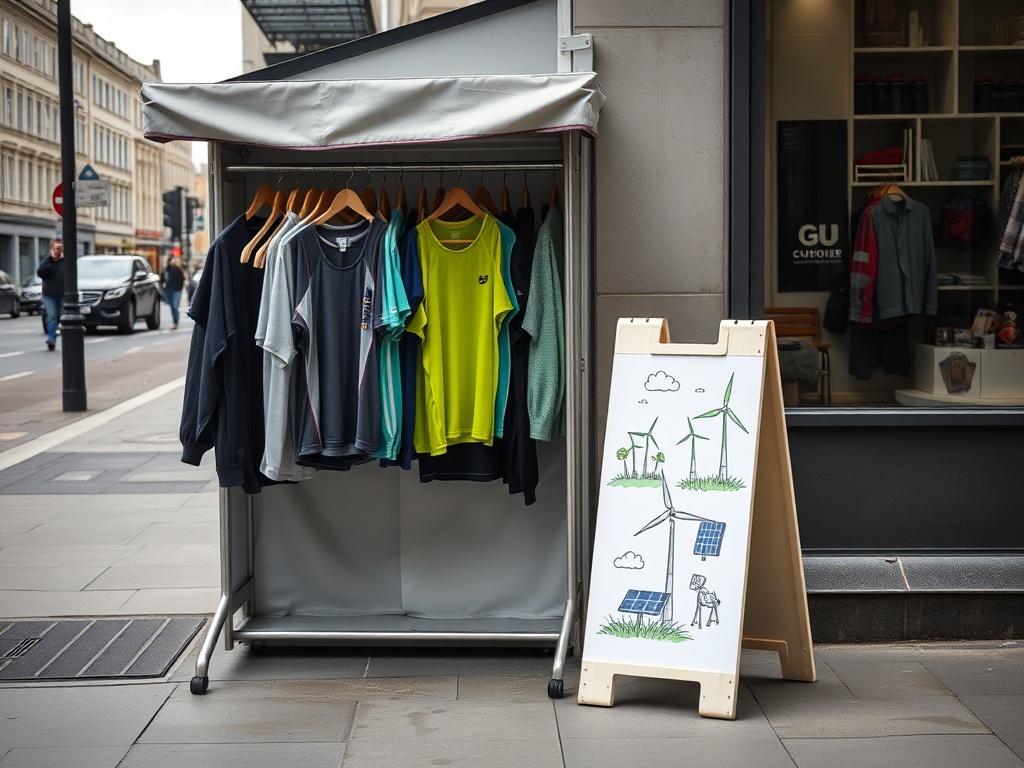

Mumumelon: When a Parody Sells More Honest Clothing Than the Original
There’s something profoundly revealing about a brand named Mumumelon, explicitly designed to mock Lululemon, ending up producing garments sourced from wind and solar energy. It didn’t merely stop at the joke; it set up a real pop-up shop in London and sold actual clothing. In doing so, it inadvertently showed that what the sportswear industry often deems as "impossible" is, in reality, just a decision that has yet to be taken seriously.
What Mumumelon Exposes About the Gap Between Rhetoric and Supply Chain
For years, Lululemon has built a wellness narrative rooted in community with an increasingly emphasized commitment to environmental responsibility. As a publicly-traded company on the S&P 500, it has enjoyed capitalizations exceeding $40 billion at its peak and has invested considerable resources in communicating its dedication to sustainability. The problem isn’t that this narrative is necessarily false; it’s that Mumumelon accomplished in a pop-up shop what Lululemon, despite its vast scale and infrastructure, has yet to execute consistently across its supply chain: manufacturing powered solely by renewable energy.
This reveals a mechanism I have known well from analyzing companies in energy transition: the gap between sustainability rhetoric and operational execution is not technological; it is structural. The tools exist. Accessing renewable energy contracts for textile manufacturing has been viable at an industrial scale for over a decade. What slows down adoption is an incentive architecture where short-term considerations—margins, quarterly pressure, and renegotiation costs with established suppliers—outweigh declared commitments.
Mumumelon, unencumbered by legacy contracts or board pressures, moved with an agility that larger brands structurally cannot afford or have chosen not to embrace. Here lies the precise diagnosis: the size that should be an advantage for negotiating greener supply chains has become the primary anchor preventing movement.
The Disruption Phase No One in Sports Fashion Wants to Name
From the perspective of the 6Ds, the Mumumelon case isn’t in the phase of collapse. It’s in something more uncomfortable: the phase of perceptual de-monetization. Lululemon hasn’t lost sales to a parody; rather, the perceived value of its brand premium—the extra consumers pay for the label and its associated values—is beginning to erode when an external actor can, with a physical product, demonstrate that sustainable promises are feasible at a cost justifying action.
This pattern has precedents in other sectors. When Tesla proved that electric vehicles could perform well and be desirable, it didn’t destroy General Motors overnight; it initiated a slow erosion of the argument "the technology isn’t ready yet." Mumumelon's parody functions similarly: it doesn’t destroy Lululemon but strips away one of its most comfortable narrative shields.
The strategic risk for brands in this position isn’t the parody itself. It’s that parody inspires serious imitators. If five serious activewear startups arise behind Mumumelon, adopting the same renewable manufacturing model without the overhead of a global brand, and with prices competing directly in the mid-high segment where Lululemon holds its greatest margins, that scenario is not speculative; it is the logical trajectory when a proof of concept becomes public and replicable.
What Distinguishes Brands That Survive Their Own Narratives
Some companies have navigated such public questioning and emerged strengthened, not by ignoring the pressure, but by converting it into a lever for operational restructuring. The difference doesn’t lie in communication. It hinges on whether the board and operations team are willing to incur the transition cost in the present, rather than deferring it with commitments to 2030 or 2040 that no current executive will be accountable for fulfilling.
Sustainability as a durable competitive advantage requires that transition costs be recorded on the balance sheet today, not announced as goals in a slide deck. Brands that grasp this stop treating green supply chains as a public relations project and begin treating them for what they are: a cost architecture decision with implications for the premium the market will be willing to pay in five years.
Paradoxically, Mumumelon has done the industry a favor. It has shown through a low-cost, high-visibility experiment that the argument of technical infeasibility doesn’t hold water. What remains on the table, for any brand wishing to maintain its purpose narrative, is a question that is no longer rhetorical: if a parody can manifest in a London pop-up, scale is not the issue.
The technology to manufacture using renewables already exists, is available, and is commercially accessible. Brands that integrate it into their production architecture before market demand necessitates it will cease to bear the premium of delay when that moment arrives.