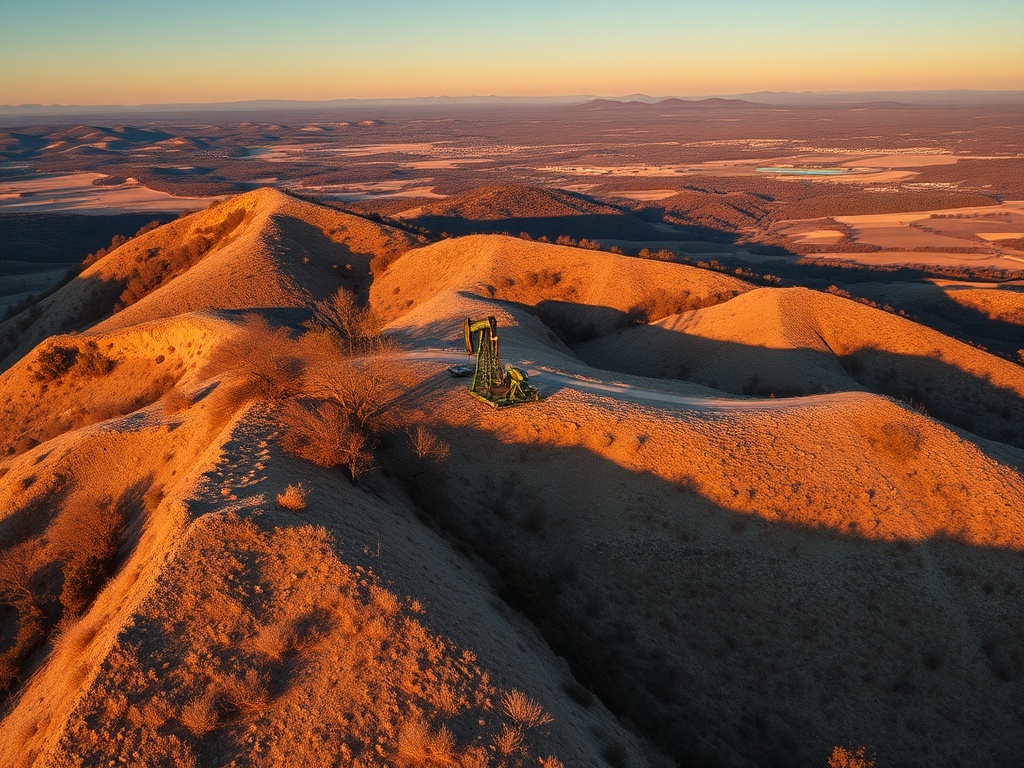

Drilling Under Parks Is Not Energy: It's Creative Accounting with Public Land
There is a type of operation that extractive models perfect over time: socializing costs while privatizing benefits. The Bureau of Land Management (BLM)’s proposal to open more than a million acres of public land in California—including areas adjacent to Mount Diablo State Park, Henry W. Coe State Park, and Pinnacles National Park—is not a political anomaly. It is the clearest expression of this mechanism in action.
The BLM published a Draft Supplemental Environmental Impact Statement (DSEIS) that opens the door to drilling and fracking in areas where the federal government controls the subsurface mineral rights, even though the surface is protected as parkland or reserves. This is known as split-estate: the land is public, but what lies beneath can be exploited. The public comment period has already closed, with tens of thousands of recorded oppositions. What follows is a final decision expected this year.
The Architecture of the Model: Who Pays, Who Profits
Before debating whether there is viable oil beneath Mount Diablo, it is worthwhile to audit the structure of the model that makes it possible. The mineral rights in these split-estates belong to the federal government. If exploitation concessions are approved, the companies that obtain them will pay royalties to the federal state and use infrastructure that, in many cases, has already been funded with public investment over decades. The surface—parks, trails, ecosystems—absorbs operational risks: contamination of aquifers, habitat degradation, impact on nature tourism that generates real income for local economies.
Juan Pablo Galvan, Senior Director of Land Use at Save Mount Diablo, articulated this precisely: proposing key peaks of the state park system as targets for exploitation is, in addition to being strategically questionable, potentially a waste of public capital invested in protection over the years. His argument is not solely environmental; it is economic: if the presence of viable reserves is, according to the plan’s own critics, "extremely unlikely," the risk-return ratio of this operation does not meet the standards for any serious investor.
The BLM, in its institutional response, stated that the oil and gas produced would enter commercial markets outside its oversight. That phrase deserves attention. It means that the federal agency designs the access conditions, assumes initial regulatory responsibility, and manages public image impacts, while financial returns flow to market players not named in any document in the process. There are no identified companies, no estimates of reserves, no production projections. Just an enabling framework built with public funds and land.
What the DSEIS Says and What It Cannot Calculate
The BLM's environmental document concludes that the impacts on air, water, and biodiversity would be minor and manageable. The Center for Biological Diversity disagrees and anticipates litigation under the National Environmental Policy Act, the Clean Air Act, the Clean Water Act, and the Endangered Species Act. This technical disagreement will reach the courts, as it did in 2019, when a similar plan from the Trump administration was judicially blocked and ended in agreements requiring new environmental reviews. The current DSEIS is, in part, the result of those agreements.
But there is something that no environmental impact document is designed to calculate: the opportunity cost of not protecting. The Diablo Range and Central Coast of California support ecosystems that generate tangible services: water regulation for agricultural communities, biodiversity that supports pollinators, recreational infrastructure that drives local tourism. These streams of value do not appear in the accounting books of any oil concession. They are positive externalities that the exploitation model would absorb without compensating for.
California has state prohibitions on new drilling and fracking. The tension between federal regulation over lands with federal mineral rights and state energy policy is not new, but this plan brings it to an operational breaking point: the state can prohibit drilling in California land under its jurisdiction, but it cannot directly block federal mineral rights in split-estates. California State Parks confirmed that they are still reviewing the proposal. There is no formal opposition from the State at the time of this analysis.
The Pattern This Proposal Reveals for Any C-Level Executive
The case of Mount Diablo is not just a dispute between conservationists and the oil industry. It is a case study on how access to common resources is structured when regulatory frameworks allow separating surface ownership from subsurface rights. For any business leader operating in sectors that depend on social licenses, public concessions, or shared natural resources, the pattern is legible and applicable.
First, the absence of names. No company has been identified as a potential concessionaire in this process. This is not an accidental information gap: operating on the front line of a highly visible regulatory conflict comes with reputational costs that sophisticated actors prefer to defer until the legal framework is consolidated. The risk of litigation in this case is high, documented, and historically repeated.
Second, the unit economics do not hold up in public. Without estimates of viable reserves, without known production projections, and without disclosed concession prices, the investment case for any operator is opaque. Critics of the plan, including Galvan, argue that resources in these areas are extremely unlikely. If that is correct, the model only makes sense as a regulatory enabling exercise for future use, not as an immediate business.
Third, the litigation pattern as a competitive tool. The history of this process, which began in 2019 and reaches the current DSEIS following judicial agreements, shows that environmental groups have effectively used the legal system to delay and modify exploitation proposals. For companies that eventually compete for these concessions, the true cost of entry is not the bid price: it is the legal and temporal cost of navigating a litigation chain that can extend for years.
Business models that build their advantage on privileged access to public resources without compensating the costs they externalize on communities have a risk structure that does not improve over time. The social license is not an intangible asset ignored in the balance sheet; it is the condition of operability. When that license erodes—as shown by each litigation cycle in this case—the costs of regaining it often exceed the income that the model promised.
The mandate for any organization evaluating operations on shared resources is straightforward: audit whether its model uses the environment and communities as cheap inputs to generate private returns, or if it has the architecture to return measurable value to those who sustain the conditions for its own viability. There are no middle grounds in that equation. Only results.