
CoreWeave Wins the Race for Inference Computing Ignored by Giants
On April 10, 2026, CoreWeave announced a multi-year agreement with Anthropic to provide Nvidia GPU capacity in U.S. data centers, specifically aimed at the production workloads that power its Claude models. The financial terms were not disclosed, but the market reaction was significant: CoreWeave's shares rose over 10% the same day.
However, that wasn’t the most revealing aspect of the day. More telling was that this announcement came just 24 hours after Meta confirmed an expansion of its partnership with CoreWeave by an additional $21 billion, increasing the total value of that relationship to approximately $35 billion. Two of the ten leading AI model developers on the planet betting, just one day apart, on the same infrastructure. For a company that generated $5.13 billion in revenue in 2025 with a year-on-year growth of 168%, that’s not just traction—it’s a signal that CoreWeave built something the hyperscalers either didn’t know how to or didn’t want to build.
The Niche Left Open by Amazon, Microsoft, and Google
There is a technical distinction that has gone unnoticed in corporate strategy rooms at major cloud providers for years: training an AI model is a massive, relatively latency-tolerant computing problem; running it in production at enterprise scale is a completely different challenge. Inference, the process by which a model like Claude responds to millions of simultaneous users, requires low latency, high availability, and a hardware architecture specifically optimized for that usage pattern.
AWS, Azure, and Google Cloud have primarily built their GPU offerings around training, where large customers sign long contracts and consume computing blocks predictably. That market offers acceptable margins and a known business dynamic. In contrast, production inference is less predictable, more demanding in terms of configuration, and requires operational specialization that the hyperscalers treated as a secondary use case. CoreWeave has positioned itself perfectly in that gap.
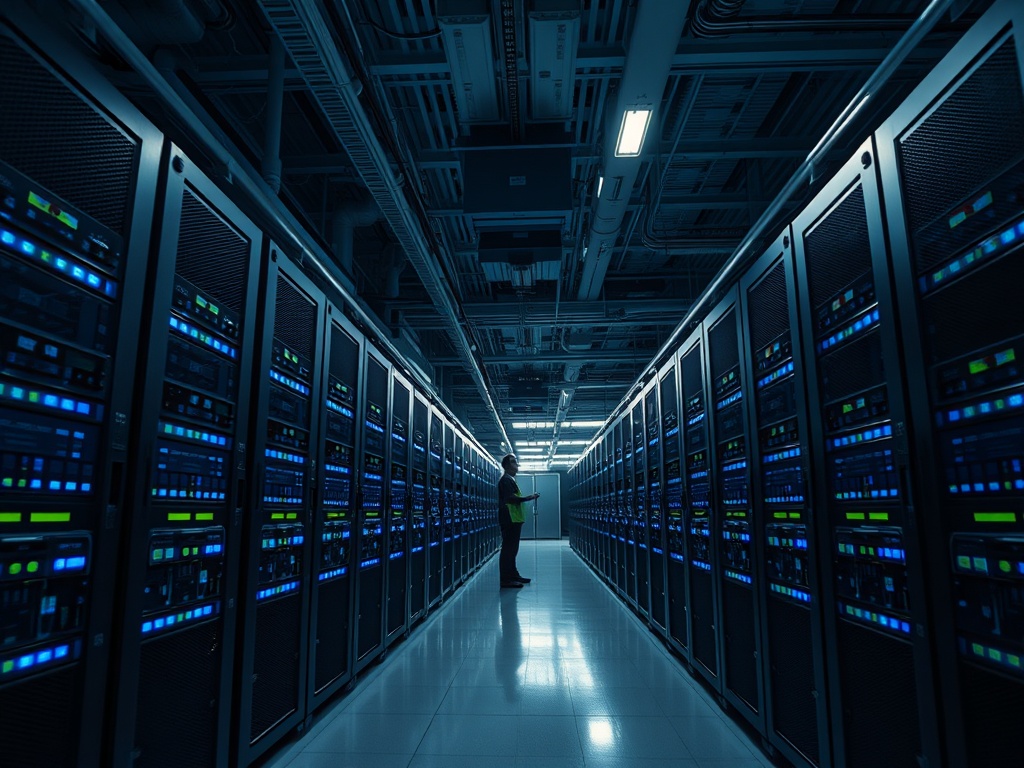
Today, it operates 32 data centers with over 250,000 GPUs and 1.3 gigawatts of contracted electrical capacity. Its client portfolio includes nine of the top ten AI model developers globally: Microsoft, Meta, OpenAI, Mistral, Cohere, IBM, and Nvidia, among others. The sum of these contracts translates into a backlog of $66 billion and a revenue guide for 2026 exceeding $12 billion. These are not figures from a company that found a marginal niche; they are the figures of a company that has defined a category.
Why Anthropic Chose to Depart from Traditional Clouds
Anthropic's decision to partner with CoreWeave speaks volumes about how mature model developers are rethinking their relationship with infrastructure. Anthropic had already committed $100 million to develop its enterprise partner network around Claude. This implies that the model needs to operate consistently, at low latency, and at scale for corporate clients who can’t tolerate performance degradation.
While the big clouds provide that compute, they do so within platforms designed to be horizontal, where the AI client competes for resources with a relational database client, a video streaming client, and a payroll processing client. CoreWeave offers infrastructure designed exclusively for AI workloads. That specificity is not just a marketing argument; it translates into performance metrics that matter when a model is responding to 100,000 simultaneous requests in an enterprise application.
The agreement with CoreWeave also allows Anthropic to implement computing in a scalable manner, with options to expand, giving it flexibility without compromising the base capacity needed for its current clients. In a market where the shortage of Nvidia GPUs remains structural, securing that access through a specialized provider mitigates a concrete operational risk.
CoreWeave's spokesperson articulated this with unusual precision for a corporate statement: "AI is no longer just about infrastructure; it’s about the platforms that turn models into real impact." That phrase precisely describes the work that Anthropic needed to contract: not generic GPUs but the ability to put Claude to work in production conditions without crashing performance.
The Structural Risk Two Agreements Cannot Resolve
CoreWeave's success has a crack that investors have identified since its IPO and that the market continues to watch closely: Microsoft accounted for approximately 67% of its revenues in 2025. This concentration on a single client converts any changes in the business relationship with Microsoft into a systemic risk for the company.
The agreements with Meta and Anthropic in a span of 48 hours provide the most direct evidence that CoreWeave is executing a deliberate diversification strategy. However, the work is far from finished. If Meta now represents a significant portion of the multi-year backlog, CoreWeave will have shifted concentration from one client to two. The risk decreases, but it does not disappear.
Additionally, there is an execution factor that the projected figures do not capture: maintaining 32 data centers, adding new capacity to meet the $66 billion in contracted commitments while energy and construction costs remain volatile, requires operational precision that few companies of this size and growth speed have demonstrated consistently. The guidance of more than $12 billion for 2026 implies more than doubling revenues in a single year. This is not impossible given the existing backlog, but it requires that the hardware supply chain, energy contracts, and infrastructure construction operate without significant friction.
CoreWeave's model converts variable computing costs into long-term fixed commitments for its clients, which protects its future revenues but shifts the execution pressure inward. If a data center is delayed or a GPU purchase is held up by Nvidia’s supply restrictions, the impact is not borne by the client; it’s absorbed by CoreWeave.
The Work Behind the Agreement
CoreWeave’s journey from Ethereum mining to being a computing provider for nine of the world's top ten AI developers is relevant not because it is a story of corporate resilience, but because it illustrates how a company can redefine its purpose around a specific customer problem that no one else was solving effectively.
The agreement with Anthropic does not confirm that CoreWeave has good technology. It confirms that it identified the specific work that Anthropic, Meta, OpenAI, and others needed to contract: not generic computing capacity but inference infrastructure that makes models work reliably when users engage them, not just when engineers test them. That seemingly technical distinction is, in reality, the separation between a commodities provider and a company with pricing power in a market where demand structurally exceeds supply.
The success of this model demonstrates that the work that major AI developers were contracting was never about access to GPUs: it was the assurance that their models would perform in production without the infrastructure becoming a bottleneck to the business.