
The Airport as a Mirror of a Business Lacking Safety Nets
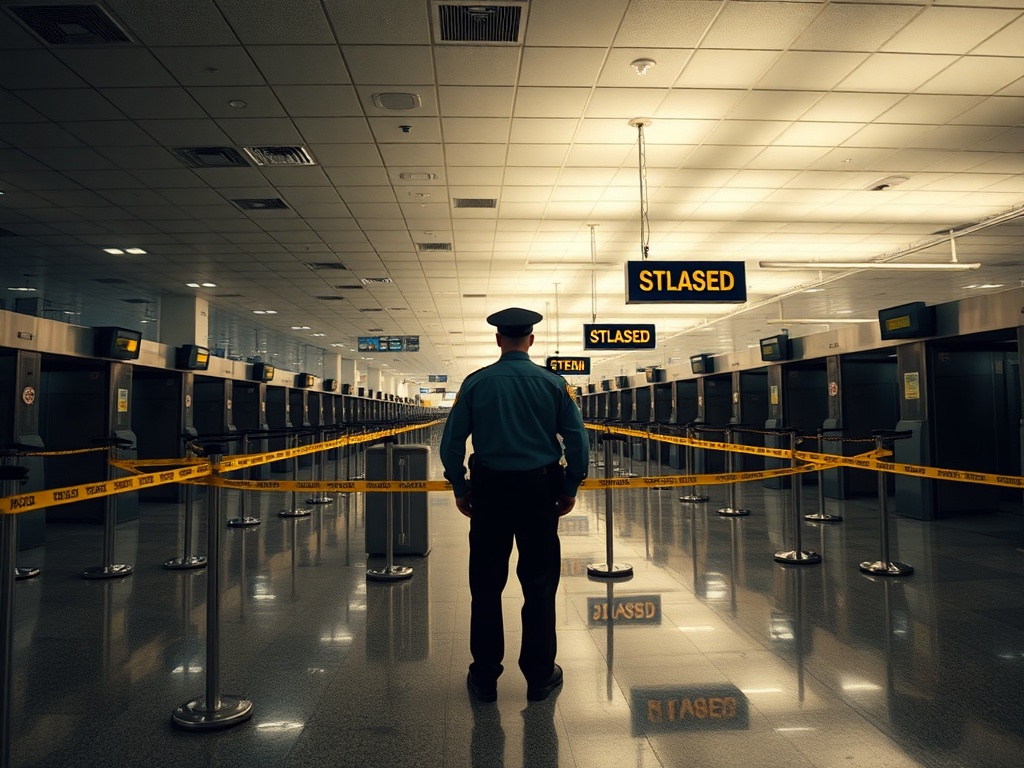
On February 23, 2026, during a snowstorm in New York, more than 76% of security agents at JFK airport failed to show up for work. In Newark, the absentee rate exceeded 53%. Thousands of passengers were stranded in terminals as the system collapsed in real time. This wasn't a hacking incident. It wasn't a formal strike. It was something quieter and, from my perspective as a social capital analyst, far more revealing: it was the organic response of a human network that ceased to trust the institution that supports it.
Since February 14, 2026, approximately 60,000 agents of the Transportation Security Administration (TSA) have been working without receiving their full salaries due to a partial government shutdown. On March 13, they received their first paycheck for $0. More than 300 agents have already resigned. Unscheduled absences skyrocketed from a historic average of 2% to a national rate of 6.16%, with peaks of 21% at JFK and 19% at Atlanta's Hartsfield-Jackson airport. At Houston's Hobby Airport, on a regular Sunday, more than half of the agents were absent: wait times stretched to 3.5 hours.
What interests me is not the political debate behind the budget shutdown. What intrigues me is the anatomy of the collapse.
When Institutional Loyalty Has No Reserve Price
There is a hypothesis commonly found in corporate human resources analyses that this case crushes with hard data: the idea that frontline workers remain in their positions out of inertia, diffuse loyalty, or because they "have no options." The 300 agents who resigned in less than 30 days, and the thousands who simply stopped attending work, illustrate that this hypothesis is a convenient fantasy for management teams that have never had to rely on a paycheck to cover gasoline.
Agent Angelina Reed summed it up with a precision that no consultant could improve: "It becomes exhausting. This is our third shutdown, and it's very frustrating and stressful." Three shutdowns. Each eroding the psychological contract between the institution and the individual a little more. Social capital doesn't get destroyed all at once; it degrades in layers until one day, 76% of a workforce decides that the personal cost of showing up outweighs the benefit of maintaining the bond.
This is not a phenomenon exclusive to the public sector. Private organizations replicate this architecture at a frequency that should alarm any board of directors: compensation systems designed at the peaks, without consulting those who operate at the periphery; continuity policies that assume that talent at the base is infinitely replaceable; and a risk management approach that models financial scenarios but never considers what happens when 20% of its key operators disconnect simultaneously.
JFK Airport did not fail because it snowed. It failed because its operational architecture depended on obedience that was never reciprocal.
The Illusion of a Centralized Network Under Pressure
The TSA operates as a deeply centralized network: decisions in Washington, execution at the terminals. When the center fails to fulfill its part of the contract—paying on time, protecting its agents, maintaining minimal dignity in labor conditions—the periphery lacks horizontal mechanisms to self-organize and maintain the service. There is no social capital among peers to compensate for the absence of vertical bonds. Each agent faces the crisis individually, and the individual responses—multiplied by thousands—produce the systemic collapse we witnessed in February and March 2026.
The contrast with organizations that build denser networks is revealing. The Denver International Airport made an unusual decision: it launched a donation campaign asking travelers for $10 to $20 to cover security agents' gasoline and grocery expenses. It’s a minor operational patch, even uncomfortable from an institutional perspective. But its analytical relevance is another: it shows that when the vertical network collapses, informal horizontal networks emerge to try and sustain it. The frequent flyer community of Denver, emotionally connected to the airport, activated a reciprocity mechanism that no crisis management manual foresaw.
That is social capital functioning in emergency conditions. And its existence, albeit marginal in this case, signals something that executive teams in the private sector should process: organizations that invest in building genuine—non-transactional, non-performative—connections between their various levels and with their external communities have buffers that purely hierarchical organizations cannot buy when they need them.
The Transportation Security Administration temporarily suspended its Global Entry program to reassign personnel, and it was reactivated on March 11, 2026, under operational pressure. This decision to go back and forth on a service that benefits the most valuable frequent travelers—those who tolerate friction the least—perfectly illustrates how internal fragility ultimately erodes the value proposition to the segments that matter most commercially.
The Spring That Does Not Forgive Executive Blind Spots
Spring break weeks in the United States are approaching with a demand pressure that the system can no longer absorb without severe friction. The TSA faces a second paycheck of zero expected on March 20, 2026. The projectable scenarios do not require sophisticated models: more resignations, sustained absence rates above 6% nationally, and waits exceeding two hours at major airports during peak days.
For the commercial aviation industry, the impact is direct and quantifiable in terms of satisfaction, cancellations, and reputation—even though they are not the operationally responsible party for the problem. Former TSA Administrator John Pistole succinctly described the effect on morale and safety: the damage is not just to the agents’ wallets but to the system’s capacity to guarantee minimum standards under pressure.
And here lies the lesson that corporate executive teams should draw before their own airport gets stranded: fragility does not announce itself with a dramatic crisis. It announces itself with a 2% absentee rate that no one monitors, with turnover at the base normalized as "operational noise," and with compensation designed on the tenth floor without verifying if it's enough to live on two hours from work. When the pressure arrives—and it always does—the system doesn't fail at the center. It fails at the periphery, which is precisely where the operational intelligence and customer contact are concentrated.
Organizations that have built their models on the assumption that the base is passive and replaceable will discover, at the worst possible moment, that this assumption carried a market price they never included on their balance sheet.
The next time the board meets, observe who is sitting at that table. If everyone arrived by the same paths, studied in the same contexts, and never had to worry about whether their salary would cover the month, they inevitably share the same blind spots about how the organization operates from the ground up. This is not an ethical issue: it is a structural vulnerability with an expiration date.