
The Experiment Intel Didn't Want to Happen
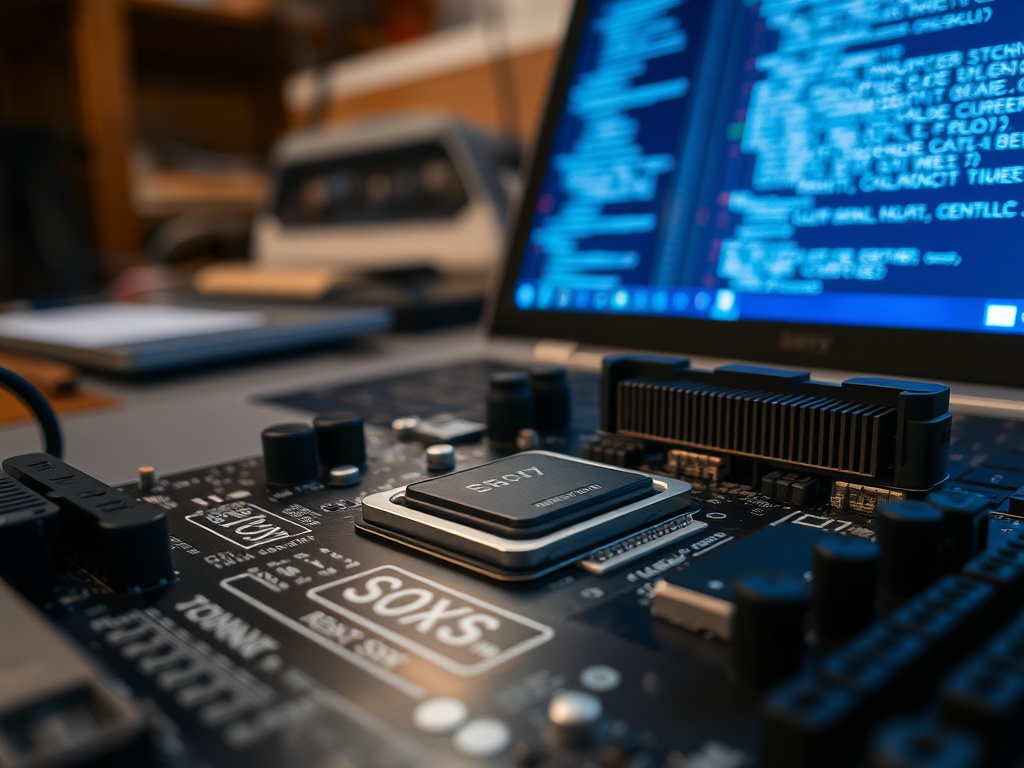
A user successfully booted Windows 11 on an Asus Z790 motherboard using a processor that, according to Intel, never should have been there. The chip in question is the Core 9 273PQE, codenamed "Bartlett Lake," a CPU specifically designed for original equipment manufacturers (OEMs) with performance features unavailable in the consumer market. This maneuver required no lab hardware or corporate access. Instead, it required time, patience, and Claude, Anthropic's AI model, to edit the motherboard's BIOS code and make it recognize the processor.
While the technical aspects are impressive, they are not the most interesting part. What is fascinating is that the "BIOS modification" process, which once necessitated a firmware engineer's expertise honed over years, can now be executed with the guidance of a language model through conversation. The technical skill threshold for breaching platform restrictions has just dropped several floors.
Intel didn’t create a barrier for this chip due to technical incapacity but rather for business design. The processors in the Bartlett Lake line are intended for OEM contracts with margins and conditions very different from the retail market. Maintaining this separation implies that the same silicon, equipped with superior capabilities, does not compete against its own consumer SKUs. It is a deliberate segmentation, a classic mechanism of channel price discrimination. The issue with this strategy is that it assumes the technical barrier is sufficiently high to be respected. This case demonstrates that it is no longer the case.
How AI Changed the Modding Equation
Hardware modding has always existed. Communities that unlock multipliers, flash alternative firmware, and activate disabled cores have been operating for decades. However, these communities historically relied on a steep learning curve marked by scarce documentation, destructive trial and error, and knowledge accumulated over years in specialized forums.
This particular case reveals that general-purpose AI is becoming a technical competence accelerator. The modder did not need to deeply understand the binary format of the BIOS or memorize Intel's initialization architecture. They needed to know what to ask Claude and how to interpret its responses. The learning curve hasn’t vanished, but it has significantly compressed.
This has implications that extend beyond chips. When an AI tool can guide a non-expert user through low-level firmware modification, the concept of "technical restriction as a commercial barrier" becomes much more fragile. Intel is not the only manufacturer employing this logic. The model of closed platforms, where hardware and activation software are deliberately decoupled to manage distribution channels, is a cross-cutting practice in semiconductors, automotive, medical devices, and printers. All these models assume that the cost of breaking the barrier is prohibitive for the average user. That assumption is being reevaluated.
The operational question is not whether this is ethical or legal—an important discussion in its own right—but rather how long it will take a corporation to update its business model when its primary entry barrier, which was not technological but rather complexity, ceases to function as a barrier.
The Work the User Hired, and What Intel Missed
Analyzing the behavior of the user behind this feat reveals a clear pattern that Intel did not anticipate in its channel strategy design. The segment of enthusiasts and modders is not seeking to infringe OEM agreements out of ideological principle. They are looking for access to performance that they perceive as artificially restricted.
This diagnosis pertains to the product, not ethics. The user hired the AI to resolve a specific frustration: there exists a chip with superior capabilities, that chip runs on the same platform I already own, and the only reason I cannot use it is a firmware restriction that protects a corporate distribution model. When that frustration becomes solvable through accessible tools, it drives behavior. And that behavior could easily scale.
Market segmentation by channel makes sense when barriers are physical or when the cost to circumvent them surpasses perceived benefits. When the barrier is just software, and there is an AI capable of guiding its modification, the cost-benefit equation for the user changes radically. Intel will need to choose between two potential responses to this pattern: technically tightening restrictions in future generations, which involves engineering costs and possibly additional friction for legitimate OEMs, or redesigning its channel strategy so that the differential value does not rely on maintaining a technical barrier that has already proven to be permeable.
There is a third scenario, likely the most probable in the short term: ignoring it. Modding feats rarely scale to volumes that materially threaten the revenues of a manufacturer like Intel. However, the pattern it reveals—the convergence of general-purpose AI and restricted hardware—does have scale potential in markets with tighter margins where users have fewer alternatives.
The Closed Platform as Strategy is Expiring
What this case documents is not an isolated event in hacker culture. It signals the early stages of a broader reconfiguration in how hardware manufacturers will need to reconsider their restriction models.
For decades, technical complexity served as the cheapest and most effective guardian of closed platforms. It didn’t require active litigation or constant monitoring; it was simply difficult enough to deter the mass market from attempting it. That guardian is being replaced by language models that democratize specialized technical knowledge in real-time.
The most likely outcome is not chaos or massive hardware piracy. The most probable outcome is that manufacturers reliant on firmware restrictions to sustain price differentiation across channels will be compelled to migrate towards value propositions that cannot be undermined by a chat session. This means real support, software ecosystems that add continuous value, differentiated warranties, or access to data that open hardware cannot generate on its own.
The success of this modder demonstrates that what the user was hiring was not cutting-edge technology, but access to capability that already exists physically but is locked behind a business decision. When that blockage becomes surmountable with a free tool, the only value proposition that survives is one constructed by the manufacturer on the service side, not the silicon side.